
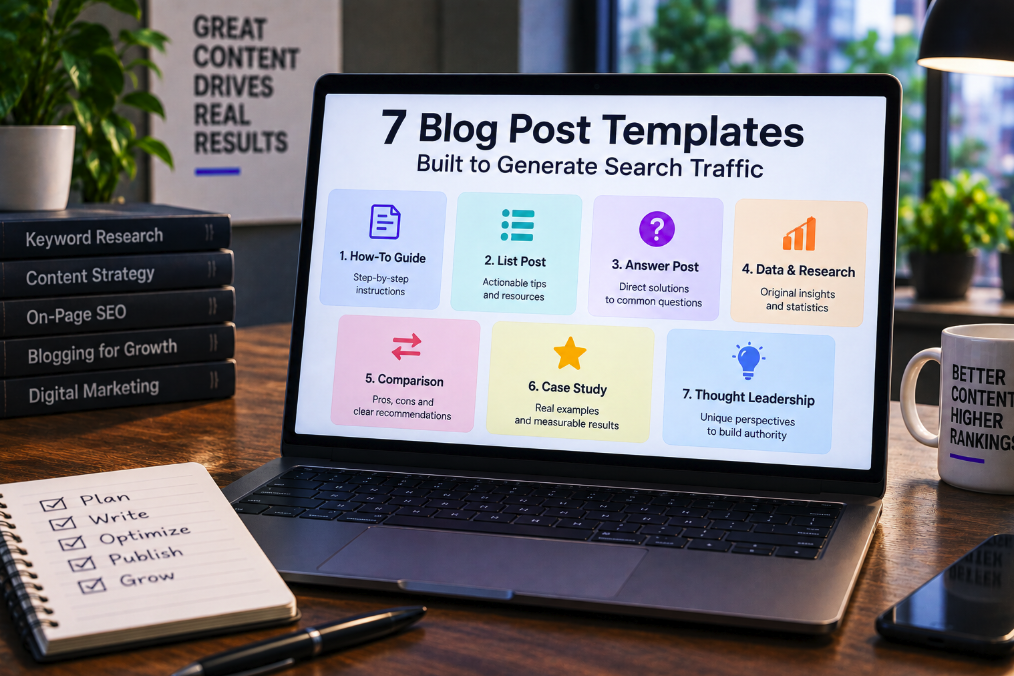
Content teams rarely struggle because they have never heard of a listicle, case study or comparison page. The harder problem is turning a promising topic into a page whose structure matches what the reader actually needs — and doing that consistently enough to build a repeatable search program.
A new Search Engine Land guide by Brian Dean approaches that problem through seven reusable blog-post formats. The September 4 guide does not simply name content types; it breaks each one into a practical architecture covering the headline, introduction, core sections, examples and conclusion.
The seven formats are the classic list post, detailed case study, product showdown, “Things to Do After X” post, beginner's guide, “How They Did It” post and myth debunker. Dean says versions of these templates helped his blog grow to more than 487,000 unique monthly visitors this year, although that is his own performance example rather than evidence that a template alone causes rankings.
That distinction matters. A content template is useful because it reduces structural uncertainty. It is not a ranking factor, and it cannot rescue a weak topic, derivative information or a page that does not deserve to be indexed. The real value is that each format maps naturally to a different kind of search intent.
1. The classic list post turns a broad problem into discrete actions
The first template is the familiar list post. Its strength is not the numbered headline by itself but the way it decomposes a broad subject into manageable units.
Dean recommends a title that makes the benefit clear, includes the number of items and, where appropriate, signals that the advice can be applied quickly. The introduction should establish the reader's problem without delaying the answer, then explain what the list will help them achieve.
The individual subheadings do much of the work. Rather than generic labels, each item should communicate both the action and its benefit. That lets readers scan the page and immediately understand why each section matters.
For SEO teams, list posts are particularly useful when the searcher expects options, tactics, examples, tools or ideas rather than one linear process. The danger is treating the number itself as the value proposition. Twenty interchangeable tips do not become useful merely because they are numbered.
2. The detailed case study makes evidence the structure
A case study resembles a how-to article but replaces hypothetical advice with a real sequence of events. The reader is not only told what might work; they are shown what happened when someone actually tried it.
The Search Engine Land template recommends anchoring the headline around a specific outcome, a number and a timeframe where those details genuinely exist. The introduction states what the case will demonstrate, introduces the person or organization involved and previews the method.
The article then moves from context to results and into the detailed steps that produced those results. This ordering creates a reason to keep reading: the audience sees the outcome first and then learns how it was achieved.
For modern content SEO, this format has an additional advantage. First-party experience, screenshots, measurements and real implementation details create information that cannot be reproduced simply by summarizing the same sources every competitor has read.
3. The product showdown serves comparison intent directly
The third format is a side-by-side comparison of competing products. This is naturally aligned with commercial investigation queries because the searcher has already narrowed the problem and is trying to make a decision.
The title should identify the products clearly rather than forcing the reader to decode a clever headline. The introduction establishes what is being compared and which criteria will be evaluated.
The core of the article is then organized feature by feature. Price, usability, capabilities, support, performance or other relevant attributes can be examined under consistent criteria so the reader can understand the tradeoffs.
The conclusion matters more here than in many informational posts. After reading the comparison, users usually want a recommendation. A useful product showdown therefore explains which option wins for which type of user rather than ending with an artificial “both are great” verdict when the evidence supports a clearer distinction.
4. “Things to Do After X” captures the next-step question
Some of the most useful search queries happen immediately after a task has been completed. The user has published a post, finished an installation, completed a workout, bought a product or launched a campaign — and now wants to know what comes next.
The “Things to Do After X” template is designed around that transitional moment. Its headline identifies the completed action and promises a defined set of next steps. The introduction places the reader directly in the post-action situation, raises the “now what?” question and previews the path forward.
Each section then explains one next action, why it matters and how to complete it. This structure is particularly effective when a process is commonly documented up to a milestone but poorly explained after that milestone.
For content research, that suggests a useful tactic: look at existing high-ranking how-to content and ask which question the reader will have five minutes after following it. The unanswered next step can become its own search opportunity.
5. The beginner's guide reduces complexity instead of displaying it
A beginner's guide succeeds when it makes a difficult subject feel navigable. That sounds obvious, but many introductory articles are written by experts who have forgotten what the topic looked like before they understood it.
Dean's template begins with a clear promise, acknowledges why the subject can feel confusing and previews what the reader will learn. The guide then defines the topic simply before moving into the first critical steps.
The goal is not to compress an entire discipline into one enormous page. In fact, the Search Engine Land guide recommends choosing a sufficiently specific subject so the article can go deep without becoming an encyclopedia.
That is an important SEO lesson. “Beginner” describes the reader's knowledge level, not permission to write generic content. A strong beginner's guide can be unusually detailed because it explains assumptions that advanced material skips.
6. “How They Did It” turns successful examples into transferable lessons
The sixth template studies people, companies or groups that achieved a notable result and asks what readers can learn from them.
The headline identifies the successful examples and the lesson they can teach. The introduction establishes the opportunity, contrasts success with the more common struggle and promises to uncover the practices behind the outcome.
Each section then examines an example, identifies what was distinctive about its approach, explains why that approach may have worked and translates the observation into something the reader can apply.
This last step separates analysis from admiration. A roundup of successful companies is easy to produce; explaining which behaviors are transferable and which depend on unique circumstances is harder and more useful.
The format also works best when the writer has enough evidence to support the explanation. Observing that two successful companies use the same tactic does not prove the tactic caused their success.
7. The myth debunker uses disagreement as an evidence problem
The final template challenges common beliefs in a field. It can attract attention because disagreement creates curiosity, but the format only works editorially when the challenge is supported by evidence.
Dean recommends opening with a recognizable misconception and promising to show what the evidence says instead. Each myth is then given context, tested against data or a case study, explained and replaced with a more useful alternative.
That sequence is stronger than simply announcing that conventional wisdom is wrong. It forces the article to explain why the belief became popular and what readers should do differently after abandoning it.
For SEO content, myth debunking can be especially valuable in industries full of repeated advice that has become detached from its original context. It can also become empty contrarianism if the writer chooses a provocative headline first and searches for evidence afterward.
The template should follow the query, not the editorial calendar
The seven formats are useful because they correspond to different reader states. A user searching for alternatives wants a list. Someone deciding between two products wants a comparison. A novice needs orientation. A reader asking what happens after a task needs sequential next steps.
This means content teams should not begin by deciding that Tuesday is “listicle day” and Thursday is “case-study day.” The search intent should select the format.
Look at the query, the results Google already surfaces and the underlying job the searcher is trying to complete. Then choose the structure that removes the most friction between the question and the answer.
A template is most useful when it disappears into the experience. The reader should feel that the article naturally unfolds in the order they needed, not that a writer filled seven predefined boxes.
Titles work when they reduce uncertainty
Across the seven templates, a recurring principle is specificity. List-post titles state the number and benefit. Case studies surface the outcome. Product showdowns name the competing products. Beginner guides declare their audience. “How They Did It” posts identify who was studied and what can be learned.
The common mechanism is not a headline trick. It is expectation management.
A search result competes in an environment where the user is trying to predict which page will solve the problem with the least wasted time. A specific title lowers that uncertainty by describing what is actually inside the page.
That makes headline structure an editorial decision before it is a CTR tactic. If the title promises a measurable result, comparison or number of items, the content has to deliver it.
Introductions should establish value before adding context
The guide is similarly consistent about introductions. Each format starts by confirming the problem, opportunity or outcome the reader came for.
This is useful discipline for search content because writers often spend too long establishing background that the searcher already understands. Someone looking for “Mailchimp vs. Aweber,” for example, does not need several paragraphs explaining why email marketing matters before the comparison begins.
A strong introduction verifies that the reader has reached the correct page, explains the benefit of continuing and provides only the context required to understand what follows.
The rest of the background can appear where it becomes useful rather than being front-loaded by default.
Examples and visuals turn structure into instruction
Dean repeatedly recommends screenshots, photographs, diagrams, videos and real examples where they make a process easier to follow. That is more than cosmetic enhancement.
A template gives the writer a logical order, but examples show the reader how an abstract recommendation behaves in practice. A screenshot can resolve ambiguity that would require several paragraphs to explain. A real case can show where a neat process becomes messy.
Original visual evidence can also differentiate a page from competitors using the same basic format. Two sites can both publish a beginner's guide, but the one documenting real interfaces, experiments or outcomes can provide substantially more information.
As NetContentSEO's own indexing experiment with two technically identical blogs illustrates, structure alone does not guarantee that Google will keep or reward a page. The information and signals surrounding that structure still matter.
A template is not evidence of quality
The obvious risk of publishing reusable frameworks in the age of generative AI is that they make mass production easier. A model can fill a list template, comparison template or beginner-guide outline in seconds.
That does not make the resulting page competitive. If every section merely restates information available on the first few search results, the structure is organized but the content remains derivative.
The template should therefore be treated as a container for information the publisher has earned: testing, experience, interviews, data, screenshots, expert interpretation or unusually clear synthesis.
Without that layer, standardization can make a content operation more efficient at producing pages that search engines and readers have little reason to prefer.
Templates are strongest when they create editorial consistency
For teams, the practical benefit goes beyond individual articles. A documented template can improve briefs, reduce revision cycles and establish a shared definition of what a complete piece requires.
A product comparison brief can require consistent evaluation criteria and a verdict. A case study can require baseline conditions, measured results and reproducible steps. A myth-debunking piece can require evidence before the conclusion is approved.
Those constraints make quality easier to review. Editors can identify missing evidence or weak sections before publication rather than debating structure from scratch on every assignment.
Templates therefore work best as minimum editorial standards, not maximum creative limits.
Seven formats, one underlying principle
The most useful lesson in Search Engine Land's guide is not that every blog needs these seven post types. It is that strong search content tends to have a structure dictated by the reader's task.
Lists organize options. Case studies prove processes through examples. Product showdowns help people choose. Next-step posts continue a journey. Beginner guides remove confusion. “How They Did It” articles translate success into lessons. Myth debunkers replace assumptions with evidence.
Once that intent is clear, titles, introductions, subheadings, examples and conclusions become easier to design because every section has a job.
That is the right way to use a content template in 2026. Do not copy the words. Copy the discipline: understand the question, choose the structure that fits it and fill that structure with information worth finding.