
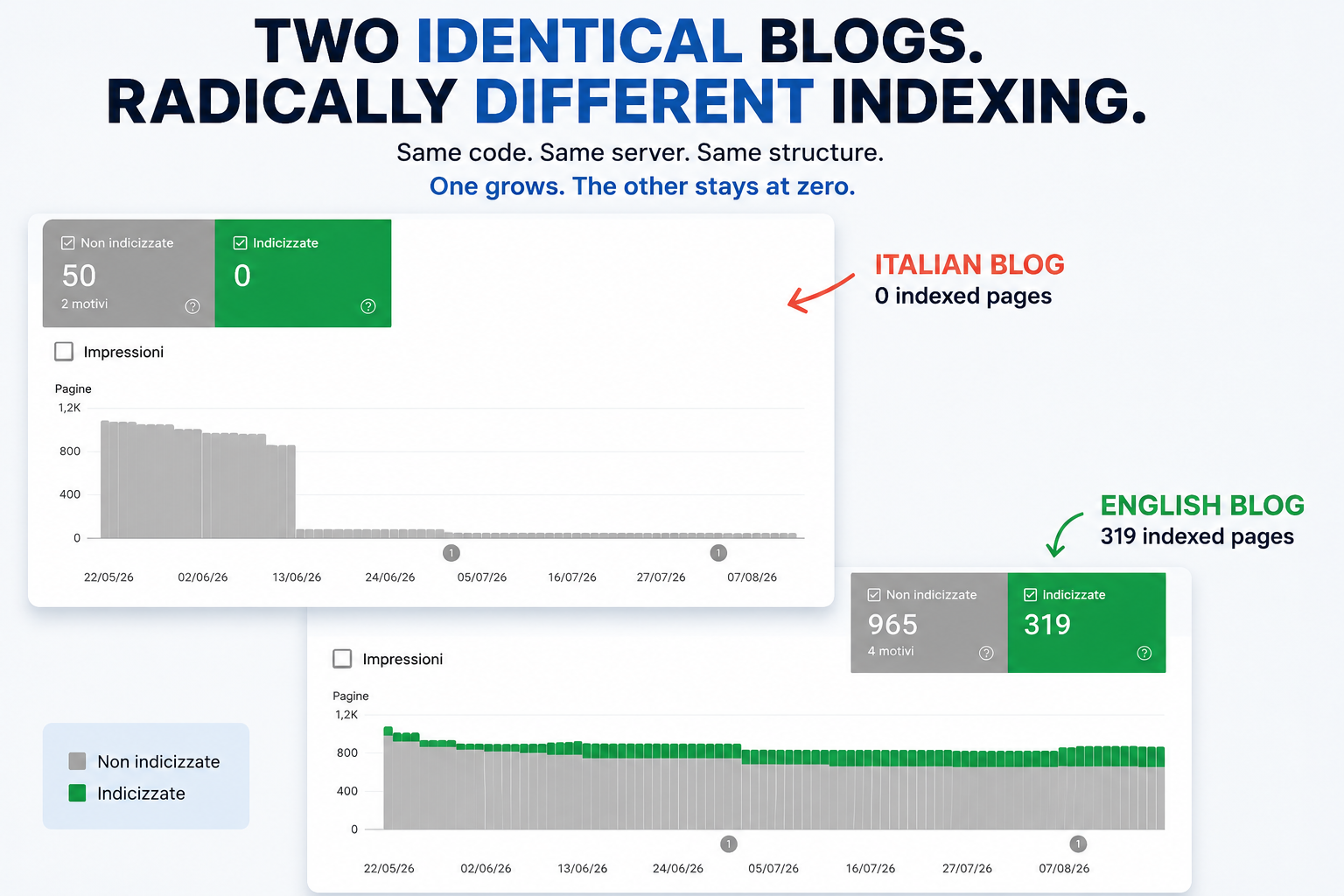
We compared two technically identical blogs running the same Laravel codebase and content structure in different languages. One has 319 indexed pages and keeps growing. The other has 0. Same architecture, same server, radically different indexing outcomes.
Over the past few months, both we and other SEO colleagues have noticed something strange: Google seems to be having a harder time indexing some websites, or at least it appears increasingly selective about how many pages it actually keeps in the index.
We wanted to understand whether what we were seeing could simply be explained by technology or site architecture, so we looked at a particularly clean comparison we already had available.
Two blogs built from the same codebase.
Same Laravel application, same structure, same templates, same publishing logic and same server environment. One is the English version, the other is the Italian version. From a technical point of view, they are essentially clones.
The result is difficult to ignore.
The English blog currently has 319 indexed pages and continues to grow. The Italian blog has 0 indexed pages. Google knows about dozens of URLs on the second site and has crawled many of them, but still chooses not to keep them in the index.
This is where things become interesting.
If the problem were Laravel, the rendering method or the basic architecture of the website, we would expect both sites to behave in roughly the same way. They don't. One continues to gain indexed pages while the other is crawled and then effectively discarded.
The obvious temptation is to search for a hidden technical difference: a canonical mistake, a robots directive, a sitemap problem, an HTTP issue or something buried in the HTML. Those are always worth checking. But when two sites are effectively clones and one behaves normally, the explanation starts to look less like “Google can't process this technology” and more like “Google doesn't value the two sites in the same way.”
And that is a much harder problem to diagnose.
Google has repeatedly explained that crawling does not guarantee indexing. A URL can be accessible, crawlable and technically valid and still not be selected for the index. What is much less transparent is why two extremely similar environments can receive such dramatically different treatment.
Language may be part of the explanation. Content demand, duplication patterns, historical signals, host-level trust, internal discovery and many other factors could also contribute. We don't have enough evidence to attribute the difference to one specific cause, and that isn't the point of this experiment.
What we can actually observe is simpler:
Same technology does not produce the same indexing outcome.
For us, this is becoming increasingly interesting because we are seeing similar behaviour across several projects. Some technically older sites continue accumulating indexed pages, while newer sites with cleaner architectures struggle to move beyond a handful.
That doesn't prove there is a single Google indexing bottleneck, nor does it prove that something fundamental has changed in Google's indexing systems. But it does suggest that many modern indexing problems may be less about whether Google can crawl and understand a page and more about whether Google ultimately decides that the URL deserves to remain in its index.
When two cloned blogs end up at 319 versus 0, that decision becomes difficult to ignore.
We will keep watching both sites to see whether the gap closes, remains stable or becomes even larger. For now, we have more questions than answers — which is exactly why this comparison is worth documenting.
Have you seen anything similar on your websites or your clients' websites over the last few months?