
If you've ever wondered how an AI can answer questions about documents it has never seen during training, you're already asking one of the most important questions in modern artificial intelligence.
In our previous article we explained that today's AI systems rarely rely on a single type of memory. Instead, they combine different memory layers depending on the task. One of the most common and powerful techniques is called Retrieval-Augmented Generation, better known as RAG.
Despite the name, RAG isn't actually a memory stored inside the language model. In many ways, it's closer to giving the AI access to an intelligent library than giving it a human brain.
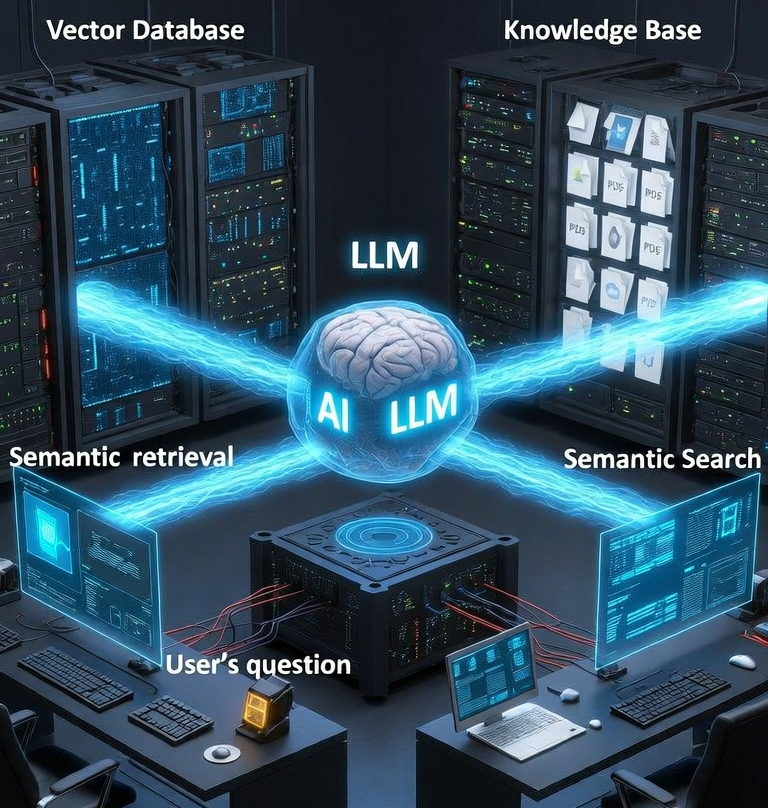
Imagine asking an assistant about your company's internal documentation. A standard language model can only answer using what it learned during training, which may be outdated or completely unrelated to your business. A RAG system works differently. Before generating an answer, it searches your documents, manuals, PDFs, databases or knowledge base, retrieves the most relevant information and sends that context to the language model. Only then does the model generate its response. This retrieval-first approach helps ground answers in real, current information instead of relying only on the model's internal knowledge.
This distinction is incredibly important because many people assume that RAG somehow teaches the model new knowledge forever. It doesn't. The language model itself remains unchanged. Nothing is permanently written into its parameters. Every new question starts with a new search through the available knowledge, allowing the system to use updated information without retraining the model.
That's one of the main reasons RAG has become so popular. A company can update a policy document, add a new manual or publish fresh technical documentation, and the AI can immediately use that information during retrieval without requiring a new training process. This makes RAG one of the most practical approaches for production AI systems where information changes frequently.
Behind the scenes, the process is usually much more sophisticated than a simple keyword search. Most modern RAG systems convert documents into numerical representations called embeddings and store them inside a vector database. Instead of searching for exact words, the system performs semantic search, looking for information that has a similar meaning to the user's question. This is why an AI can often find the right document even when the wording is completely different.
Of course, RAG isn't the answer to every problem. If the knowledge base is incomplete, outdated or poorly organized, the AI can only retrieve what actually exists. Good retrieval starts with good data. A well-structured knowledge base, clean documents and relevant information are just as important as the language model itself.
As AI assistants become more capable, RAG is increasingly being combined with other memory systems such as persistent user memory, long-term memory and autonomous AI agents. Instead of replacing these approaches, RAG complements them by providing reliable, up-to-date knowledge whenever the model needs it.
The future of AI isn't about building models that memorize everything. It's about designing systems that know where to find the right information at the right moment.
Continue reading
This article is part of our AI Labs series.
If you haven't read the introduction yet, start here:
You Installed a Remote AI. Now Comes the Hard Part: Giving It Memory.