
A lot of people spend days comparing AI models. They debate whether ChatGPT is better than Claude, Gemini, Kimi or an open-source model running through Ollama.
Choosing the right model is important, but once the installation is finished another question immediately appears, and it is arguably even more important.
How do you make an AI remember?
This is where many projects stop. The model works, answers questions and maybe even writes code, but every conversation starts almost from scratch. It doesn't know your preferences, it doesn't remember previous decisions and it has no knowledge of the documents you want it to use. In other words, it behaves like someone with perfect reasoning skills but no long-term memory.
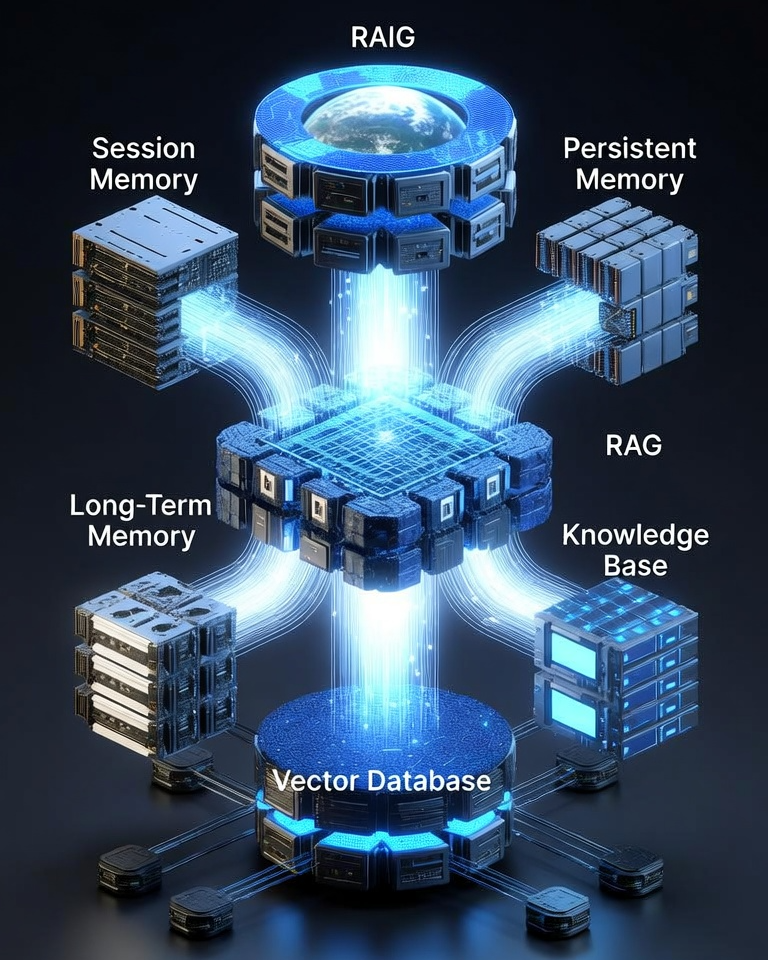
The interesting part is that modern AI systems rarely rely on a single type of memory. In reality, what we casually call "AI memory" is usually a combination of different techniques working together behind the scenes.
Sometimes the system only needs to remember the current conversation. In other cases it needs to retrieve information from thousands of documents. A personal assistant may need to remember your preferences, while an AI agent managing a business workflow might need to keep track of completed tasks, decisions and previous outcomes.
The language model itself is often just one component of a much larger architecture. Around it there may be vector databases, retrieval systems, knowledge bases, user profiles and persistent storage that together create the impression that the AI "remembers." The model isn't magically storing everything inside its neural network every time you ask a question. Instead, the surrounding system decides what should be stored, what should be retrieved and what should be forgotten.
This distinction is becoming increasingly important as more developers build remote AI assistants, internal company copilots and autonomous AI agents. Choosing the wrong memory architecture can make an excellent model feel surprisingly unintelligent, while a well-designed memory system can dramatically improve the usefulness of even a smaller model.
That's why talking only about the model is no longer enough. The real challenge is designing how information flows before the model generates an answer and how useful information is preserved afterwards.
In the next AI Labs article we'll explore the different types of AI memory in depth. We'll look at concepts such as session memory, persistent memory, Retrieval-Augmented Generation (RAG), vector databases, semantic search and long-term memory, explaining when each approach makes sense and why modern AI systems often combine several of them instead of relying on just one.
Because in 2026, building an AI isn't only about choosing the smartest model. It's about teaching it what deserves to be remembered.
https://netcontentseo.net/article/what-is-rag-memory-why-modern-ai-doesnt-need-to-remember-everything-20-385
https://netcontentseo.net/article/what-is-persistent-ai-memory-how-modern-ai-remembers-you-across-conversations-20-386