
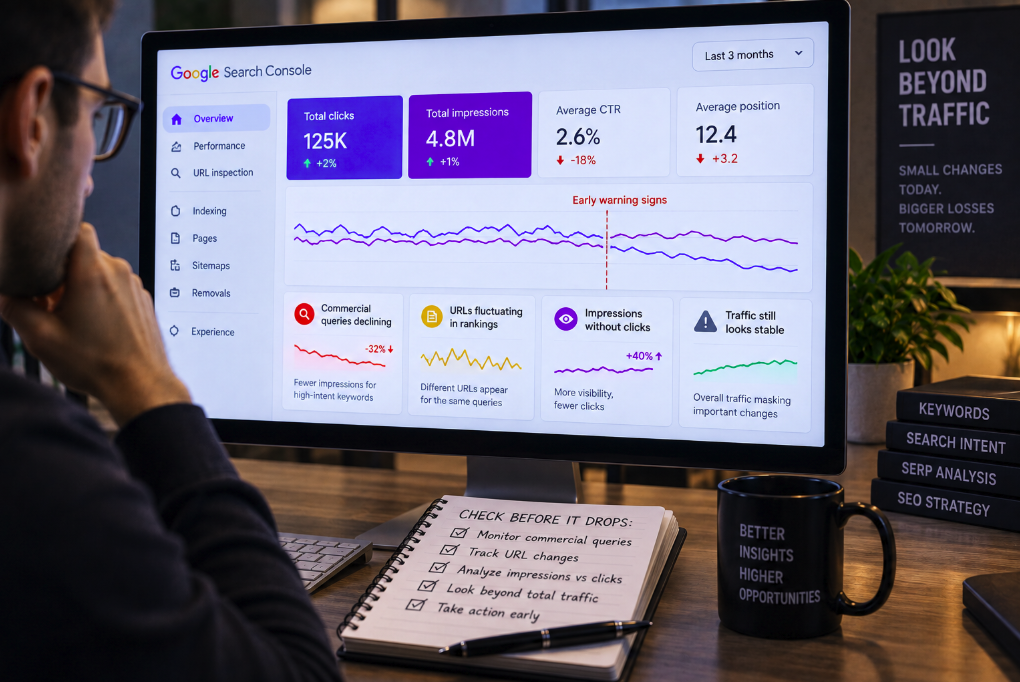
A healthy organic traffic graph can be one of the most dangerous things in an SEO report when it encourages a team to stop looking. Sitewide clicks may be flat or rising while commercially important queries lose positions, Google alternates between competing landing pages, impressions grow without equivalent clicks and lead-producing pages quietly surrender visibility. By the time the headline traffic metric finally falls, the deterioration may have been visible for months in the layers underneath it.
That is the central argument in Carrie-Ann Sudlow’s September 3 Search Engine Land analysis: organic performance rarely collapses without leaving earlier clues. The problem is that standard SEO reporting often aggregates those clues away. A five-position decline across a few high-intent searches can be more damaging to a business than hundreds of new informational rankings are valuable, yet the larger numbers can make the dashboard look reassuring.
Traffic is an aggregate, not a diagnosis
Organic sessions combine visitors with radically different intentions and commercial value. Someone researching how to maintain a product they already own is not equivalent to someone comparing suppliers before making a purchase. Both visits count as organic traffic, but only one may represent an immediate revenue opportunity.
This is why growth can conceal decline. Sudlow gives the example of an ecommerce business gaining substantial impressions around informational searches while losing clicks for core commercial product terms. The total visibility number improves, but the query mix becomes less valuable. A lead-generation site can experience the same effect when blog articles attract more visitors while service pages lose the searches most likely to produce inquiries.
The solution is not to dismiss informational traffic. Educational content can build awareness, demonstrate expertise and create future demand. The analytical mistake is treating every organic visit as commercially interchangeable. SEO reporting should separate informational visibility from product, category, service and other high-intent performance so that growth in one area cannot silently compensate for deterioration in another.
Stable rankings can hide URL instability
Average position can also tell a comforting story while Google is signaling uncertainty underneath it. A query may remain around position four for months, yet the URL occupying that position can alternate between a dedicated service page and an older informational article. The ranking appears stable in a keyword report; Google’s choice of destination is not.
Repeated URL switching deserves investigation because it can indicate overlapping intent, internal competition, unclear site architecture or a change in what Google believes users want. It also has commercial consequences. A service page designed to convert a prospect is likely to provide a very different journey from an informational guide written for someone at an earlier stage of research.
For strategically important queries, SEO teams should therefore monitor both position and ranking URL. If Google repeatedly changes which page it selects, the question is not simply whether the keyword moved up or down. It is why the search engine no longer appears confident about the page that best satisfies the query.
Rising impressions can be a warning rather than a win
Search Console impressions are frequently presented as an early sign of SEO momentum. Sometimes they are. But impression growth without comparable click growth needs to be decomposed before it is celebrated. A site can become visible for thousands of additional low-intent searches while simultaneously becoming less visible where customers are closest to buying.
The diagnostic step is to identify which queries and landing pages created the additional impressions. If the expansion comes from useful new commercial coverage, the growth may be strategically valuable. If it comes from broad informational searches while high-intent clicks decline, the same top-line graph means something very different.
Click-through rate should be interpreted in context as well. A declining CTR can reflect weaker positions, changing SERP features, shifts in query mix or more zero-click behavior. It is not automatically evidence that titles and descriptions need rewriting. The important question is where the divergence between impressions and clicks is occurring and whether it affects searches that matter commercially.
Commercial query loss can disappear inside averages
Sitewide average position is particularly vulnerable to masking important movements. A website ranking for thousands of queries can lose several places for a small group of valuable transactional terms without materially changing the overall average. For the business, however, moving from positions two or three to five or six can alter lead volume substantially.
This is why priority query groups deserve their own monitoring. Ecommerce teams can segment product and category intent. Service businesses can track searches around their highest-value offerings, locations and buying modifiers. The objective is not to return to obsessive monitoring of every individual keyword, but to make sure strategically important demand is not diluted by thousands of unrelated rankings.
The same principle applies to landing pages. A website can report 20% organic growth because three informational articles are performing exceptionally well while the pages responsible for sales are declining. Overall traffic is technically up. Organic commercial performance may still be deteriorating.
Competitor gains should be evaluated from the customer’s perspective
Early warning analysis also requires looking beyond the site itself. A page can become relatively weaker without changing at all. The content that ranked first three years ago may remain accurate and technically sound while competitors add better case studies, clearer pricing information, stronger evidence, more useful photography and answers to the questions customers actually ask before buying.
Sudlow argues that competitor analysis becomes too mechanical when it is reduced to keyword-gap exports. Knowing that another domain ranks for 2,000 additional terms does not explain why its page is a better search result. A more useful comparison asks what the competing page helps a potential customer understand, verify or decide that yours does not.
That framing changes content maintenance. Protecting successful pages does not require rewriting them every quarter simply to signal freshness. It requires periodically checking whether they remain as convincing and useful as the alternatives now surrounding them in the SERP. Search performance is relative; standing still can become a decline when the competitive standard improves.
Lead decline can precede traffic decline
One of the strongest warning signals appears when organic traffic and business outcomes stop moving together. If sessions are approximately stable while inquiries fall sharply, teams often assume the problem belongs to conversion optimization. That may be true, but search data should be investigated before SEO is ruled out.
The composition of traffic may have changed. High-intent queries may have slipped a few positions while informational visits increased enough to replace the lost sessions. Google may be sending users to different landing pages. One high-value service or location may account for most of the commercial decline even though its effect is almost invisible at site level.
SEO data also needs to be connected with what sales teams hear from prospects. Changes in lead quality, pricing sensitivity, common objections and competitor offers can reveal market changes that Search Console cannot explain. Search data shows what people typed and where they landed; it does not provide the complete story of what happened after the click.
The warning signs appear where metrics disagree
The most useful early-warning system is therefore not another isolated KPI. It is a process for finding contradictions between metrics. Rankings are stable, but the ranking URL keeps changing. Impressions rise, but clicks do not. Organic traffic grows, but commercial landing pages decline. Sessions remain flat, but leads fall. Each metric can look acceptable by itself; the disagreement between them is the signal.
SEO dashboards should be designed to make those disagreements visible. That means segmenting queries by intent, tracking priority landing-page groups, monitoring URL changes for critical searches and comparing Search Console data with conversions or qualified leads. Longer trend windows can help distinguish ordinary volatility from persistent deterioration, while annotations for major site changes and Google updates provide context when patterns shift.
This approach also changes the role of SEO reporting. A report should not exist to find the greenest metric available for a monthly presentation. Its job is to show whether organic search is becoming more or less valuable to the business and to identify emerging weaknesses while there is still time to respond.
The best time to investigate is before the traffic graph turns red
Organic traffic is a lagging indicator when it is viewed only as a sitewide total. The early signals often live deeper in the data: a commercial query cluster losing ground, a service page being replaced by an informational URL, impressions expanding into less valuable searches or leads weakening while visits remain stable. None of these automatically predicts an imminent collapse, but each deserves analysis precisely because the headline number can remain healthy.
That is the practical advantage of looking beyond traffic. When a major organic decline is already visible on the main chart, the business is diagnosing damage that has happened. When the warning signs are found earlier, SEO teams still have the opportunity to understand changing intent, strengthen commercially important pages, resolve ambiguity and respond to competitors before those weaknesses become the next quarterly traffic story.