
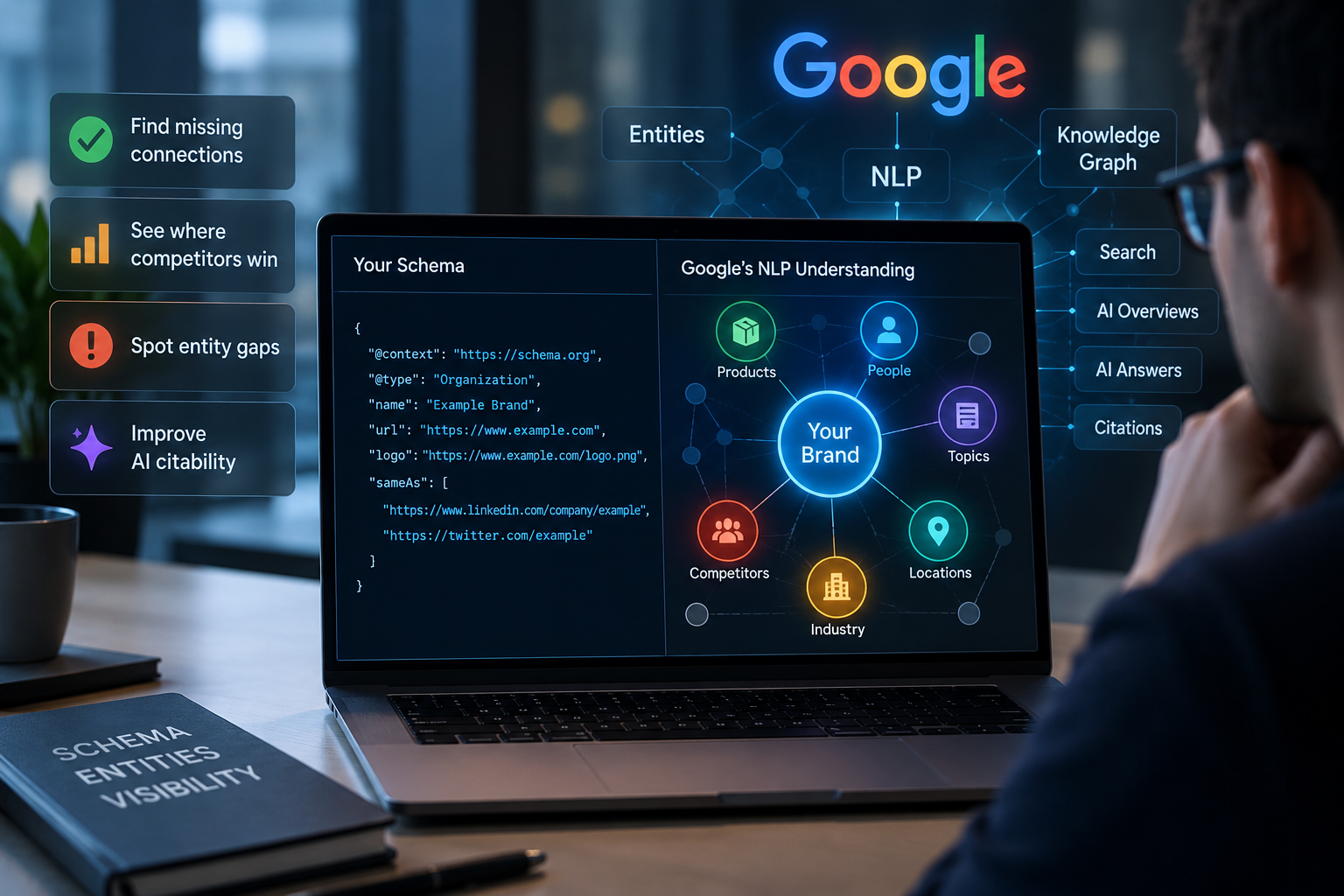
Structured data has long been treated as a way to tell search engines what a page contains. In the AI search era, it is becoming something more strategic: a declared map of what a brand is, what it offers, which topics it owns and how its expertise connects to the wider web. The uncomfortable question for SEO teams is whether Google’s systems actually interpret that map in the same way the brand intended.
That question sits at the center of a new Search Engine Land article promoting the next SMX Now session, “Find the entity gaps holding back your content strategy”, published on September 3, 2026. The session, scheduled for September 16, focuses on a practical audit process designed to compare the entities a brand declares through Schema.org markup with the entities recognized by Google’s natural language processing systems. The idea is simple but important: schema can define a brand, but recognition depends on whether Google can also infer those same relationships from the content, context and competitive landscape around it.
Search Engine Land reports that Ray Martinez, VP of SEO at Archer Education, will show marketers how to measure the gap between declared entities and recognized entities using schema.org markup, the Google Cloud Natural Language API and agentic coding tools such as Antigravity, Claude Code or Codex. The workflow turns existing schema into a queryable knowledge graph, then compares it with Google NLP output and competitor content to surface missing links, underdeveloped topics and entities that are not yet strongly associated with the brand. For teams trying to improve visibility in both traditional search and AI-generated answers, that kind of audit shifts structured data from a technical checklist to a strategic diagnostic layer.
Why schema is no longer just a rich-result tactic
Google’s own documentation describes structured data as a standardized format for providing information about a page and classifying its content, while also noting that most Google Search structured data relies on the schema.org vocabulary and that Google Search Central documentation remains the definitive reference for Google Search behavior. In practice, this means schema helps machines interpret page meaning, but it does not give brands absolute control over how search systems understand them. A page can declare an organization, product, service, author, location or topic, yet Google still evaluates those claims against visible content, internal linking, external references, reviews, citations and other signals.
This distinction matters because AI search systems do not simply list blue links. They retrieve, synthesize and cite information when answering questions. Search Engine Land has previously argued that structured data can help Google and AI systems verify business information and reduce conflicts across local packs, AI Overviews, rich results and external AI platforms. The same publication has also framed generative engine optimization as the work of positioning a brand and its content so AI platforms can cite, recommend or mention it when users search for answers. In that environment, a brand’s entity profile becomes part of its discoverability infrastructure.
An entity audit therefore asks a deeper question than whether markup validates. It asks whether the declared brand identity is supported by the language on the page, by the topical structure of the site, by internal connections between pages and by the broader evidence that Google’s systems can extract. If the schema says a company is strongly tied to a specific service category, but NLP analysis repeatedly identifies competitors, generic topics or unrelated entities more clearly, the brand may have a semantic visibility problem rather than a traditional indexing problem.
The competitive angle: what rivals are teaching Google
The most useful part of this approach may be the competitor comparison. SEO teams often compare rankings, backlinks and content length, but entity-level analysis can reveal a different kind of advantage. A competitor may not simply have more content; it may have clearer relationships among products, problems, industries, people, locations and use cases. Those relationships can make the competitor easier for search and AI systems to retrieve when a user asks a nuanced question.
For example, two brands may both sell into the same market, but one may consistently connect its brand to named industries, buyer roles, pain points, regulations, integrations and case studies. The other may describe itself broadly while relying on schema to fill in the details. In a conventional SEO audit, both sites may appear technically sound. In an entity audit, the second brand could show obvious gaps: important services not recognized by NLP, weak association with priority topics, missing internal links between related concepts or schema entities that are not reinforced by the visible copy.
This is where the Search Engine Land premise becomes especially relevant to AI citability. AI answers tend to favor sources that are easy to retrieve, summarize and trust within a given context. Schema may help define the source, but the surrounding content still has to create enough semantic confidence for systems to reuse the information. When entities are missing, vague or disconnected, a page may be technically eligible for understanding but practically less likely to be surfaced in AI-generated responses.
From markup validation to entity validation
Traditional structured data work often begins and ends with validation: is the JSON-LD syntactically correct, are required properties present and is the page eligible for a rich result? Those checks remain important, but they are not the same as entity validation. A valid schema block can still describe a brand in a way that is incomplete, isolated from the page’s main content or misaligned with how Google’s NLP systems classify the text.
An entity-first audit adds a second layer. It extracts the entities declared in schema, runs page content through NLP analysis, compares the results and looks for mismatches. Some mismatches may be harmless, but others can point to strategic problems. A brand may declare a core product but fail to have that product recognized in body copy. It may mark up an organization without strengthening sameAs references, author relationships or topical connections. It may publish content around a high-value subject while Google’s NLP model recognizes generic industry terms but not the brand’s unique angle or expertise.
The operational value is that these findings can become content actions rather than abstract SEO observations. Teams can build pages around under-recognized entities, improve internal links between related pages, refine schema so it reflects real on-page claims, add clearer definitions, expand evidence around products and services, and compare progress over time. The goal is not to trick Google into accepting a brand narrative. It is to make the narrative clear, consistent and well supported enough that search and AI systems can understand it with confidence.
What marketers should take from the Search Engine Land report
The broader lesson is that brand visibility in search is becoming less dependent on individual pages acting alone. A brand is now interpreted as a network of entities, relationships and evidence. Schema.org markup is one part of that network, but it is not a magic layer that compensates for thin content, inconsistent positioning or weak topical architecture. If Google’s NLP systems do not recognize the entities a brand considers central, the brand has a discoverability gap that may affect rankings, AI mentions and citations.
For SEO teams, this pushes audits toward a more evidence-based model. Instead of asking only whether structured data is present, they should ask what the markup claims, whether page language supports those claims, whether competitors are associated with stronger or broader entity sets, and whether AI search systems can retrieve the brand for the questions that matter commercially. That kind of work sits at the intersection of technical SEO, content strategy and brand strategy, which is exactly why it is becoming harder to separate SEO from broader digital authority.
Schema still defines what a brand wants machines to understand. The next stage of SEO is proving that Google, and the AI systems layered on top of search, actually understand it. Brands that close that gap will not merely have cleaner markup; they will have clearer authority, stronger retrieval signals and a better chance of being cited when AI becomes the interface between customers and the web.