
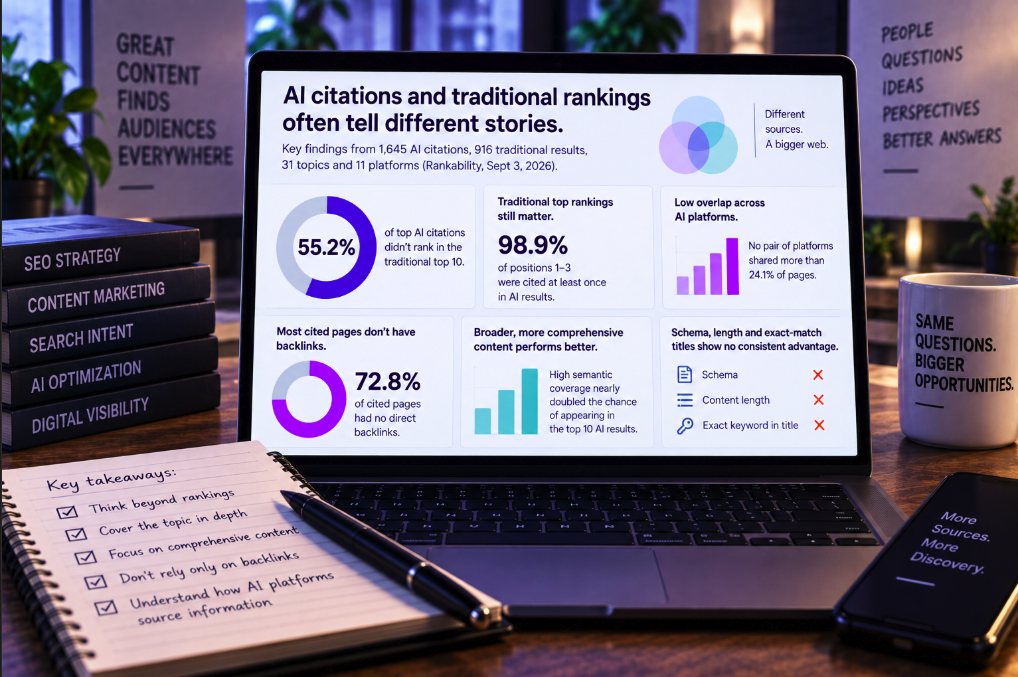
Ranking on page one still matters in AI search, but it is no longer the whole visibility story. A new Rankability analysis found that 55.2% of the pages appearing among the first 10 AI citations did not rank in the traditional top 10 for the same monitored query—or were not observed in the tracked traditional results at all.
The finding comes from Rankability’s September 3, 2026 AI search study, which compared 1,645 distinct AI query-page observations with 916 traditional search observations across 31 topics. The AI dataset spans 11 platforms, including ChatGPT, Google AI Mode, Google AI Overviews, Gemini, Claude, Perplexity, Microsoft Copilot, Brave AI, Grok, DeepSeek and Meta AI.
Traditional rankings still provide a powerful advantage
The headline number should not be interpreted as evidence that conventional SEO has stopped mattering. In fact, Rankability found a very strong relationship between high traditional rankings and inclusion somewhere in AI citations. Pages in traditional positions one through three had a 98.9% chance of being cited by at least one AI platform in the study, while 90% of traditional top-10 results were cited somewhere.
The distinction is between entering the citation pool and securing a prominent citation position. Only 44.8% of traditional top-10 results also appeared among the first 10 AI citations. In other words, ranking highly made a page much more likely to be considered, but traditional position did not determine where that page would appear in an AI system’s source order.
That is why both apparently contradictory findings can be true at once. Strong organic rankings are associated with AI citation inclusion, yet more than half of the top AI citations can still come from outside the traditional top 10. Rankability counted 310 top-10 AI citations in the relevant comparison: 108 had no observed traditional ranking and another 63 ranked below position 10.
AI platforms agree surprisingly little on which pages to cite
The study also shows that “AI visibility” is not a single distribution channel. No pair of the 11 platforms shared more than 24.1% of the pages they cited. The highest overlap was between Brave AI and Claude, and every other pair shared even fewer pages.
That fragmentation makes a blended AI visibility score potentially misleading. A publisher may be highly visible in one assistant and nearly absent in another because the systems rely on different retrieval stacks, search indexes, model behavior and source-selection processes. Rankability’s earlier ranking work, incorporated into the report, found especially large differences in how closely individual platforms resembled conventional search results.
For marketers, the implication is practical: optimizing for “AI” as though ChatGPT, Gemini, AI Overviews and Perplexity were interchangeable misses an important part of the problem. Visibility needs to be measured platform by platform, particularly when audiences use several assistants for different kinds of discovery.
Nearly three-quarters of cited pages had no direct backlinks
One of the more provocative findings concerns links. Rankability reports that 72.8% of AI-cited pages had zero page-level referring domains, and the median cited page had no direct referring domains at all. That means a page did not need its own backlink profile to appear as an AI citation in this dataset.
It would be a mistake, however, to conclude that backlinks or authority no longer matter. The study examined pages that had already been cited and does not prove that removing links would leave their visibility unchanged. Domain-level authority, indexing, brand signals, internal linking and other factors can still influence discovery indirectly. Rankability explicitly frames the result as evidence that page-level backlinks are not a citation prerequisite, not evidence that links are irrelevant.
The same caution applies to domain authority. One quarter of cited pages came from domains with a Domain Rating below 40, while the median was 63. Among pages already cited, domain authority had little relationship with citation position. Again, that describes the observed sample rather than establishing a causal AI ranking rule.
Semantic coverage showed one of the clearest relationships
Content depth produced a more consistent signal. Pages in the highest quartile for semantic topic coverage achieved a 27.6% top-10 AI citation rate, compared with 14.5% for pages in the lowest quartile. High-coverage pages also appeared on an average of 2.16 AI platforms, versus 1.28 for low-coverage pages.
That relationship remained after Rankability accounted for other page characteristics. The result points toward comprehensive topic coverage rather than simple length. AI-cited pages had a median length of 2,681 words, but longer articles did not consistently earn better citation positions. Top-10 citation rates remained relatively similar across the study’s word-count groups once topic coverage was considered.
The study also found that introducing the topic clearly near the beginning correlated with stronger performance. Pages that established the subject within the first 100 words had a 22.1% top-10 citation rate, compared with 8.7% for pages that did not. By contrast, moving the page’s single strongest passage closer to the top showed little relationship with citation position.
Schema and exact-match SEO tactics showed no universal boost
Several familiar optimization tactics failed to produce a consistent citation advantage. Rankability found no schema type that reliably improved AI citation position. Article, Image and FAQ schema were all common among cited pages, but none behaved like a universal AI-ranking lever.
Exact-match wording was similarly weak as a general strategy. Only 4.8% of AI citations came from pages whose title contained the complete search query, while most cited pages matched the topic more naturally without repeating the full phrase. Title length also showed no consistent advantage, and matching title and H1 wording exactly was uncommon in both AI and traditional results.
These findings do not make titles, headings or structured data unimportant. They remain useful for accessibility, comprehension, search eligibility and clear entity definition. The point is narrower: the study provides little evidence that mechanically increasing schema, forcing an exact keyword into a title or reaching an arbitrary word count will independently push a page higher in AI citations.
The strongest lesson is relevance, not a new checklist
Rankability’s results resist the temptation to replace an old SEO checklist with a new GEO checklist. Basic technical accessibility was nearly universal among cited pages: almost every accessible page had a title tag, most had H1 and H2 headings, and 92.5% exposed their main content without requiring JavaScript rendering. Those characteristics look more like table stakes than differentiators.
The stronger patterns concern whether a page actually answers the topic comprehensively and matches the underlying intent. Pages that closely matched intent had a 20.4% top-10 AI citation rate compared with 8.3% for poorly aligned pages. Specific facts and first-party evidence also appeared frequently among pages visible in both traditional and AI top 10s, although the observational design cannot prove that adding those elements directly causes citation gains.
This matters because marketers may be tempted to optimize for superficial signals that are easy to scale: more schema, longer articles, exact-match headings or a target number of backlinks. The data instead support a less mechanical approach—make the page accessible, establish the topic clearly, cover the concepts and entities users expect, and provide useful evidence.
The study is a snapshot, not a universal AI ranking formula
The methodology places important limits on the conclusions. The citation analysis is an August 2026 observational snapshot. AI answers and citations can change with the platform, model, location, account state and time, so the measured overlaps should not be treated as permanent characteristics of any individual assistant.
The query mix is also heavily commercial and recommendation-oriented. Twenty-four of the 31 queries contained the words “best” or “top.” That helps explain why listicles and comparison pages generated 63.6% of citations and means the format findings should not be generalized to informational, navigational, news, medical or other search intents.
There is another subtle methodological point: “traditional search” in the report refers to Rankability Tracker’s cross-engine evidence rather than a Google-only ranking dataset. A page classified as having no observed traditional ranking was absent from the monitored comparison set; the study does not prove that the URL could never rank elsewhere or under another search configuration.
SEO and AI visibility increasingly need separate measurement
The most useful conclusion is therefore not that AI has replaced organic search. Traditional top rankings remain strongly associated with citation inclusion, which means the foundations of SEO continue to create valuable visibility. But the path from ranking to AI prominence is incomplete and highly platform-dependent.
For publishers, that creates a two-layer measurement problem. Conventional rankings show how pages compete in search engines, while AI citation tracking reveals whether those pages are actually being selected and surfaced by generative systems. Neither metric fully predicts the other.
Rankability’s 55.2% figure captures that divergence neatly. More than half of the leading AI citations in the study came from beyond the traditional top 10, yet almost every page ranking in positions one through three was cited somewhere by AI. The emerging search environment rewards strong traditional visibility while simultaneously opening additional routes into the answer. Winning one channel helps, but it no longer guarantees winning the other.