
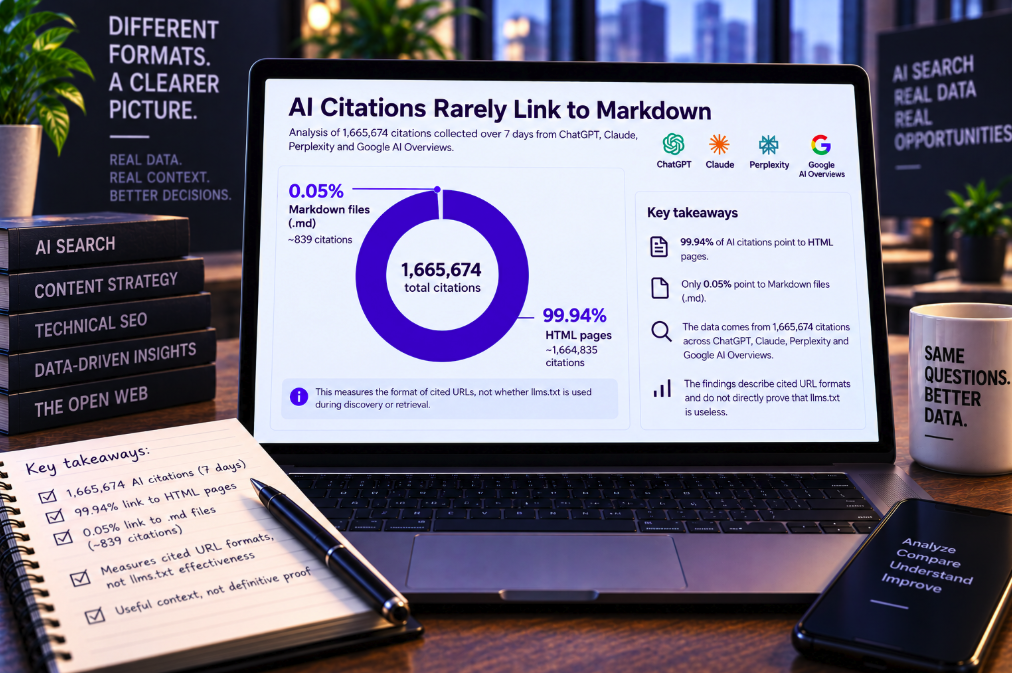
A dataset of more than 1.6 million AI-search citations offers a striking answer to one narrow question: when ChatGPT, Claude, Perplexity and Google AI Overviews link to sources, they overwhelmingly point users to ordinary HTML pages rather than Markdown files.
According to Promptwatch’s Markdown in AI Search dataset, 99.94% of the measured citations pointed to HTML pages, while only 0.05% pointed directly to files ending in .md. The dataset covers 1,665,674 citations collected over seven days across the four AI search experiences.
The result has obvious implications for a debate that has become increasingly loud in generative engine optimization: whether publishers need Markdown versions of their content and an llms.txt file to become visible to AI systems. But the number cannot answer that question on its own. It measures the format of URLs that appear as citations, not every resource an AI system may use during discovery, crawling, retrieval or grounding.
HTML captured virtually the entire measured citation surface
At the level actually measured by the dataset, the result is unambiguous. Direct Markdown citations were extremely rare. For every citation pointing to a .md file, thousands pointed to conventional web pages rendered as HTML.
That matters because some technical GEO advice has treated Markdown as though it were becoming a primary publishing format for AI search. The citation data does not support that interpretation. Whatever is happening behind the scenes, the visible destinations presented to users remain overwhelmingly part of the conventional web.
Promptwatch’s broader public AI-search data library is based on monitoring real interfaces across major AI platforms and publishes aggregated citation and prompt data. Its Markdown report sits alongside datasets examining source types, domains, social platforms and other characteristics of citations.
The simplest practical takeaway is therefore strong: publishers do not need to abandon normal HTML publishing in order to be cited by AI search systems. In this sample, HTML was not merely the leading citation format; it represented essentially the entire measured citation inventory.
But a cited URL is not the same thing as a retrieval input
The methodological distinction becomes crucial when the dataset is used to make claims about llms.txt. A citation report observes the URL ultimately shown as a source. It does not expose every intermediate step the system took before selecting that source.
An AI system could theoretically discover a page through a sitemap, internal link, search index, Markdown representation, API, feed or another machine-readable resource and still present the canonical HTML page to the user. Looking only at the final citation would reveal the HTML destination but not the discovery path.
The reverse is also true. A site could publish extensive Markdown files and an llms.txt file without any AI system ever consulting them. The existence of the files does not prove they influence retrieval. Citation-format data simply does not observe that layer of the process.
This is why the 99.94% figure is compelling evidence about citation destinations but weak evidence about hidden retrieval mechanics. Conflating those two questions turns a useful dataset into a claim it was not designed to test.
What llms.txt is trying to solve
The llms.txt proposal is intended to give language models a concise, human-curated guide to a website. A site can place the file at its root and use it to describe important resources or direct machines toward useful content, often with Markdown-oriented conventions.
The idea is attractive because modern websites can be difficult for automated systems to interpret. Navigation, JavaScript, advertising, personalization and complex page templates create substantial noise around the underlying information. A lightweight file that points models toward authoritative resources could, in principle, make a site easier to understand.
But that theoretical usefulness is separate from adoption. A convention matters only when relevant systems actually fetch it and use the information in consequential parts of their pipelines. Different AI companies can make different choices, and behavior can change over time.
That makes empirical measurement essential. The challenge is designing measurements that observe the stage being claimed. Citation URLs can test what gets cited. Server logs can help reveal what bots fetch. Controlled experiments may help determine whether adding or removing a resource changes retrieval or visibility. No single measurement necessarily answers all three questions.
The September analysis makes a stronger strategic argument
A September 13 analysis by AI Search Tool Rank uses Promptwatch’s 0.05% figure to argue that GEO teams should prioritize measuring citation sources over assuming a technical file will materially change visibility.
That strategic recommendation is reasonable when framed carefully. If almost every visible citation points to ordinary web content, companies should not neglect product pages, documentation, articles, comparisons and other HTML resources that AI systems demonstrably cite. Shipping an llms.txt file while leaving those pages thin, inaccurate or difficult to discover would be a questionable allocation of effort.
The analysis goes further in arguing that llms.txt should be treated as a low-cost technical addition rather than a visibility strategy. That distinction is useful. Even if a machine-readable file helps some systems understand a site, it cannot substitute for having authoritative content worth retrieving and citing.
Where caution is needed is in converting the citation percentage into proof of mechanism. The low share of .md citation URLs does not establish that an llms.txt file was absent from, ignored by or irrelevant to the process that produced an HTML citation.
Markdown can be consumed without becoming the user-facing source
This distinction is familiar in other parts of web infrastructure. Search engines routinely use resources that never become search-result URLs. Robots directives, sitemaps, structured data and feeds can influence crawling or understanding without being the page a searcher ultimately visits.
That analogy does not prove that AI systems use llms.txt. It illustrates why final-destination analysis alone cannot rule it out. A supporting machine-readable resource can perform an infrastructure role without appearing as a citation.
Markdown itself also exists in several contexts. Documentation platforms may store source material in Markdown but render canonical public pages as HTML. Content-management systems can transform Markdown into HTML before publication. Repositories can expose raw .md files as well as rendered interfaces. Classifying only the cited URL extension will naturally count the final web representation, not necessarily the authoring or retrieval format behind it.
The dataset still pushes back against a real GEO misconception
None of these caveats make the Promptwatch finding trivial. The data challenges a practical misconception: that AI assistants primarily want publishers to expose standalone Markdown pages and will preferentially cite those machine-friendly versions.
At least across this large seven-day citation sample, that is not what the visible source layer looks like. Users are being directed overwhelmingly to HTML. For publishers deciding whether to maintain a high-quality canonical website or divert substantial resources toward parallel Markdown versions, the observed citation distribution strongly favors keeping the web experience at the center.
That is especially relevant because maintaining duplicate content formats can introduce operational costs. Documentation can become inconsistent, stale versions can survive after the canonical page changes and teams can spend engineering time on infrastructure without knowing whether target systems use it.
A lightweight llms.txt implementation may be inexpensive enough that experimentation is reasonable. A large program to rebuild a website around Markdown for the sole purpose of earning AI citations requires much stronger evidence.
What would actually test whether llms.txt works?
A stronger test would need to observe behavior before and after the file is introduced while controlling as many other variables as possible. Researchers could monitor verified crawler requests for llms.txt, inspect whether linked resources receive different retrieval activity and compare citation outcomes across matched pages or sites.
Even that would need to distinguish among AI systems. ChatGPT, Claude, Perplexity and Google’s generative search products do not necessarily share crawling infrastructure, retrieval architecture or source-selection policies. A file used by one system could be ignored by another.
Server logs could establish whether known bots request the file, but fetching alone would not prove that its contents influence answers. Citation experiments could show an association with visibility, but ranking and retrieval systems change continuously. Ideally, evidence would combine crawler behavior, controlled interventions and downstream citation outcomes.
Until that kind of evidence exists at scale, the strongest claims on either side remain premature. “Every site needs llms.txt to rank in AI” goes beyond the evidence, but so does “0.05% Markdown citations proves llms.txt does nothing.”
HTML remains the safest place to invest
For content and SEO teams, the practical hierarchy is clearer than the technical debate. Make the canonical HTML site crawlable, useful and authoritative first. Publish information AI systems and humans have a reason to reference. Keep important product, documentation and editorial pages accurate. Strengthen internal discovery and conventional web architecture.
Then treat experimental machine-readable layers according to their cost and the evidence available for the platforms that matter to the business. An llms.txt file may be cheap enough to test, particularly for documentation-heavy sites, but it should not displace work on the HTML pages that currently dominate actual citations.
The Promptwatch dataset is valuable precisely because it narrows one part of the discussion with real observations: among 1,665,674 measured AI citations, direct Markdown links were almost nonexistent. What it does not show is equally important. It cannot tell us every file or representation an AI system consulted before producing those citations.
In other words, 99.94% HTML is a powerful statistic about where AI assistants send users. It is not yet a verdict on every machine-readable resource they may use to decide where to send them.