
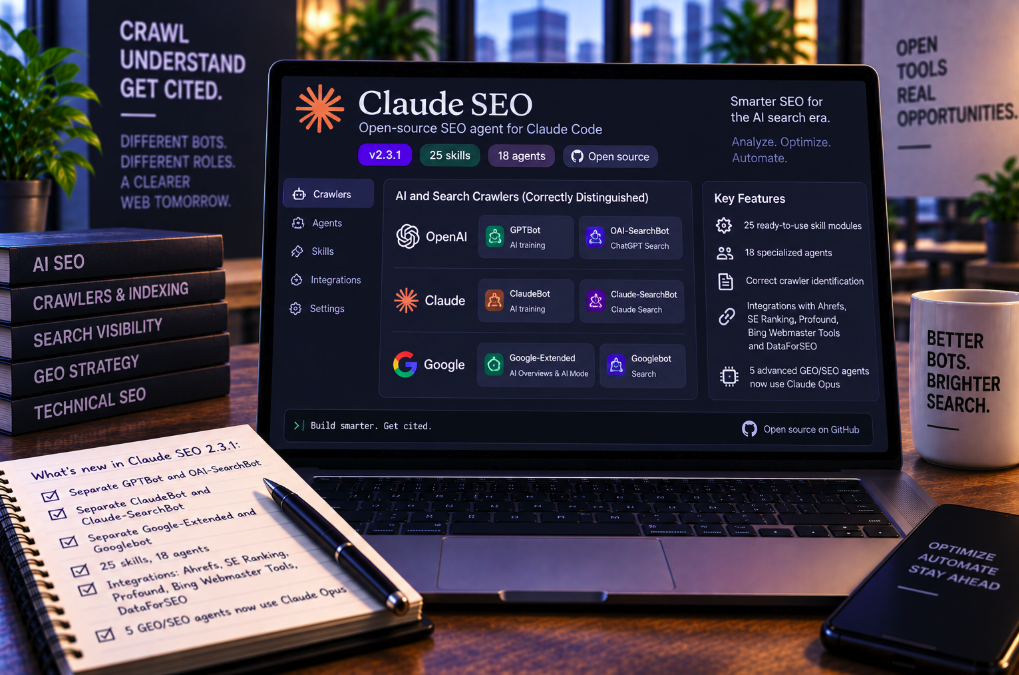
One of the most consequential mistakes in generative engine optimization is also one of the easiest to make: treating every crawler operated by an AI company as though it serves the same purpose. An open-source SEO plugin for Claude Code has now corrected that distinction explicitly, separating bots used for model training from the crawlers that determine whether content can participate in search and citation experiences.
Claude SEO, an independent open-source project maintained by Daniel Agrici, updated its crawler guidance in versions 2.3.0 and 2.3.1 on September 10. The GitHub releases and project changelog show that the tool now distinguishes OpenAI’s GPTBot from OAI-SearchBot, Anthropic’s ClaudeBot from Claude-SearchBot, and Google-Extended from Googlebot.
Those distinctions are more than terminology. A publisher can make a technically valid robots decision and still get the strategic outcome wrong if it blocks a search crawler while intending only to restrict AI training, or allows a training crawler because it mistakenly believes that access is required for search visibility.
GPTBot is not the crawler that controls ChatGPT Search citability
The v2.3.0 changelog says Claude SEO previously described GPTBot as a ChatGPT web-search crawler in its GEO guidance. That was incorrect. GPTBot is associated with OpenAI’s model-training and improvement activities, while OAI-SearchBot is the crawler relevant to surfacing websites in ChatGPT Search.
The difference creates two separate publisher decisions. A site owner may have one policy about whether content can be used to improve generative AI models and another about whether the same content can appear as a source when a user searches through ChatGPT.
Conflating the bots collapses those choices into a single switch. A publisher that wants search referrals but does not want to permit training could make the wrong robots.txt decision if an SEO tool tells it that GPTBot governs search visibility. Conversely, allowing GPTBot does not by itself make a page eligible to become a ChatGPT Search citation if the crawler that supports search access is blocked.
Claude SEO now includes OAI-SearchBot in its technical crawler table and requires training access and search citability to be reported as separate findings.
Anthropic has the same training-versus-search distinction
The project found a similar problem in its Anthropic guidance. ClaudeBot had been listed as a search-visibility crawler in the GEO module even though the project’s technical SEO documentation already treated it as training-related. Claude-SearchBot, the crawler associated with Claude’s search citability, was missing from the GEO table entirely.
Version 2.3.0 brings those sections into alignment. ClaudeBot and Claude-SearchBot are now treated as separate agents with separate implications, and the project adds a vendor-level claim-to-bot mapping designed to prevent recommendations from attaching a search consequence to the wrong crawler.
This is particularly important as AI assistants evolve from closed conversational systems into products that retrieve current web information. The infrastructure required to build or improve a model is not necessarily the same infrastructure used when an assistant fetches or indexes information for a live user query.
For publishers, “Can this company train on my content?” and “Can this assistant cite my page in search?” are therefore different governance questions. A technically mature GEO audit needs to preserve that distinction.
Google-Extended does not control Google Search readiness
The Google correction may be even more important because Google’s ecosystem spans traditional search, AI Overviews, AI Mode and Gemini-related products. Claude SEO’s updated guidance says Google-Extended should not be treated as a Google Search readiness signal.
Google-Extended is a control associated with how site content may be used for certain Gemini and Vertex AI generative systems. Google Search crawling, including the eligibility foundation for AI Overviews and AI Mode, remains tied to Googlebot and the normal Search infrastructure.
That means blocking Google-Extended is not equivalent to blocking Google Search. A publisher can restrict Google-Extended without automatically removing its pages from ordinary Google indexing, AI Overviews or AI Mode. By contrast, blocking Googlebot has direct implications for Search crawling and therefore for visibility across search experiences built on that index.
This distinction cuts through a recurring misconception in AI-search optimization: that every Google AI feature is governed by an AI-specific crawler token. AI Overviews and AI Mode are part of Google Search and rely on the same fundamental crawl and index eligibility that supports conventional results.
Robots controls do not guarantee a citation
Correctly identifying the crawler is necessary, but it should not be mistaken for a ranking formula. Allowing OAI-SearchBot, Claude-SearchBot or Googlebot gives the relevant system permission to access content under the applicable rules; it does not guarantee that the content will be retrieved, selected, cited or prominently displayed.
Search citability still depends on factors beyond crawler access, including whether the page can be discovered and processed, whether its information is relevant to the user’s question, and how each platform selects sources. Traditional search eligibility works the same way: allowing Googlebot is a prerequisite for normal crawling, not a promise of a top ranking.
The crawler distinction is therefore best understood as an infrastructure layer. It prevents publishers from accidentally closing the door to a search system they want to participate in, while allowing them to make a different choice about model training where the platform provides separate controls.
Claude SEO now documents the mapping across vendors
The September update adds a claim-to-bot mapping across OpenAI, Google, Anthropic and Apple, backed by references to the vendors’ crawler documentation. It also adds Applebot-Extended as distinct from Applebot, reinforcing the broader principle that search indexing and AI-training controls should not automatically be treated as interchangeable.
The changelog also flags the older anthropic-ai user-agent entry as unverified because it does not appear in Anthropic’s current crawler support documentation. That kind of maintenance is important in a field where crawler names, policies and product roles can change faster than static SEO checklists.
For agencies and technical teams, the operational lesson is straightforward: crawler guidance needs a verification date and a primary source. A robots.txt recommendation copied from an old blog post can become wrong even if the syntax itself remains valid.
The project has grown into a 25-skill SEO toolkit
The crawler correction is part of a much larger open-source system. The Claude SEO repository currently describes 25 sub-skills and 18 specialist agents covering technical SEO, content quality, schema, sitemaps, Core Web Vitals, local SEO, backlinks, AI search optimization, ecommerce, international SEO, semantic clustering and other workflows.
The plugin is designed for Claude Code and can orchestrate multiple specialist agents during an audit. Its core works without paid services, while optional integrations can add external data from providers and webmaster platforms.
Among the optional integrations documented by the project are Ahrefs, SE Ranking, Profound, Bing Webmaster Tools and DataForSEO. The repository also includes integrations for additional services and Google APIs. These connections are optional rather than requirements for running the core SEO skills.
The architecture illustrates a broader trend in SEO software: instead of using an LLM only to draft content or summarize an audit, agentic tools are increasingly being built to coordinate technical checks, external APIs, page analysis and specialized reasoning within one workflow.
Five judgment-heavy agents now run on Opus
Version 2.3.1 also changes the model assignment for the project’s more reasoning-intensive agents. Five agents—seo-content, seo-geo, seo-sxo, seo-cluster and seo-drift—now use Claude Opus by default, while the other thirteen specialist agents remain on Sonnet.
The project explicitly notes the cost implication: a full audit can cost more under 2.3.1 because the judgment-heavy tasks are routed to the more capable model. Users can change the model in each agent’s configuration if they prefer a different balance between cost and reasoning depth.
This division is conceptually sensible for agentic SEO systems. Deterministic checks such as parsing tags or identifying HTTP behavior do not necessarily benefit from the most expensive reasoning model, while content judgment, GEO analysis, search-experience evaluation, semantic clustering and drift analysis involve more ambiguous decisions.
This is an independent project, not an Anthropic SEO product
The name can create confusion, so the ownership distinction should be explicit. Claude SEO is not an official Anthropic product. It is an independent MIT-licensed open-source project built to run with Claude Code.
That matters when evaluating its recommendations. The project can cite Anthropic documentation and use Anthropic models, but its SEO guidance should not be interpreted as an official statement from Anthropic about search optimization. The same standard applies to any community plugin built on top of a commercial AI platform.
The open-source model does provide one advantage for methodological scrutiny: users can inspect the skill instructions, agent prompts, scripts, changelog and crawler mappings directly on GitHub. The September correction itself is visible in that history, including an explanation of what was wrong and how the guidance changed.
The correction exposes a wider problem in GEO tooling
Claude SEO’s update is notable partly because the original error is easy to understand. AI companies now operate multiple bots with similar names, while marketing discussions often use “AI crawler” as a single category. That simplification is increasingly dangerous.
Training, indexing, live retrieval, user-triggered fetching and search citability are different functions. A bot may serve one of those roles, several of them or a platform-specific variation. A robots control that affects one function may have no effect on another.
As GEO tools proliferate, crawler audits should therefore do more than detect whether GPTBot or ClaudeBot appears in robots.txt. They should explain what each verified crawler actually controls and separate training permissions from search eligibility in the final recommendation.
That is the real significance of the Claude SEO 2.3.x correction. The project did not discover a new ranking factor. It fixed the map between publisher controls and AI-platform behavior. In an environment where one wrong bot name can mean blocking the search visibility a publisher intended to preserve, that distinction is foundational.