
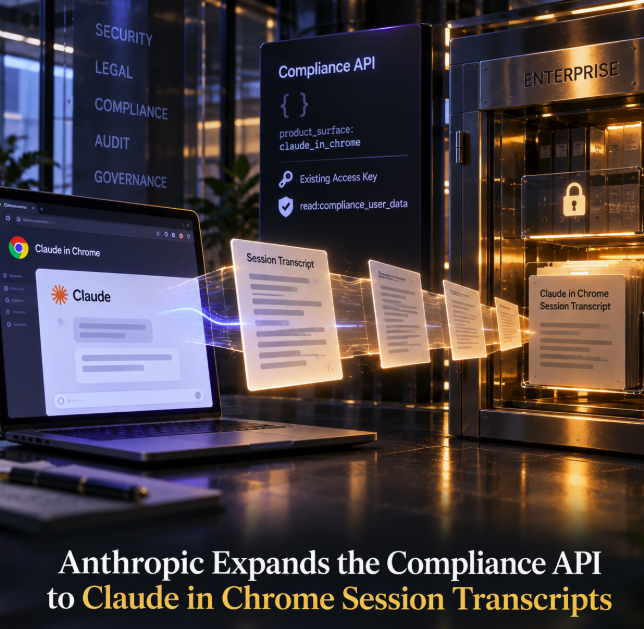
Anthropic has expanded the reach of its Compliance API again, this time bringing Claude in Chrome session transcripts into the enterprise governance layer. The change, published in the Claude Platform release notes on September 18, means eligible Claude Enterprise organizations can retrieve transcripts generated through Anthropic's browser-based Claude experience using the same local-session compliance endpoints already used for other Claude products.
According to the official Claude Platform release notes, Claude in Chrome sessions now appear with the product_surface value claude_in_chrome. The capability is currently in beta for Claude Enterprise organizations and works with an existing Compliance Access Key carrying the read:compliance_user_data scope. In practical terms, Anthropic has extended an existing compliance pipeline rather than introducing a separate browser-specific audit API.
Claude in Chrome joins Anthropic's growing list of auditable AI surfaces
The update is easier to understand in the context of Anthropic's broader Compliance API expansion. The company's Compliance API documentation describes the service as programmatic access to organizational Claude activity for compliance, audit and governance. For Enterprise customers, that coverage now spans Claude chats and files as well as sessions from Cowork, Claude Code, Claude Science, Claude for Microsoft 365 and Claude in Chrome.
Anthropic began adding local-session transcript support in August. On August 11, the Compliance API gained beta access to transcripts from Cowork and Claude Code sessions running on users' machines. On August 26, those endpoints moved out of beta for Cowork and Claude Code, while beta coverage expanded to Claude Science and Claude for Microsoft 365 sessions in Excel, PowerPoint, Word and Outlook. The September 18 Chrome addition continues that pattern of bringing more agentic and application-integrated Claude activity under the same enterprise audit model.
The significance is not simply that another transcript type can be downloaded. Claude is increasingly operating outside the conventional chatbot window. As AI systems move into browsers, terminals, IDEs and productivity applications, enterprise governance has to follow the model into those environments rather than monitoring only conversations started on a central website.
The existing local-session endpoints do the work
Anthropic's design keeps the implementation relatively consistent for compliance teams. The local-session API can list sessions across the organization, retrieve metadata for an individual session and return the messages associated with that session. The September update adds Claude in Chrome as another product surface that can be returned through that infrastructure.
The company says local sessions are captured while users are signed in with their Claude Enterprise account. The relevant endpoints serve Enterprise content, and access requires a Compliance Access Key rather than an ordinary Claude API key. Anthropic's setup documentation emphasizes that a key with read:compliance_user_data can read chats, files, projects and session transcripts across linked Enterprise organizations, so it should be handled like a sensitive production credential.
This architecture is useful for organizations that already export Claude activity into internal governance systems. Instead of building a separate collection mechanism for browser sessions, teams can extend existing Compliance API ingestion and distinguish Chrome activity using the new product_surface value.
Browser AI creates a different governance problem
A browser-integrated AI assistant can interact with a very different information environment from a standalone chat. Depending on the product's permissions and the user's workflow, browser sessions can involve web pages, internal applications, research material and other information encountered during normal browsing. That makes auditability particularly important for enterprises operating under data-loss-prevention, legal-hold, eDiscovery or internal AI-use policies.
Anthropic's Compliance API is designed for after-the-fact access to organizational records. Security and compliance teams can retrieve session content and feed relevant data into downstream tooling, including systems used for auditing and governance. Anthropic distinguishes this from its inference hooks, which can act inline before model inference and potentially deny governed prompts in real time.
The Chrome transcript update belongs to the first category: it improves visibility into what occurred. It should not be interpreted as a new real-time browser-control mechanism or as a change to Claude's underlying model capabilities.
The change is Enterprise-only and currently beta
The scope of the announcement is narrow. Anthropic specifically identifies the Chrome transcript capability as beta for Claude Enterprise organizations. It is not a general feature that lets arbitrary API developers retrieve the browsing conversations of Claude users, and ordinary Claude API workloads do not expose prompt text or model responses through the Compliance API in the same way.
The company's Compliance API FAQ says chats in the Claude in Chrome browser extension are captured when users are signed in with their Claude Enterprise account and are available through the local-session endpoints. That Enterprise authentication boundary is central to the feature's purpose: the API exists so an organization can govern activity occurring inside its own managed Claude environment.
For administrators, the update therefore does not eliminate the need to configure access and retention policies carefully. The ability to retrieve full session transcripts is itself sensitive, and organizations need appropriate controls over who can use the Compliance Access Key and where retrieved content is stored.
Anthropic is building one compliance plane across many Claude products
The broader direction is becoming clear from the sequence of release notes. Claude is no longer one application surface. The same underlying AI ecosystem can appear in a browser, a coding environment, a desktop agent, Microsoft 365 applications and specialized scientific workflows. Anthropic is responding by making the Compliance API increasingly product-agnostic: the session system identifies which surface produced the activity while giving governance teams a common way to retrieve it.
That approach can simplify enterprise adoption because every new Claude interface does not necessarily require a completely new compliance integration. A security team can build around common endpoints and then adapt policy or reporting based on fields such as product_surface. As new surfaces appear, the governance pipeline can expand with them.
It also reveals how enterprise AI infrastructure is evolving. Model capability is only one part of the buying decision. Large organizations increasingly need identity, auditability, retention controls, administrative visibility and integrations with existing security processes. A browser agent that cannot be governed may be difficult to deploy broadly even if its underlying model performs well.
For enterprise AI, observability is becoming a product feature
The September 18 release is a small technical change, but it fits a larger transition. AI assistants are moving closer to the places where employees actually work, and every new surface creates another stream of organizational activity that security and legal teams may need to understand. Compliance infrastructure therefore has to expand at roughly the same pace as the assistants themselves.
Claude in Chrome joining the Compliance API means browser-based Claude activity can now participate in the same audit architecture Anthropic has been extending across Cowork, Claude Code, Claude Science and Microsoft 365. It does not change search rankings, GEO or Claude's reasoning abilities, but it does make Anthropic's enterprise platform more governable as Claude spreads across applications.
The important development is the convergence: Claude's user experiences are multiplying, while Anthropic is trying to keep their enterprise records accessible through one compliance layer. For security and governance teams, the browser is now another Claude surface that can be audited programmatically rather than a blind spot outside the existing session-transcript system.