
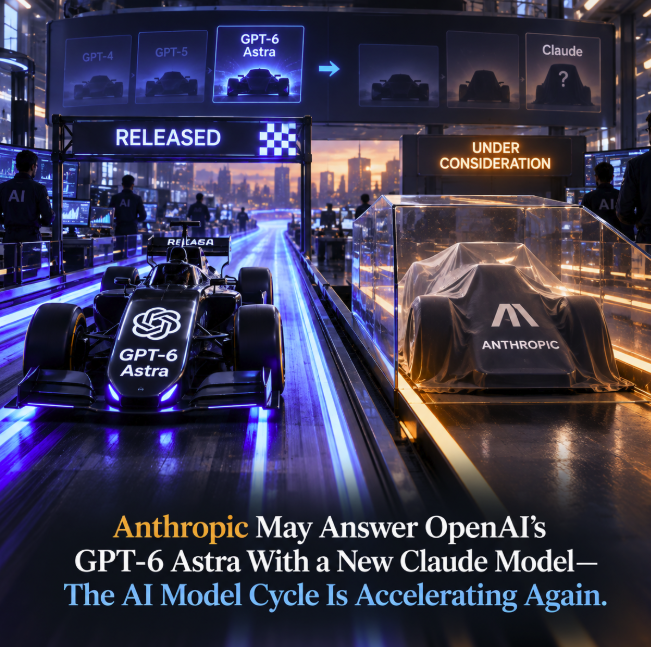
Anthropic is considering releasing another Claude model as competition among frontier AI labs accelerates again, according to Reuters. The important word is considering: as of September 19, Anthropic has not announced a new model, published specifications or confirmed a release date. What Reuters is reporting is that the company is weighing another release after OpenAI's recent GPT-6 Astra launch intensified competitive pressure in the enterprise AI market.
Reuters reported on September 19, citing people familiar with the matter, that Anthropic is considering a new AI model in response to OpenAI's Astra. The potential release is also being discussed against the backdrop of Anthropic's expected IPO, making the decision relevant not only as a technical product move but as part of a broader contest for enterprise customers, investor confidence and leadership in frontier AI.
There is no new Claude launch yet
The distinction between internal consideration and an announced product is especially important in a market where model rumors quickly become treated as release news. Anthropic's official newsroom currently contains no announcement of a successor tied to the Reuters report. Its recent model portfolio already includes Claude Fable 5.1 and Claude Mythos 5.1, introduced earlier in September, alongside active Sonnet and Opus models.
That means there is currently no official model name, benchmark table, pricing structure, API identifier or availability schedule for the model Reuters says Anthropic is considering. Any claim about those details would go beyond the available evidence. The report is significant because of the strategic decision under discussion, not because Anthropic has already shipped another Claude generation.
GPT-6 Astra has reset the competitive reference point
OpenAI recently introduced GPT-6 Astra, positioning it as a new generation of its frontier model family with advances across computer use, browsing, software engineering, science and professional knowledge work. OpenAI said the model would first reach a limited set of organizations before expanding across ChatGPT paid plans, the API and cloud distribution channels.
Reuters reports that Astra has rapidly gained traction among enterprise users. That matters because frontier-model competition is increasingly decided not only by public benchmark leadership but by which systems companies actually deploy for coding, research, agents, internal knowledge work and other expensive production workloads.
A model release from one laboratory can therefore change the commercial calculation for another almost immediately. If enterprise buyers perceive a meaningful capability or cost advantage, providers have incentives to respond before long procurement cycles lock customers into competing platforms.
Anthropic had already refreshed Claude this month
The timing makes the Reuters report particularly notable. Anthropic introduced Claude Fable 5.1 and Claude Mythos 5.1 earlier in September, describing them as its most advanced models for coding and knowledge work. Fable 5.1 is generally available, while Mythos 5.1 is distributed through trusted-access programs with safeguards intended for sensitive cybersecurity and life-sciences work.
Anthropic has also kept multiple model tiers active, including Claude Sonnet 5 and Opus-class systems. Its official model documentation shows a portfolio rather than a single flagship endpoint, reflecting the way frontier vendors increasingly segment models around capability, price, latency, safeguards and specialized use cases.
If Anthropic decides to release another model shortly after the 5.1 refresh, the sequence would illustrate how compressed the frontier-model cycle has become. Major releases no longer necessarily define a stable competitive period lasting many months. A rival's launch can create pressure for another capability step almost immediately.
The enterprise market can force faster model cycles
The economics behind this acceleration are different from a consumer software update cycle. Companies integrating frontier models can generate substantial recurring API and subscription revenue, while model providers face enormous training, inference and infrastructure costs. Losing a large enterprise workload can therefore matter much more than losing a casual chatbot user.
At the same time, switching is becoming technically easier in some environments. Enterprise AI stacks increasingly use model gateways, evaluation layers and multi-model architectures that allow organizations to compare providers or route workloads according to cost and performance. That does not eliminate migration costs, but it can reduce the permanence of a model lead.
The result is a market where capability improvements can rapidly translate into competitive pressure. Coding performance, autonomous tool use, context handling, reliability, inference price and enterprise controls all become dimensions on which a new release can challenge an incumbent deployment.
The possible release also sits beside Anthropic's safety push
There is another tension in the timing. Anthropic has been publicly advocating for greater visibility and stronger controls around frontier AI development. On September 17, the company published work proposing measurements that could help outsiders understand the pace of development inside frontier laboratories. On September 18, it announced an embedded evaluation partnership with Accenture intended to give independent evaluators unusually deep access to frontier-model development.
Reuters notes the contrast between competitive pressure to keep releasing stronger models and CEO Dario Amodei's warnings about the risks of increasingly capable AI. That tension should not automatically be interpreted as a contradiction: a company can argue for stronger safeguards while continuing to develop products within the current competitive environment. But it does illustrate the structural problem facing frontier labs. Calls for caution exist alongside strong commercial incentives not to fall behind.
An IPO raises the stakes further
Reuters places the possible model decision in the context of Anthropic's expected public offering. For a company approaching public markets, model competitiveness can influence revenue expectations, customer retention and the narrative investors attach to future growth. A frontier AI company cannot easily present itself as a technology leader while appearing to concede capability leadership to a rival for an extended period.
That does not mean a new Claude release would necessarily be timed for financial optics, and Reuters does not establish that Anthropic has made a final launch decision. It does mean the company is operating under overlapping pressures: research progress, safety commitments, enterprise competition and potential public-market scrutiny.
Those forces can make release timing increasingly strategic. The question is no longer simply whether a laboratory has trained a stronger model, but whether releasing it now creates more value than waiting for additional evaluation, optimization or product integration.
Frontier leadership is becoming more temporary
The broader pattern is a shortening window in which any single model can dominate the conversation. OpenAI, Anthropic, Google and other laboratories continuously improve their systems, while open-weight models create additional pricing and deployment pressure. A model that looks clearly ahead on one benchmark or workload can face a new competitor weeks later.
For companies buying AI, this makes vendor evaluation a continuous process rather than a one-time selection. The best model for software engineering may not be the best for search, scientific reasoning or high-volume customer support, and the answer can change as providers update models and pricing. Procurement strategies built around a single permanent “best model” are increasingly difficult to sustain.
For publishers, SEO teams and AI-search practitioners, faster frontier cycles can also alter discovery environments quickly. Changes in browsing, retrieval, citation behavior, agentic tool use and web interaction can reach millions of users when a new model becomes the default inside a major assistant. Model launches therefore increasingly function as distribution changes for the web, not merely benchmark events.
The next Claude is still a possibility, not a product
The immediate story remains deliberately narrow. Reuters has reported that Anthropic is considering a new model after OpenAI's GPT-6 Astra release. Anthropic has not announced that model, and its official channels currently provide no technical details that would justify describing the release as imminent or confirmed.
What the report does reveal is the speed at which the competitive clock is moving. Anthropic refreshed major Claude models earlier this month, OpenAI released Astra, and Anthropic is already reported to be weighing another response. The frontier is beginning to resemble a continuous release cycle rather than a sequence of isolated model generations.
If Anthropic proceeds, the important story will not only be how the new Claude compares with GPT-6 Astra. It will be how little time now separates one frontier-model move from the next. Until an official announcement arrives, however, the responsible status is exactly the one Reuters reports: Anthropic is considering its next move.