
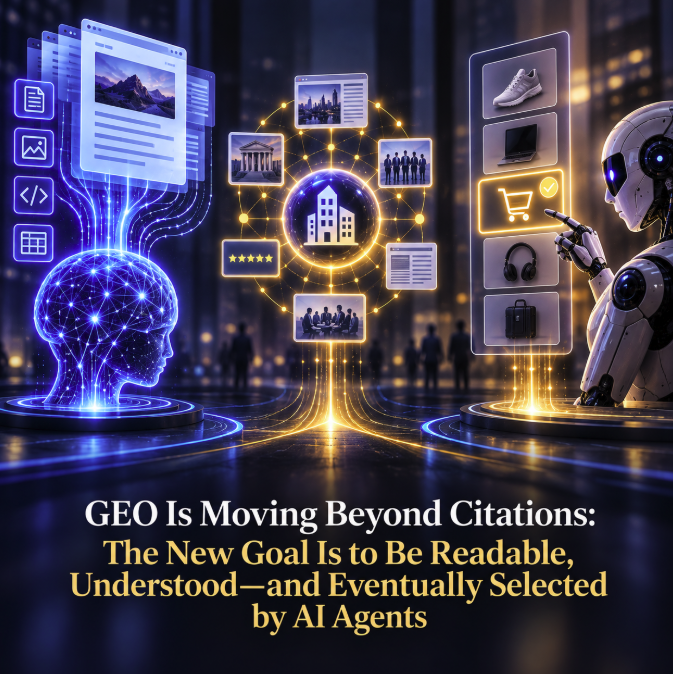
Generative Engine Optimization is moving beyond the question that dominated its first phase: “Did the AI cite us?” A new framework published by Search Engine Land on September 16, 2026 argues that AI visibility now needs to be understood through three distinct but connected pillars — LLM readability, brand context and agentic commerce. The progression is important because generative systems are evolving from answer engines into recommendation and action layers.
In “3 GEO pillars: LLM readability, brand context, agentic commerce,” Olaf Kopp separates GEO into three goals. Content can be optimized to become a source that an AI system can retrieve and cite. A brand can be positioned so that AI understands what it represents and recommends it in the right context. Products and offers can then be structured so autonomous agents can evaluate, select and potentially process them on a user's behalf. These are related outcomes, but they require different signals, teams and technical capabilities.
GEO now has three different definitions of visibility
Traditional search made visibility comparatively easy to conceptualize. A document was indexed, ranked for a query and appeared somewhere in a results page. AI systems introduce several layers between retrieval and the user's eventual decision. A source may influence an answer without receiving prominent exposure. A brand may be recommended even when its own website is not cited. A product may eventually be selected by an agent without the user visiting a conventional search result at all.
Kopp's framework is valuable because it treats these outcomes separately. LLM readability optimization asks whether content can be efficiently processed, understood and used as a source. Brand context optimization asks whether an AI system associates a company with the correct topics, needs and attributes. Agentic commerce optimization asks whether products and services are represented in a form that software agents can reliably evaluate and act upon.
For marketers, this means “AI visibility” can no longer be measured by one number. Citation frequency, brand mentions, recommendations and agent-driven product selection describe different stages of the emerging discovery funnel.
Pillar one: LLM readability begins after retrieval
The first pillar does not replace conventional SEO. It depends on it. Search Engine Land's framework explicitly places document retrieval before LLM readability: if a page is not accessible, indexed or otherwise available to the retrieval layer used by an AI system, its carefully structured passages have little opportunity to influence an answer.
Once the document enters the candidate pool, however, machine interpretability matters. Modern retrieval-augmented systems frequently work with passages or chunks rather than treating a page as one indivisible object. Clear paragraphs, explicit entities, consistent terminology, useful headings and concentrated factual information make it easier to determine what a passage means and when it is relevant.
This creates an editorial discipline that resembles good human writing but has additional machine-facing requirements. Important conclusions should appear early. Evidence should sit close to the claim it supports. Individual sections should remain understandable when extracted from the rest of the page. Semantic ambiguity and filler become more costly because the system may have only a limited chunk of text available when deciding whether to use a source.
The practical lesson is not to write robotic content for machines. It is to remove unnecessary ambiguity. Strong grammar, precise language, descriptive headings and well-defined relationships between entities benefit human readers while making the same material easier for retrieval and language systems to process.
Pillar two: the brand has to exist beyond its own website
The second pillar shifts attention from documents to entities. A company's website can explain its positioning perfectly, but generative systems encounter the same brand across journalism, reviews, comparison pages, databases, marketplaces, forums, social platforms and other third-party sources. Those surrounding references help establish the semantic context in which a model interprets the brand.
Brand context optimization therefore resembles a convergence of GEO, digital PR, reputation management and entity optimization. The objective is not merely to rank a page for a category term. It is to make the relationship between the brand and that category sufficiently clear and consistent across trustworthy sources that an AI system can confidently include the company when answering a relevant recommendation query.
This changes the competitive surface dramatically. A user asking an AI assistant for project-management software, accounting tools or a hotel may receive only a small shortlist rather than ten blue links followed by pages of additional results. Brands that fail to enter that shortlist may never reach the user's consideration set.
Third-party context consequently becomes strategically important. Expert coverage, product comparisons, authentic community discussion, reviews and authoritative mentions can reinforce what a brand is known for. The goal is not to manufacture artificial mentions, but to create enough credible external evidence that the intended brand positioning is observable outside the company's own marketing copy.
Pillar three: AI agents become a new kind of customer
Agentic commerce is the most forward-looking part of the framework because it moves beyond information retrieval and recommendation into action. An AI agent may research a product, compare alternatives against a user's constraints, evaluate price and availability, and eventually participate in purchasing or booking it.
At that point, product visibility becomes a data and infrastructure problem. Agents need accurate attributes, identifiers, prices, inventory, delivery information, reviews, return policies and other trust signals. They may also require APIs, structured feeds or agent-compatible interfaces that allow them to interact reliably with the merchant.
The implications are substantial. Marketing language that persuades a human visitor may have less influence during an automated preselection stage than factual product data. If an agent is asked to find a specific item below a price threshold with delivery by a particular date, incomplete inventory or shipping information can make an otherwise attractive product impossible to select.
Agentic commerce therefore expands the audience that ecommerce teams design for. Product pages still need to convince people, but product data increasingly needs to satisfy machines that may decide which options people see in the first place.
From citation to recommendation to selection
The three pillars can be understood as a progression in the authority delegated to AI. At the first level, the system uses a publisher's information. At the second, it interprets the broader information environment and decides that a brand belongs in a recommendation. At the third, an agent may evaluate a specific offer and act on it.
Each step moves the AI closer to the transaction and farther away from the familiar search journey. That is why optimizing exclusively for citations may eventually become analogous to optimizing only for impressions: useful, measurable and incomplete. A company may care much more about whether an AI recommends its brand or selects its product than whether the assistant displays a source link.
The measurement model should evolve accordingly. Publishers can track citations and AI referrals, brands can monitor mentions and recommendation share, while ecommerce organizations will increasingly need visibility into agent-originated product discovery and transactions. Attribution will become difficult because an AI system may synthesize multiple sources before making a recommendation or taking an action.
This is not an indexing incident
The framework arrives during the usual background noise of SEO discussions about crawling and indexing, but there is no official Google Search incident associated with the September 16 publication. At the time of verification, the Google Search Status Dashboard reported “No incidents,” with Crawling, Indexing, Ranking and Serving all shown as available for September 16.
That distinction matters. GEO should not be treated as a troubleshooting response to a temporary search outage or indexing bug. It describes a structural change in how information is retrieved, interpreted and acted upon as AI interfaces become a larger part of discovery. Traditional technical SEO remains foundational, but the optimization target is expanding above it.
SEO remains the foundation, not the finish line
One of the most useful aspects of the three-pillar model is that it does not require marketers to declare SEO obsolete. Technical accessibility, indexing, internal linking, semantic clarity and authority still determine whether content can enter the information systems that AI products rely upon. GEO adds additional layers rather than erasing those foundations.
The organizational challenge is that those layers cross traditional departmental boundaries. LLM readability sits naturally with SEO and editorial teams. Brand context requires PR, communications and reputation work. Agentic commerce reaches into ecommerce operations, product data, engineering and transactional infrastructure. No single “GEO specialist” can realistically control every signal involved.
That may ultimately be the most important lesson of the framework. AI visibility is becoming less like a new SEO tactic and more like an integration problem across the entire digital presence of a business.
The future target is machine eligibility
The next phase of GEO is likely to be defined by whether AI systems consider a source, brand or product eligible for the task they are trying to complete. Being technically accessible is the first gate. Being clearly understood is the second. Being trusted enough to recommend — and structured well enough to select — comes after that.
Citations remain meaningful evidence that content is entering generative answers, but they are no longer the endpoint. As AI systems move from retrieving information to narrowing choices and executing actions, the competitive objective changes with them. The brands best prepared for that transition will not simply be visible to AI. They will be readable, understandable, contextually credible and technically usable when an agent is ready to make a choice.