
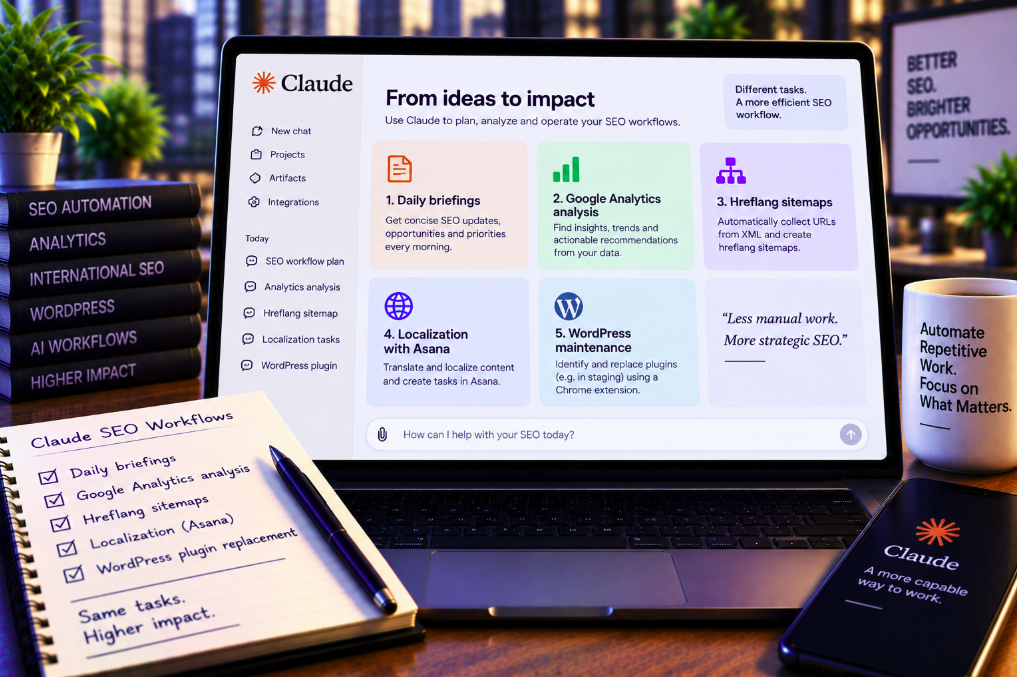
Claude is starting to look less like an SEO writing assistant and more like an operator that can move work across analytics, technical SEO, localization systems and website administration.
That shift is visible in a new Search Engine Land case study by Elmer Boutin, who describes five ways he is using Claude in everyday SEO operations: generating daily intelligence briefings, analyzing Google Analytics data, building hreflang XML sitemaps, coordinating international content localization and replacing outdated WordPress plugins through a browser-based workflow.
The examples are notable because the model is not merely producing paragraphs for a marketer to copy and paste. In several workflows, Claude retrieves information, works across tools, creates structured technical output or performs actions inside an authenticated environment. The human role shifts toward defining the task, providing examples, checking edge cases and approving the final result.
But the evidence is anecdotal. These are one practitioner’s experiences, not controlled benchmarks showing that Claude will reproduce the same speed, quality or reliability on every site.
The important change is from generation to execution
Generative AI entered many SEO teams through familiar writing tasks: outlines, title tags, summaries, keyword classifications and draft copy.
The workflows described by Boutin go further. Claude is being asked to gather data, reason about an operational task and then carry out portions of the workflow rather than simply explain what the SEO professional should do next.
That difference is the beginning of agentic SEO in practical terms.
The value is not that the model can write an hreflang sitemap tutorial. It is that, in the reported test, it could take sitemap inputs, collect the underlying URLs and produce the technical artifact for the practitioner to inspect.
Workflow one: a daily SEO intelligence briefing
The first use case is comparatively low risk but illustrates an important pattern.
Boutin configured Claude to produce a daily intelligence briefing covering subjects such as industry developments, competitor news, mergers and acquisitions. The usefulness of the output depended on giving the model a detailed description of what mattered and refining that specification over time.
This is less about replacing news reading than compressing the first pass through a large information environment.
An SEO professional can begin the day with a filtered briefing and then decide which developments deserve investigation.
The strategic judgment remains human; the repetitive collection and summarization layer becomes increasingly automated.
A useful briefing requires editorial calibration
The author’s advice is to reject generic output and train the workflow through specific feedback.
That matters because automated briefings can easily optimize for volume rather than relevance. A system that delivers 30 loosely related AI and search stories every morning may create more work rather than less.
The operational goal should be a narrow information product aligned with the company’s markets, competitors and priorities.
That principle applies to the other workflows as well: automation becomes valuable when the task definition is precise enough that the machine can distinguish useful completion from merely plausible activity.
Workflow two: asking Claude questions about Google Analytics
The second workflow connects Claude to analytics data so the practitioner can ask questions conversationally rather than manually navigating every report.
Boutin says he followed instructions shared by Rank Math for making a direct connection and found the approach substantially faster for retrieving the analysis he needed.
This is a natural extension of AI-assisted reporting.
Instead of exporting a spreadsheet, restructuring it and prompting a model with a static file, the workflow brings the analytical assistant closer to the data source.
The SEO professional can then ask for trends, comparisons or anomalies in natural language.
Conversational analytics does not eliminate validation
Speed is useful only if the interpretation is correct.
Analytics systems contain dimensions, filters, attribution choices and date comparisons that can materially change a conclusion. A model can produce a confident explanation of the wrong slice of data if the request is ambiguous or the connection is misconfigured.
For that reason, conversational analytics should preserve the ability to inspect the underlying numbers and reproduce important findings in the source platform.
Claude can reduce the mechanical work of finding patterns. It should not turn an unexplained number into an unquestioned business decision.
Workflow three: Claude builds an hreflang XML sitemap from sitemap URLs
The technical SEO example is one of the most interesting in the article.
Boutin had previously worked on an hreflang XML sitemap project using Gemini. He then gave Claude the same general challenge, supplied the latest sitemap information and asked how it would approach the task.
According to the practitioner, Claude asked only for links to the XML sitemaps. It then gathered the pages itself and built the hreflang sitemap without further intervention.
Boutin says he double-checked the result and found the first output excellent.
The model reportedly retrieved the URL inventory itself
The retrieval step is what separates this workflow from ordinary code generation.
A text model can easily produce an XML template if a user supplies every URL and language mapping. In the reported workflow, Claude used the sitemap links as the starting point and assembled the page set before producing the final sitemap.
That compresses several manual stages into one supervised task.
For international sites with large URL inventories, the time saving can be significant if the mappings are accurate.
But the practitioner’s successful test should not be interpreted as proof that autonomous hreflang generation is safe for every site architecture.
Hreflang errors are exactly the kind that require QA
International SEO contains edge cases that can make a syntactically valid sitemap operationally wrong.
Regional sites may have missing equivalents, inconsistent canonicals, redirected URLs, language-country combinations or pages intentionally unavailable in certain markets.
An automated system needs rules for all of those cases.
The author’s workflow retained an essential step: he checked the output.
That human verification is not incidental. It is the control that turns fast generation into a deployable technical artifact.
One successful comparison does not establish that Claude beats Gemini
Boutin reports that the Claude sitemap workflow required less back-and-forth than his earlier Gemini process.
That is useful practitioner evidence, but it is not a controlled model comparison.
The tools may have been used at different times, with different prompts, integrations, product capabilities or accumulated lessons from the first project.
It would therefore be misleading to convert the anecdote into a general ranking such as “Claude is better than Gemini for hreflang.”
The defensible conclusion is that Claude handled this particular workflow with less intervention in the author’s test.
Workflow four: localization becomes a multi-system operation
The international content workflow moves even further beyond text generation.
Boutin’s team supports three primary businesses across several regions, which means approved content must be adapted across websites, translated, localized and tracked through an operational pipeline.
He gave Claude examples of previously approved translation and localization work, then provided a new content item with a sequence of instructions.
Claude was asked to identify the corresponding service page on the main .com site, understand its context, check regional sites to determine whether the service was offered there, create localized versions where appropriate and generate tasks in the team’s workflow tracker.
Claude also created Asana tasks and scheduled due dates
The task did not end when the translation was generated.
The workflow instructed Claude to create tasks in Asana, space due dates according to the team’s standard formula and upload the content documents to the relevant task.
According to Boutin, Claude completed everything except uploading the document to the ticket.
That partial failure is as instructive as the successes.
Agentic workflows should be evaluated step by step rather than judged only by whether the model appeared to understand the overall assignment.
Translation quality was checked by in-country experts
Boutin says regional experts reviewed the translations and found them comparable to what the organization had been receiving from Google Translate.
Again, this is not a controlled translation benchmark.
It does demonstrate the right operational pattern: machine translation was followed by review from people with local language and market knowledge.
Localization is not simply replacing one language string with another. Product terminology, service availability, regulatory wording, cultural conventions and brand voice can all require human judgment.
The AI can accelerate the production pipeline while local expertise remains the quality gate.
The localization workflow shows why context matters more than raw translation
The strongest part of the process may not be the translation itself.
Claude was instructed to inspect the main site to understand the service, then verify whether the same offering existed on regional sites before creating localized content.
That turns a linguistic task into a business-logic task.
A conventional translation engine can translate a page that should never have been published in that market. An agentic workflow can potentially check whether the underlying service exists before producing the regional asset.
The benefit comes from connecting content generation to operational context.
Workflow five: Claude replaces a WordPress plugin in staging
The WordPress example is the clearest demonstration of Claude acting as an operator rather than an adviser.
Boutin discovered an outdated plugin with known security issues while setting up a new WordPress site. He selected a suitable replacement and considered the manual cost of making the same change across more than 20 websites.
Using Claude’s Chrome extension, he logged into a staging environment for one of the smaller sites and instructed Claude to perform the replacement.
According to the article, Claude found the locations where the old plugin was being used, swapped in the replacement and performed a quick visual check.
The first attempt was not perfect
One small discrepancy appeared during the initial replacement.
Boutin pointed it out, and Claude corrected it.
The model then offered to inspect the site for other plugin security issues and identified another plugin that was unused and no longer supported. That plugin was subsequently deactivated and deleted.
This detail is important because it shows both sides of agentic execution.
The system can discover and act on additional issues, but it can also make mistakes that require a human to notice and correct them.
The human kept control of staging, QA and production
The workflow did not give Claude unsupervised authority over the live site.
Boutin describes his hands-on process as pulling a copy of production into staging, letting Claude perform the work, visually checking the URLs that changed and then pushing the updated staging version to production.
That is a sensible division of responsibility for a potentially destructive maintenance task.
The AI performs repetitive interface work. The professional controls the environment, validates the result and decides whether it reaches users.
This distinction should not be lost in the headline claim that Claude “replaced a WordPress plugin.”
The author estimates five minutes of hands-on work instead of an hour
Boutin estimates that the supervised process required roughly five minutes of his active time per site, compared with around an hour of hands-on work if the plugin replacement were performed manually.
Across more than 20 websites, that difference would be substantial.
But it remains a practitioner estimate from a particular maintenance task.
The complexity of WordPress sites varies enormously. A plugin that controls a small visual component is not equivalent to replacing an ecommerce, caching, security or multilingual plugin with deep dependencies.
Time savings should therefore be measured on the organization’s own site portfolio rather than imported as a universal productivity benchmark.
Security-sensitive automation needs stricter controls than content automation
Replacing plugins introduces risks that do not exist when Claude drafts a briefing.
A failed content summary can waste time. A failed production change can break a site, alter tracking, expose data or create a security problem.
Teams automating WordPress maintenance should retain staging environments, current backups, least-privilege access, change logs and explicit human approval before production deployment.
The Search Engine Land example already preserves several of those controls by keeping the work in staging and requiring visual verification before publication.
That supervised architecture is more important than the choice of AI model.
Agentic SEO changes the unit of automation
The five examples reveal a broader transition in SEO automation.
Earlier tools automated isolated calculations: crawl a site, export rankings, identify broken links or generate a report. Generative AI automated isolated outputs: write a title, classify keywords or summarize data.
Agentic systems can connect multiple steps.
They can inspect a source, make a decision, create an artifact, open another system, create a task and continue until they reach a permission boundary or an error.
The unit of automation becomes the workflow rather than the individual output.
That makes process design a core SEO skill
If the model is doing more of the execution, the SEO professional needs to become better at defining the process.
Boutin recommends discussing architecture, logic and edge cases before demanding a final result. He also advises providing examples of successful outputs whenever possible.
This resembles managing a junior operator more than using a search box.
The practitioner must know what “done” means, which decisions can be delegated, what requires approval and how errors will be detected.
Poorly defined workflows can automate confusion just as efficiently as well-defined workflows automate repetitive work.
Human review becomes more valuable as the AI gains more permissions
The risk profile rises with capability.
A model that can only suggest an XML sitemap can produce a bad recommendation. A model that can edit a website can implement the bad recommendation.
That is why Search Engine Land has separately argued in “Use Claude for SEO. Don’t let Claude do SEO” that AI can accelerate research and execution while professional judgment remains necessary.
The apparent tension between that advice and the new workflow examples is actually productive.
Claude can do more SEO work without becoming the accountable SEO strategist.
Analytics, localization and CMS access also raise governance questions
Connecting an AI system to business tools is not only a productivity decision.
Organizations need to consider what data the model can access, which accounts it can act through, what permissions are necessary and how actions are audited.
An analytics connection may expose sensitive business data. An Asana integration may reveal internal projects. A browser session authenticated to WordPress can modify a public website.
The more valuable the workflow becomes, the more important access governance becomes.
Agentic SEO therefore belongs partly to security and operations, not only marketing.
The best candidates are repetitive tasks with clear acceptance criteria
The examples share an important characteristic.
Each workflow has a reasonably clear definition of success. A briefing should contain specified categories. Analytics questions should return traceable numbers. An hreflang sitemap should map known URL equivalents. Localization follows an approved template. A plugin replacement can be checked visually in staging.
Those are strong automation candidates because the human can inspect the result.
Tasks dominated by ambiguous business judgment, stakeholder politics or novel strategic tradeoffs are harder to delegate safely.
The right question is not “Can Claude do SEO?” but “Which parts of this SEO process are repetitive, observable and reversible?”
Reversibility is a useful rule for deciding what to automate
A daily briefing is highly reversible: discard it and nothing changes. An analytics interpretation is moderately reversible if the underlying data remains available. A staging plugin replacement is reversible if backups and deployment controls are intact.
Production changes without backups are not.
This suggests a practical automation ladder.
Start with low-risk tasks where errors are easy to detect and undo. Move toward higher-permission workflows only after the team has reliable prompts, validation procedures and rollback mechanisms.
Capability should expand after controls, not before them.
The anecdotes are valuable because they expose the operational details
Controlled benchmarks are useful for comparing models, but practitioner reports can reveal something benchmarks often miss: where automation actually fits into a working team.
Boutin’s examples show the messy middle of adoption.
Claude completed most but not all of the localization workflow. A WordPress replacement needed one correction. Translation quality was verified by local experts. Technical output was double-checked. Production deployment remained human-controlled.
Those details make the cases more useful than a simple claim that “AI saved time.”
They show where supervision was still required.
What the cases do not prove
The article does not establish that Claude is the best model for SEO automation, that every analytics integration will be faster, that hreflang output will always be correct or that WordPress maintenance can safely run without oversight.
It also does not provide a randomized comparison against manual work, Gemini, Google Translate or dedicated automation platforms.
The author’s reported productivity gains are tied to his own environment, expertise, prompts, integrations and websites.
Teams should treat them as workflow ideas to test rather than performance guarantees to budget around.
SEO automation is moving closer to delegated operations
The strategic significance of these examples is not that Claude can write better SEO copy.
It is that an AI assistant can increasingly move through the operational systems where SEO work happens.
It can inspect analytics, collect URL inventories, create technical files, coordinate localization tasks and manipulate a staging website through a browser interface.
That changes the productivity question from “How much content can AI generate?” to “How much repetitive execution can a supervised agent absorb?”
For experienced SEO teams, that is a much larger opportunity.
The SEO professional becomes the architect and quality gate
Boutin summarizes the model as being the strategist while letting AI be the doer.
That division captures the strongest lesson from the five workflows.
Human expertise is still required to define the objective, recognize a bad output, understand edge cases and decide when a change is safe to publish. Claude’s value appears in compressing the repetitive steps between those decisions.
In the sitemap case, the professional specified the desired architecture and verified the XML. In localization, local experts validated the language. In WordPress, the professional used staging, spotted a discrepancy and retained control of production.
Those controls are not evidence that the automation failed. They are what makes the automation usable.
Claude is moving from writing about SEO to operating parts of SEO workflows. The teams that benefit most will not be the ones that remove humans fastest, but the ones that define precisely where the machine can act—and where professional judgment must still stop it.