
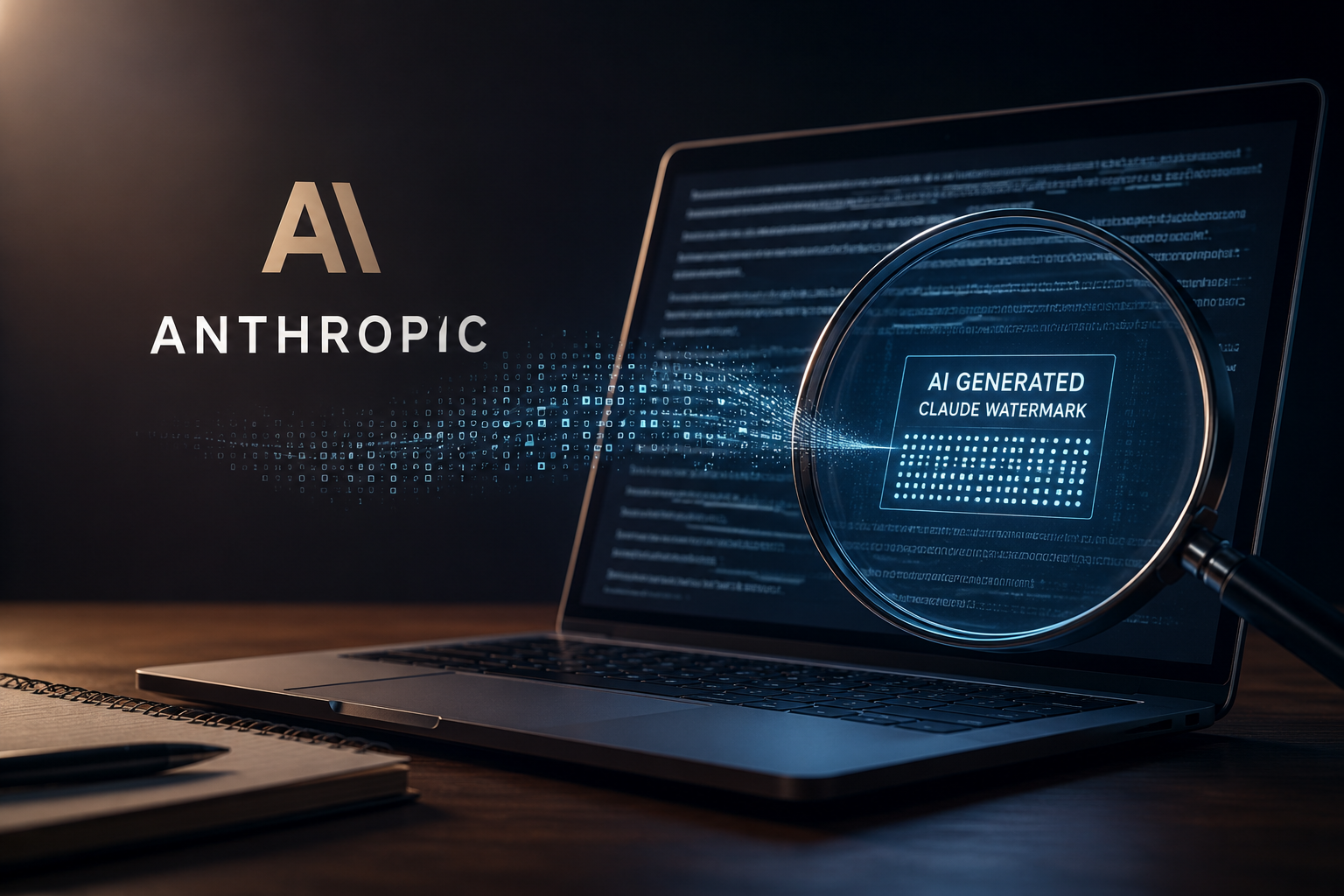
Anthropic’s decision to add machine-readable marks to Claude-generated content is easy to overread as the beginning of a new era in which search engines, publishers and clients will instantly know who wrote what. The reality is more nuanced and, for content teams, more operational than dramatic. Claude’s watermark does not make AI text visible to readers, does not add hidden characters and does not by itself tell Google whether a page deserves to rank. What it does is turn AI involvement into a detectable signal for certain parties, pushing editorial workflows closer to compliance, provenance and accountability.
In its official explainer, Anthropic says future Claude models will generate watermarked text as part of its response to the EU AI Act. The company describes the system as a statistical pattern embedded through ordinary word-choice decisions, not as metadata, invisible Unicode characters or a tag attached to the document. In practical terms, Claude still writes normal prose, but when it has several plausible ways to continue a sentence, the watermarking method nudges those choices in a way that can later be checked by someone with access to the right detection key.
That distinction matters. A machine-readable watermark is not the same thing as a public label saying “this article was written by AI.” It is also not equivalent to the commercial AI detectors that scan for stylistic fingerprints and often produce disputed results. Anthropic’s approach is closer to a cryptographic or statistical provenance signal: it can indicate that Claude was likely involved in producing or processing a piece of text, but it cannot reliably answer the editorial question readers and clients usually care about most, which is whether the piece reflects original reporting, human judgment and responsible review.
The SEO impact is indirect, but still important
For SEO teams, the most important point is that watermarking is not a ranking factor announced by Google, nor is it a magic penalty trigger. Search visibility still depends on whether a page is useful, accurate, original, well structured and aligned with user intent. A poor article does not become safer because it lacks a watermark, and a strong article does not become low quality simply because Claude helped draft or edit part of it. The watermark changes the evidence trail around production, not the intrinsic value of the content.
Where it does matter is in risk management. Agencies, publishers and in-house marketing teams increasingly need to prove how content was produced, especially in sensitive verticals such as finance, health, law, public policy and education. A client may not care whether an AI assistant helped clean up a paragraph, but they may care deeply if an entire advice article was generated without expert review. Anthropic’s own support documentation stresses that a detected mark means the content may have been processed by Claude, not that Claude was the original author, and that the absence of a mark does not prove a text is human-written. That creates a new layer of ambiguity that professional editorial teams will need to document internally rather than outsource to a detector.
The immediate SEO lesson is therefore not “avoid watermarked text.” It is “stop treating AI use as an invisible shortcut.” Content operations should record when AI is used for drafting, translation, summarization, optimization or formatting, and they should maintain a human review process that can stand on its own. If a page is challenged by a client, regulator, platform or reader, the strongest defense will not be the lack of a watermark. It will be a documented workflow showing source checks, expert review, editorial decisions and accountability.
What the watermark can and cannot prove
Anthropic’s documentation is unusually clear about the limits of the system. The watermark can survive copying and some light editing because it is embedded in the statistical pattern of the text itself, but heavy rewriting, paraphrasing, translation or mixing the passage into a larger human-written document can weaken or remove the signal. Short snippets may also be too small for reliable detection. Code is a special case because there are fewer harmless word-choice decisions in functional syntax, though comments may still carry a mark.
This means watermarking will not end the messy debate around AI authorship. It may help a regulator, newsroom, fact-checking organization or enterprise compliance team test whether Claude was probably involved, but it will not provide a complete chain of custody. A marked article could be a machine-written draft barely touched by a person, or it could be a human essay translated by Claude. An unmarked article could be entirely human, produced by a different AI system, generated by an older model, or rewritten enough to erase the signal. Treating the result as a binary judgment would be a serious category error.
That is particularly relevant for publishers worried about reputation. Readers do not object to automation in the abstract as much as they object to being misled, served generic filler or denied accountability when something is wrong. Watermarking may make undisclosed industrial-scale AI production harder to hide in some settings, but it does not replace editorial standards. In fact, it raises the bar: if AI involvement can be detected, publishers should be more precise about where AI fits into the process and where human responsibility begins.
Why Europe is forcing the issue
The timing is not accidental. The European Commission describes the EU AI Act as a framework built around risk, transparency and trustworthy AI. Its transparency rules require providers of generative AI systems to help ensure that AI-generated content is identifiable, with special attention to deepfakes and public-interest information. Anthropic says it is applying watermarking globally because it does not yet have a durable way to limit the system by region, a choice that turns a European compliance obligation into a worldwide product change.
Claude’s approach also extends beyond plain text. Anthropic says supported image and file outputs can receive signed provenance metadata using the C2PA standard, which is designed to record content credentials and detect tampering. That is a different mechanism from text watermarking: file metadata can be read by compatible tools, while text watermarking is embedded in patterns of language. For content teams working across articles, graphics, reports and social assets, the larger trend is clear. The web is moving toward provenance systems that make the production history of media more inspectable, even if the implementation remains uneven.
What content teams should change now
The practical response is not panic, but process. Publishers should define acceptable AI use by task rather than by tool: drafting, outlining, proofreading, summarizing sources, translating interviews and generating metadata all carry different levels of editorial risk. They should also separate disclosure from quality control. A disclosure policy tells readers when AI materially shaped a piece of content; a quality policy ensures the piece is accurate, useful and reviewed by accountable humans. Watermarking intersects with both, but it cannot replace either.
Agencies should also revisit client contracts and handoff documentation. If Claude is used to translate a client’s original white paper, the resulting text may carry a watermark even though the intellectual substance came from the client. If Claude rewrites a human draft for clarity, the detector may indicate Claude involvement without proving machine authorship. These scenarios should be explained before they become disputes. The safest commercial position is transparency in the workflow, not secrecy in the output.
For SEO specifically, teams should keep their focus on durable signals of quality: original analysis, first-hand experience, accurate sourcing, fresh context, expert input, clear structure and editorial usefulness. Machine-readable marks may become part of compliance audits, platform trust systems or newsroom verification workflows, but they do not solve the central challenge of AI content: too much of it is cheap, generic and detached from real knowledge. A watermark can identify probable model involvement. It cannot make thin content authoritative.
A new layer of accountability, not a new ranking apocalypse
Anthropic’s Claude watermark is best understood as part of a broader shift from AI novelty to AI governance. The industry is moving from “can this system generate content?” to “can we trace, label, evaluate and defend how that content was made?” That shift will affect SEO because SEO is no longer just about pages and keywords; it is about trust signals, editorial reputation and the ability to show that published information was produced responsibly.
The watermark will not end AI spam, and it will not settle every authorship dispute. It will, however, make invisible AI assistance a little less invisible for organizations with access to detection tools. For serious publishers, that should be seen less as a threat than as a prompt to professionalize AI workflows. The future of AI-assisted SEO will not belong to teams that learn how to hide the machine. It will belong to teams that use it openly, edit it rigorously and publish only when the final work deserves the reader’s trust.