
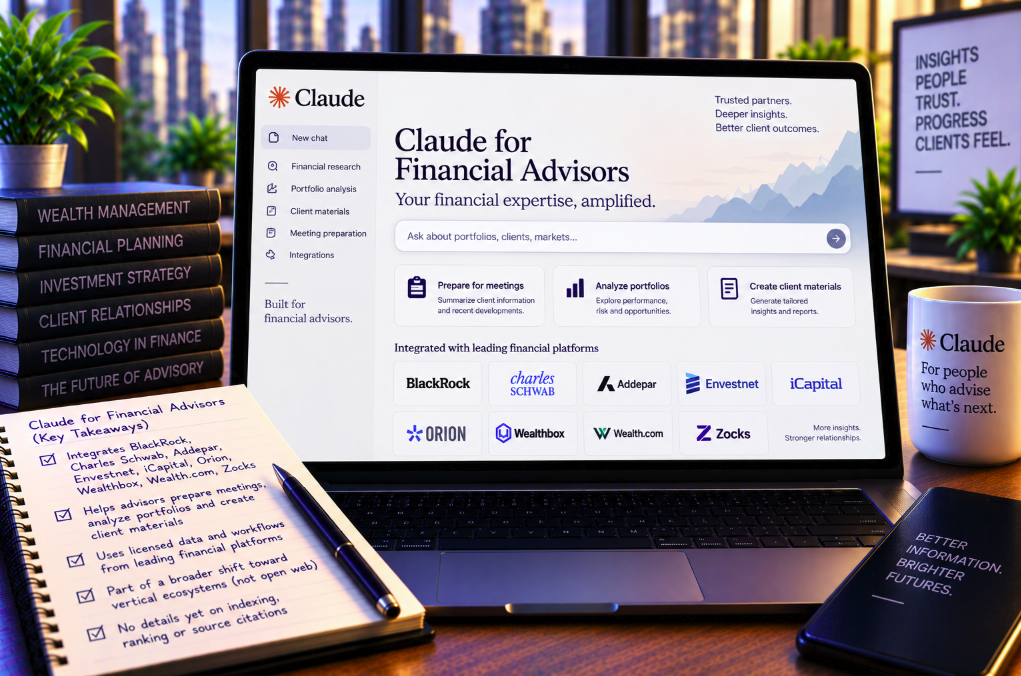
Anthropic is pushing Claude deeper into the infrastructure that financial advisers already use, connecting its AI assistant to investment analytics, portfolio systems and wealth-management software from some of the industry’s largest platforms. The move changes the financial AI visibility problem: being discoverable on the open web may matter less when the assistant can work directly with authorized data and workflows inside the adviser’s existing technology stack.
The new product, Claude for Financial Advisors, was reported by Reuters on September 14. It connects Claude with systems and data from BlackRock, Charles Schwab, Addepar, Envestnet, iCapital, Orion, Wealthbox, Wealth.com and Zocks.
Anthropic is positioning the product around practical advisory work: preparing for client meetings, reviewing portfolios and handling follow-up tasks. It extends the company’s broader financial-services push, where Claude is already being used for investment research, portfolio analysis, financial modeling and the creation of client materials.
The launch arrives only days after OpenAI introduced a specialized financial-services version of ChatGPT. Together, the products suggest that professional AI research is moving toward vertical ecosystems in which authorized databases and enterprise software can sit alongside—or sometimes ahead of—the open web as the evidence layer behind generated answers.
Claude is connecting to the wealth-management stack
The partner list is significant because it spans several parts of the adviser workflow rather than a single category of financial data.
BlackRock and Charles Schwab represent major institutional and brokerage ecosystems. Addepar, Envestnet and Orion are deeply embedded in portfolio management, reporting and adviser technology. iCapital operates in alternative investments, while Wealthbox, Wealth.com and Zocks cover areas including CRM, estate planning and adviser productivity.
Connecting Claude to those systems means an adviser can potentially bring together information that would otherwise require moving among multiple specialized applications.
The value proposition is not simply “ask Claude about markets.” It is “let Claude work with the systems that contain the information and workflows required to serve a client.”
Meeting preparation is a natural AI workflow
Financial advisers routinely assemble information before a client conversation: portfolio changes, recent market developments, planning issues, account activity and outstanding follow-up items.
That preparation is often fragmented across software platforms.
A connected AI assistant can compress the process by gathering relevant context and turning it into a usable meeting brief. The adviser can then ask follow-up questions or request client-facing material based on the same information environment.
Reuters says Claude for Financial Advisors is specifically designed to support meeting preparation, portfolio review and post-meeting work.
That workflow orientation makes the integrations more important than a generic chatbot interface.
Portfolio analysis moves the assistant closer to proprietary data
Portfolio questions often depend on information that is not available through ordinary web search.
A public search engine can retrieve market commentary, company filings and general fund information. It cannot automatically know a particular client’s holdings, allocation, tax situation, account history or firm-specific investment framework.
Those details live behind authenticated financial systems.
By connecting Claude to adviser platforms, Anthropic is moving the assistant closer to that private and permissioned context. The resulting analysis can be based on the actual portfolio environment rather than a generic description supplied manually in a prompt.
This is one reason enterprise AI retrieval is becoming structurally different from consumer search.
The open web is only one possible evidence layer
Traditional SEO assumes that a publisher earns visibility by making information crawlable, indexable and relevant on the public web.
Connected enterprise AI introduces another route.
A source can become important because it is available through an authorized platform integration rather than because its public webpage ranks for a keyword. Data inside a portfolio system, CRM or investment platform may never need to compete in a conventional search-results page at all.
That does not mean Claude has abandoned the web or that every financial answer now comes from closed systems. Reuters does not report such a change.
It means professional financial workflows can increasingly draw on a retrieval environment that extends beyond public web documents.
This is not yet evidence of an OpenAI-style hosted financial index
The distinction with OpenAI’s recent financial-services launch is important.
OpenAI has explicitly said that selected premium financial datasets in ChatGPT for Financial Services are indexed and hosted on OpenAI infrastructure, enabling faster retrieval and granular citations to specific tables and passages.
Anthropic has not publicly disclosed comparable technical details for Claude for Financial Advisors in the materials available around this launch.
There is no published explanation of whether partner information is centrally indexed by Anthropic, retrieved live through connectors, cached, federated across systems or handled through some combination of approaches.
It would therefore be inaccurate to describe the two products as technically identical simply because both connect AI to professional financial information.
Anthropic has not explained how individual sources are ranked
The unanswered retrieval questions are consequential.
If Claude can access several systems that contain overlapping information, how does it decide which one to use? Does it prioritize a primary record over an external market-data source? How does freshness affect source selection? What happens when two connected systems disagree?
Anthropic has not publicly documented those mechanics for this product.
There is likewise no disclosed ranking framework comparable to the familiar signals that SEO practitioners analyze in web search.
That makes “ranking in Claude for Financial Advisors” a premature concept. The relevant visibility mechanism may depend on connector permissions, workflow context and data availability rather than a public ranking contest.
Source-level citation behavior is also unclear
Reuters describes the integrations and workflows but does not provide a technical account of how Claude attributes individual financial claims to connected sources.
Anthropic has not published, in the material available for this launch, a specification showing whether every figure can be traced to a particular partner record, whether citations appear at the dataset level or how conflicts between sources are surfaced.
That is an important difference from OpenAI’s announcement, which explicitly emphasized granular citations within its hosted financial-data environment.
Until Anthropic documents the behavior, it is safer to say Claude can use connected financial systems than to claim a specific citation architecture.
Visibility can become a platform-access problem
For data providers, the strategic implication is larger than the unanswered technical details.
In open-web search, distribution depends heavily on crawlability and ranking. In enterprise AI, distribution can depend on whether a provider has a product integration, API relationship or customer-authorized connector into the assistant’s environment.
A dataset that is deeply integrated into an adviser workflow can become available at the exact moment the model needs it.
A competing publisher may have excellent public SEO but no equivalent path into the connected workspace.
That changes the competitive surface from pure content optimization toward platform distribution.
Partnerships can become the new form of discoverability
This does not make SEO irrelevant. Financial professionals still research public information, read news, inspect company websites and search the web.
But some of the most valuable context in advisory work is not public.
For providers serving that market, an integration can create discoverability inside a workflow where no traditional search query occurs. The adviser asks Claude a question, and the relevant system becomes part of the answer because it is connected and authorized.
That resembles software distribution more than search ranking.
The strategic questions become: Is our data available through the platforms advisers use? Can AI systems access it with appropriate permissions? Is the information structured well enough to be used reliably?
Financial software vendors can become AI source gateways
The partner list also shows why established software platforms may gain new power in the AI ecosystem.
A wealth-management platform already sits between advisers and large amounts of client or market information. Once connected to a generative assistant, that platform can become a gateway through which the model accesses domain-specific context.
The value of the software then extends beyond its own user interface.
Its data and workflows can potentially surface inside an AI conversation, allowing the adviser to interact with the platform indirectly through Claude.
For software vendors, being AI-accessible may become as important as having a polished standalone application.
Private context is where generic web search is weakest
The logic behind vertical connectors is straightforward.
Open-web search is powerful when the question concerns public information. It becomes insufficient when the user asks, “Which of my clients are most exposed to this market move?” or “What changed in this household’s portfolio since our last meeting?”
Those questions require private records and organizational context.
An AI assistant that can securely access authorized enterprise systems has a structural advantage over one restricted to public pages.
Financial advisory is therefore an ideal environment for the transition from web-grounded answers toward workspace-grounded answers.
Generated client materials raise the stakes for provenance
Reuters says Anthropic’s broader financial work includes preparing client materials, and the new adviser product is designed to support follow-up workflows.
Once AI-generated analysis moves from an internal conversation into a client-facing document, source reliability becomes more important.
An adviser needs to know whether a portfolio figure came from the portfolio-management system, whether a planning detail came from the CRM and whether market information reflects current data.
The absence of publicly documented source-ranking and citation mechanics does not mean those controls do not exist inside the product. It means outside observers currently cannot evaluate them in detail.
For financial institutions, those implementation questions are likely to be central to deployment and governance.
Permissioning may matter more than crawlability
Public search engines generally start with a question of access: can the crawler reach the page?
Enterprise financial AI starts with a different question: is the user authorized to access the underlying system and data?
That distinction changes the optimization problem.
A provider may want its information to be highly available to authorized customers while remaining completely inaccessible to public crawlers. The ideal distribution mechanism is therefore a controlled connector, not an SEO-friendly webpage.
In vertical AI, permissioning can become a prerequisite for retrieval.
The financial AI market is splitting by professional workflow
Anthropic and OpenAI are entering financial services from different starting points.
OpenAI’s recent product initially targets investment banking and equity research, with tools for research, modeling and presentation creation. Anthropic’s latest offering focuses specifically on financial advisers and wealth-management workflows.
That segmentation is revealing.
Instead of one generic financial chatbot serving everyone, AI companies can build specialized retrieval and workflow environments for bankers, researchers, advisers, asset managers and other professional groups.
Each vertical can have its own data partners, software connectors, permissions and output requirements.
There may be no single “financial ranking” inside AI
This fragmentation makes traditional ranking language increasingly inadequate.
A publisher might be highly visible in consumer ChatGPT web search, absent from an investment-banking workspace and irrelevant inside an adviser workflow connected to private portfolio systems.
Those are not contradictory rankings. They are different information environments.
Visibility depends on which corpus, connector set and permissions are active for the task.
For SEO and GEO teams, the implication is that measuring a brand across generic prompts may reveal only one layer of AI discovery.
Open-web authority can still matter at the edges
Vertical connectors do not eliminate the need for public information.
Advisers still need current news, company announcements, regulatory developments, market commentary and specialized research that may live on the web.
Public sources can provide context that a portfolio-management system does not contain.
The likely future is therefore hybrid rather than closed: private enterprise records, licensed or connected professional data and public web information can all contribute to an answer depending on the task.
The competitive question is which source layer becomes authoritative for each type of claim.
Data structure becomes part of AI distribution strategy
As assistants connect directly to business software, providers need to think about machine usability beyond HTML pages.
APIs, normalized identifiers, timestamps, permissions, structured records and reliable metadata become important because the assistant needs to retrieve information programmatically and interpret it correctly.
A beautifully optimized public article may be ideal for web discovery but poorly suited to a portfolio calculation. A structured holdings record may be invisible to Google yet indispensable to an adviser’s Claude workflow.
Different content types therefore require different distribution strategies.
Platform relationships may become a new moat
For established financial technology companies, integration into a major AI assistant can deepen customer lock-in.
If advisers rely on Claude to work across their existing systems, the connected platforms become part of the AI workflow rather than standalone destinations that users must remember to open.
That can make integration breadth strategically valuable.
For smaller data providers, however, the same trend can create a distribution challenge. If AI workflows privilege a set of integrated platforms, companies outside that ecosystem may struggle to become visible even if their public information is strong.
The competitive moat moves partly from search authority to platform access.
Anthropic’s missing technical details are worth watching
The next important disclosures will concern architecture rather than partner count.
Does Claude retrieve partner information live or maintain indexes? How are competing sources prioritized? Can users inspect the exact origin of portfolio figures? What citation format appears in client-facing work? How are stale records handled? Which data remains inside partner systems and which information is processed by Anthropic?
Those questions will determine whether Claude for Financial Advisors functions primarily as an orchestration layer over external tools or develops into a more deeply indexed vertical knowledge system.
Reuters confirms the integrations and intended workflows, but the current public record does not answer those questions.
Financial AI is moving from search to embedded retrieval
The broader direction is already visible even without those technical details.
Professional AI assistants are being embedded into ecosystems where the most valuable information is licensed, private or operational rather than publicly crawlable.
OpenAI has explicitly built hosted financial-data indexes for its financial-services product. Anthropic is connecting Claude to the wealth-management platforms advisers already use. The implementations differ, but both reduce the assumption that professional AI research begins with an open-web search.
For users, the benefit is contextual relevance. For financial platforms, the opportunity is becoming a native source inside the assistant. For publishers and SEO teams, the challenge is that public search visibility may no longer be enough to participate in every high-value answer.
AI visibility is becoming an ecosystem question
Claude for Financial Advisors illustrates a fundamental change in what “being visible to AI” can mean.
On the open web, visibility is largely earned through publishing, technical accessibility, authority and relevance. Inside a permissioned professional workspace, visibility can depend on integration, customer entitlement and platform partnership.
Anthropic has not yet disclosed how its new adviser product indexes, ranks or cites the individual connected sources, so it would be premature to describe a closed Anthropic financial index or a deterministic partner-ranking system.
What is clear is that Claude can now operate across a network of major wealth-management tools while helping advisers prepare meetings, analyze portfolios and produce client work.
That makes the next generation of financial search less like a contest among webpages and more like an orchestration problem across authorized systems. For companies that want to become sources in those answers, SEO may remain useful—but increasingly, the decisive question could be whether the platform is connected at all.