
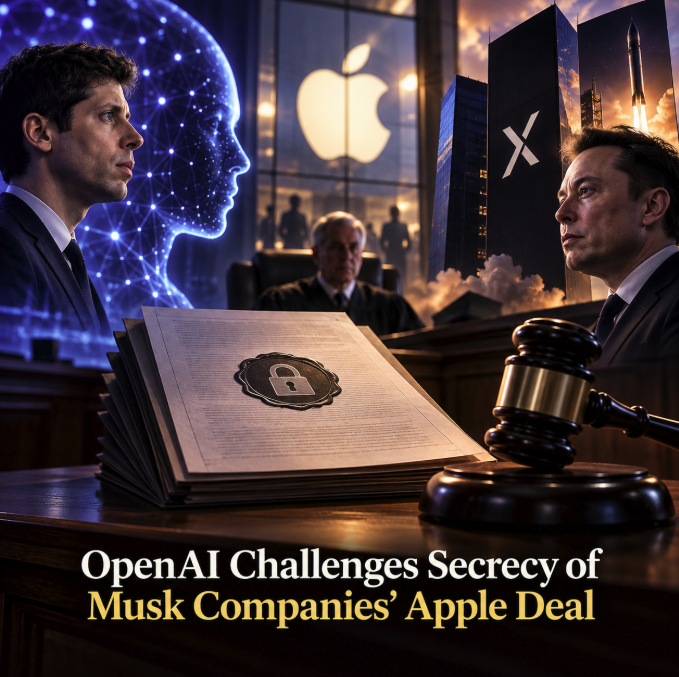
A confidential settlement between Apple and companies controlled by Elon Musk has become the latest point of contention in the long-running legal battle over competition in artificial intelligence. OpenAI is seeking access to the terms of the agreement, arguing that what Apple agreed with Musk’s companies could matter to its defense against antitrust claims that remain active even after Apple exited the dispute.
The development follows a federal judge’s order requiring X Corp. and SpaceXAI to disclose the agreement to OpenAI. Reuters reported that OpenAI requested the material after Musk’s companies resolved their claims against Apple while continuing their case against the ChatGPT maker. The unusual procedural fight illustrates how a settlement involving one defendant can remain significant when litigation continues against another.
Apple is out of the case, but OpenAI is not
Musk’s companies had accused Apple and OpenAI of engaging in anticompetitive conduct tied to the distribution of generative AI services on the iPhone. The dispute centered in part on Apple’s integration of ChatGPT into its operating system, which the plaintiffs argued gave OpenAI an unfair advantage and limited competition from rival chatbot providers.
Earlier this week, X and SpaceXAI agreed to end their claims against Apple. CPI reported that the terms of that resolution were not publicly disclosed. A related PYMNTS report noted that the claims against OpenAI were not part of the settlement, leaving the AI company to continue defending itself against allegations that it used anticompetitive conduct to preserve its position in the chatbot market.
That split is what makes the settlement potentially important. If Musk’s companies resolved allegations against Apple that overlap with the theory of liability they continue to pursue against OpenAI, the remaining defendant has an obvious interest in understanding the terms and rationale behind that agreement. OpenAI has argued that the information could assist its defense.
The dispute is now about what the settlement can reveal
Settlement agreements in commercial litigation are frequently confidential, particularly when large companies want to resolve a dispute without public disclosure of financial payments, business commitments or other negotiated terms. Confidentiality between the settling parties, however, does not automatically mean that the information is irrelevant to another defendant still involved in the underlying litigation.
The court’s decision to require disclosure does not necessarily mean that the agreement will become public. Sensitive litigation material can be exchanged under protective orders that limit who may see it and how it can be used. The immediate issue is therefore access within the lawsuit rather than wholesale publication of the settlement.
For OpenAI, the agreement could potentially provide context about how the plaintiffs viewed Apple’s role in the alleged conduct, what claims were relinquished and whether any commitments affect the continuing allegations against OpenAI. The precise significance cannot be determined until the terms are known, and a settlement itself does not establish that either side’s underlying legal claims were correct.
The case reflects a larger fight over AI distribution
The lawsuit also highlights how competition in generative AI increasingly depends on distribution rather than model quality alone. Smartphone operating systems, app stores, browsers and cloud platforms can place an AI assistant directly in front of enormous user populations. Partnerships between AI developers and platform owners therefore have competitive implications that extend beyond the technical capabilities of the models themselves.
Apple announced its integration with OpenAI in 2024, bringing ChatGPT into parts of the Apple Intelligence experience while allowing users to decide whether to send certain requests to the service. Musk publicly criticized the arrangement from the beginning. The later antitrust litigation transformed that commercial disagreement into a legal argument about whether the partnership unlawfully disadvantaged competing AI providers.
The broader question is likely to remain relevant even beyond this particular case. As AI assistants become embedded in operating systems and consumer devices, regulators and courts will increasingly have to distinguish ordinary partnerships from arrangements that improperly foreclose competitors. The answer will depend on market structure, contractual terms, user choice and the practical ability of rival services to reach customers.
Musk and OpenAI remain entangled in multiple legal disputes
The Apple-related case is only one front in a much larger legal conflict involving Musk and OpenAI. The two sides have fought over OpenAI’s corporate structure, Musk’s early involvement with the organization and allegations concerning confidential information and competitive conduct. Separate litigation involving xAI and OpenAI has also moved through federal appellate proceedings.
The overlapping cases make individual procedural developments more consequential because evidence produced in one dispute can influence arguments in another. OpenAI has previously accused Musk’s companies of failing to preserve relevant communications, while Musk and his companies have pursued claims against OpenAI in multiple forums. Each side disputes significant parts of the other’s account.
Against that backdrop, the confidential Apple settlement is more than an administrative detail. It potentially provides OpenAI with information about how its adversaries resolved claims against a company that was originally accused alongside it, and the court has now concluded that OpenAI should be allowed to examine those terms for purposes of its defense.
A settlement can close one case while opening another question
Apple’s agreement with Musk’s companies removed one major technology company from the antitrust fight, but it did not end the underlying dispute over competition in AI. Instead, it created a new discovery question: whether the remaining defendant is entitled to know what was exchanged or promised when its former co-defendant settled.
The court’s disclosure order gives OpenAI an opportunity to examine that answer, although confidentiality protections may keep much of the agreement away from public view. What happens next will depend on whether the settlement contains information that materially affects OpenAI’s defense and how the surviving antitrust claims develop. For an industry increasingly shaped by alliances between AI laboratories and dominant technology platforms, the litigation is also a reminder that the contracts behind those alliances can become as important as the models themselves.