
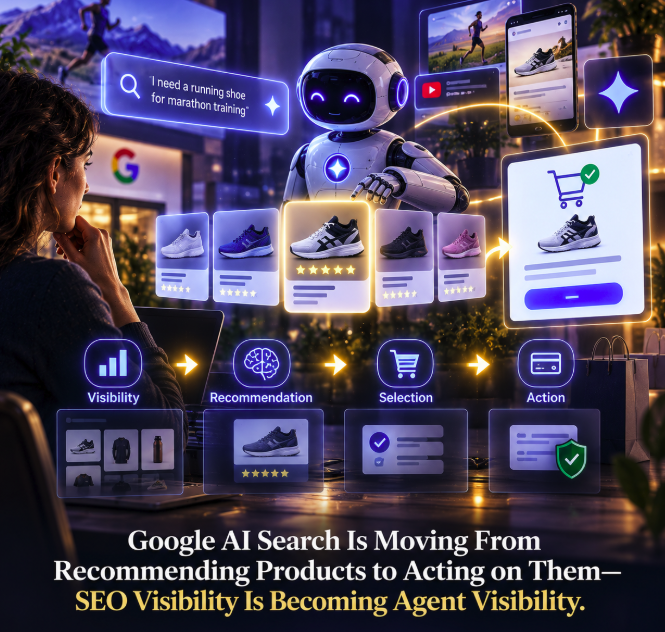
Google's search-to-shopping pipeline is moving beyond product recommendations and into execution. A new set of agentic commerce updates announced on September 16 gives merchants more visibility into how their products perform inside AI experiences, expands conversational shopping assistance and strengthens the infrastructure that can move a shopper from discovery to checkout without following the conventional search-to-website path.
The update, detailed by Search Engine Land, brings together several initiatives Google has been building throughout 2026: AI performance measurement in Merchant Center, Business Agent, richer product attributes and the Universal Commerce Protocol, or UCP. Taken together, they point toward a new ecommerce funnel: visibility, recommendation, selection and action.
For SEO teams, that progression matters because the optimization target is changing. A product that ranks well but cannot be confidently interpreted, compared or transacted by an AI agent may be less competitive in a search environment where software increasingly participates in the buying decision. Search visibility is beginning to overlap with what might be called agent visibility: the ability to enter an AI system's consideration set and remain usable all the way through the transaction.
Merchant Center can now measure AI visibility
Google's AI performance insights in Merchant Center are now generally available to businesses in Australia, Canada, India, New Zealand and the United States, according to Search Engine Land. The feature allows merchants to compare their share of visibility with similar brands across Google AI experiences, including AI Mode and AI Overviews.
This is an important measurement shift. Ecommerce teams have traditionally evaluated organic rankings, Shopping impressions, paid placements, clicks and conversions. AI-mediated discovery introduces another layer before the click: whether the brand and its products are represented at all when Google's models synthesize options for a shopper.
Google had previewed these capabilities earlier in the year. In its Google Marketing Live commerce announcement, the company described AI performance insights as a way for retailers to understand how their brand is performing across AI-powered surfaces and compare its share of visibility with similar brands.
The implication is straightforward. If Google is giving merchants a dedicated measurement layer for AI visibility, appearing inside generative shopping experiences is becoming a distinct performance surface rather than merely a side effect of conventional search rankings.
Business Agent is moving from Search into YouTube ads
Google is also expanding Business Agent, its conversational shopping assistant for retailers. Eligible U.S. merchants are being invited to a beta that embeds Business Agent directly into YouTube ads, allowing viewers to ask detailed product questions without leaving the video experience.
This compresses stages of the shopping journey that previously happened across separate surfaces. A user can discover a product in a video, ask questions about fit, features or suitability and continue evaluating it inside the same interface. The merchant's product information therefore needs to support not only a visual advertisement but a live conversational layer capable of answering follow-up questions.
For marketers, this illustrates why AI-era product optimization cannot be reduced to keywords. Agents and conversational interfaces need attributes that describe what a product actually is, who it is for, how it differs from alternatives and under which constraints it should be recommended.
UCP is turning recommendation into transaction
The most consequential development sits further down the funnel. Google is expanding the capabilities available through the Universal Commerce Protocol integration hub in Merchant Center. UCP is designed as a standardized framework through which AI agents, retailers and commerce platforms can interact across the shopping journey.
Merchants using UCP-powered checkout can now enable cart transfers to their own sites and access improved checkout-flow testing, with analytics and additional capabilities planned. The technology is gradually rolling out in the United States, with Australia and Canada expected to follow in early 2027.
Google has been explicit about the broader goal. When it introduced UCP in January, the company described it as an open protocol spanning discovery, buying and post-purchase support. In May, Google expanded that architecture with Universal Cart, a shopping cart designed to work across retailers and Google services including Search and Gemini. Google's latest UCP roadmap positions checkout as a native part of the AI shopping experience rather than something that necessarily begins after a referral to a merchant website.
Coach and Kate Spade show what the new funnel looks like
The shift is no longer theoretical. On September 16, Tapestry announced that products from Coach and Kate Spade can now be purchased directly through Google Search, including AI Mode, and the Gemini app in the United States. According to Tapestry's announcement, shoppers can complete a single-item purchase through Google Pay in a few taps without being redirected to the retailer's website, with each transaction requiring explicit consumer approval.
That creates a concrete example of the new journey. A shopper can ask an AI system for help, encounter a product during the recommendation process, select it and proceed to purchase while remaining inside Google's interface. The merchant remains the merchant of record, but the discovery and transactional experience can increasingly be mediated by the AI platform.
This is the point at which conventional search metrics become insufficient. A website session may no longer be required for search visibility to produce a sale. Conversely, a merchant could lose opportunities before a website visit ever becomes possible if its product information does not make the item eligible for recommendation or agentic checkout.
Product feeds are becoming machine decision infrastructure
For all the attention on agents and protocols, Google continues to emphasize something familiar: product data. Search Engine Land reports that Google says merchants following its core Merchant Center feed best practices see an average 5% increase in conversions the following month. Google also says that during testing with Lululemon, conversational attributes supplied by the retailer were incorporated 50% of the time in relevant product recommendations in AI Mode.
Those figures are Google-reported results rather than guarantees for other merchants, but the direction is important. Product feeds are evolving from distribution files used primarily to populate Shopping listings into structured knowledge sources that AI systems can use to reason about products.
That raises the value of attributes that help answer natural-language questions. Color and size remain necessary, but AI shoppers may also ask whether a jacket works in heavy rain, whether a suitcase fits a particular airline's cabin rules or whether a running shoe is appropriate for a specific training goal. The more precisely product data represents those characteristics, the more material an AI system has when deciding which item fits the request.
Loyalty data can influence the offer an AI sees
Google is also connecting loyalty-program information to Merchant Center so eligible shoppers can see member-specific prices and benefits. Search Engine Land cites Minted as an example, with members of its Minted More program able to see their pricing while searching for holiday cards.
This adds another dimension to agentic selection. The “best” product is not necessarily determined by public list price alone. An agent acting for a known customer may need to account for loyalty status, personalized offers, delivery constraints and other context before determining which option represents the best fit.
As these systems mature, merchant competitiveness may increasingly depend on how much accurate commercial context can be exposed safely and appropriately to the agent. Static product pages were built primarily for people. Agentic commerce requires a machine-readable representation of the offer itself.
Visibility → recommendation → selection → action
Google's September update arrives on the same day Search Engine Land published a new three-pillar GEO framework built around LLM readability, brand context and agentic commerce. The two developments fit together unusually well.
The first challenge is visibility: can the system retrieve and understand the product? The second is recommendation: does the AI have enough context and confidence to present the brand as a suitable option? The third is selection: can the system determine that a particular product satisfies the user's constraints? The final stage is action: does the infrastructure allow the agent and user to move from that decision into checkout?
Traditional ecommerce SEO concentrated heavily on the first stage because ranking created the opportunity for the user to handle the rest. Agentic commerce redistributes some of that work. The AI system can participate in comparison and selection, while protocols such as UCP allow the transaction to begin inside the same environment.
Agent visibility is becoming a new ecommerce objective
This does not mean ecommerce sites or conventional SEO suddenly stop mattering. Google's Shopping Graph, Merchant Center feeds, structured website information, brand authority and product content remain part of the information environment that makes these experiences possible. What changes is the endpoint marketers optimize toward.
Ranking for “best running shoes” is useful if it produces visibility. But in an agentic environment, a merchant also wants its products to be understood when the user asks for a shoe for marathon training under a particular budget, recommended among the available options, selected when the constraints match and technically available when the user tells the agent to buy.
That is a much deeper form of visibility. It requires search optimization, product-data quality, brand context, inventory accuracy, commerce infrastructure and transactional compatibility to work together. A weakness at any stage can remove the product from the journey before the shopper ever encounters the merchant's website.
SEO teams will need metrics beyond rankings and clicks
Google's new Merchant Center reporting gives marketers an early indication of what those metrics may look like. AI share of voice, recommendation presence, product eligibility, conversational attribute coverage and agent-assisted conversions could become increasingly important alongside rankings, impressions, CTR and revenue.
Attribution will also become harder. If an AI assistant researches several sources, recommends a product and completes a transaction through a standardized commerce layer, the familiar sequence of organic result, website session and conversion may disappear. Search can still influence the sale even when analytics never records a traditional organic visit.
This is one reason agent visibility deserves to be treated as an extension of SEO rather than merely another advertising format. The underlying competition is still about being discovered when a user expresses intent. The difference is that the intermediary interpreting that intent is becoming capable of doing substantially more than ranking links.
Google is building the path from answer engine to commerce agent
Google's agentic commerce updates are incremental when viewed individually: a new visibility report, a YouTube beta, better UCP tooling, richer attributes and loyalty integration. Together they form infrastructure for a much larger shift. Search and Gemini are becoming environments where an AI can help identify a need, narrow the market, answer product questions and participate in completing the purchase.
For ecommerce marketers, the strategic question is therefore moving beyond “Can Google find my product?” The emerging questions are whether Google's AI understands the product, whether it considers the brand relevant, whether the offer survives comparison against the user's constraints and whether an agent can act on the selection. In that environment, SEO visibility does not disappear. It expands into agent visibility — and the path from discovery to revenue increasingly depends on being usable by the machine making the shortlist.