
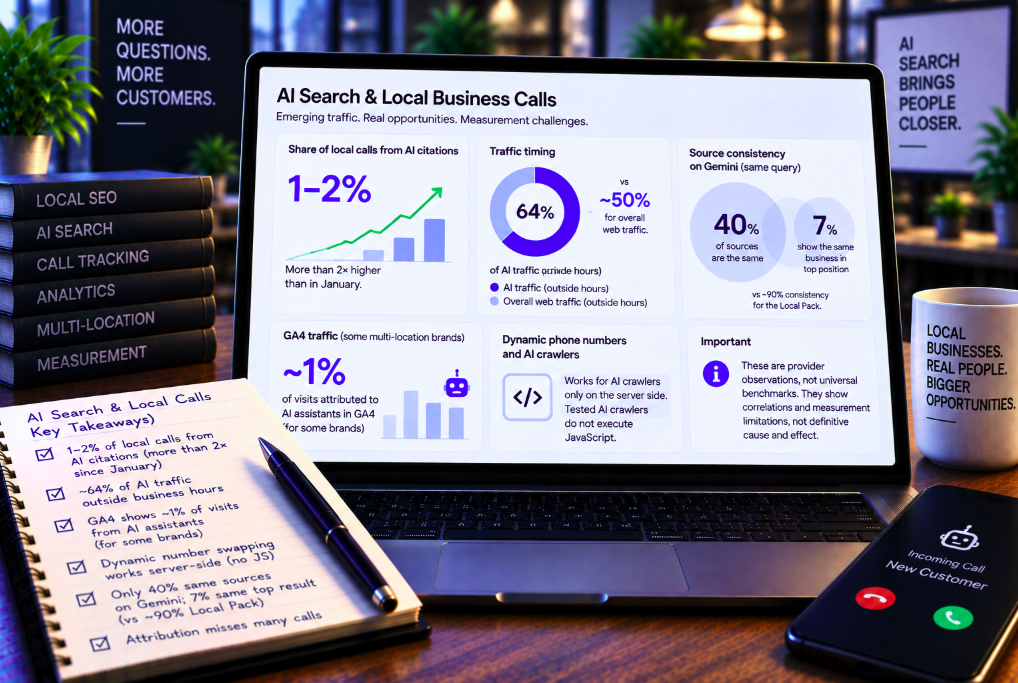
AI search may still look small in local lead reports, but the visible numbers can understate how often it influences a customer before the phone rings. Provider observations reported by Search Engine Journal suggest AI citations are already associated with roughly 1–2% of local calls in some measured environments, while some multi-location brands see around 1% of GA4 visits attributed directly to AI assistants.
The more important story is attribution. A customer can ask an AI assistant for a local recommendation, remember the business name, search for that brand on Google and then call. Analytics may credit branded organic search. Another customer can copy or tap a phone number surfaced directly by an AI answer without ever creating a website session. In both cases, AI may have shaped the decision while disappearing from conventional acquisition reports.
The September 14 Search Engine Journal report, drawing on observations from CallRail and local-search practitioners, highlights just how difficult this emerging channel is to measure. It also surfaces an equally important warning: the figures are vendor observations with incomplete public samples, not universal benchmarks for local search.
The 1–2% local-call figure is not CallRail’s cross-industry average
One denominator needs to be kept clear. The reported 1–2% share relates to local AI-citation call observations discussed in the Search Engine Journal account. CallRail’s broader public call index shows a much smaller direct-attribution rate across its large cross-industry dataset.
In CallRail’s continuing analysis of tens of millions of inbound calls, AI-attributed calls represented 0.073% of all inbound calls in November 2025. The figure rose to 0.104% in April 2026, 0.121% in May and 0.115% in June. June remained 58.2% above November despite a slight month-over-month decline.
CallRail’s January report based on nearly 20 million inbound leads similarly described AI search as a small but measurable source of calls, with ChatGPT dominating the directly attributed AI volume at the time.
The difference between a broad 0.1%-range aggregate and 1–2% in particular local observations is exactly why these numbers should not be generalized without their denominators.
Direct attribution captures only the easiest AI journeys
The cleanest measurement path is straightforward: a user clicks from ChatGPT, Perplexity, Gemini or another identifiable AI source to a business website, then calls through a trackable number during that session.
That journey leaves a referrer and can often be connected to the call.
Local discovery frequently does not work that way. AI assistants can provide business names, addresses, opening hours and phone numbers directly. The user may have enough information to act without clicking the cited website.
Once that happens, browser-based attribution loses much of its visibility into the journey.
A branded Google search can hide the AI touchpoint
Consider a customer who asks an assistant, “Who is a good emergency plumber near me?” The AI recommends a company. Instead of clicking the citation, the user opens Google and searches the company’s name to verify reviews, hours or directions.
GA4 may see a branded organic visit from Google. Search Console may record the branded query. The business may conclude that traditional search generated the lead.
But the initial discovery happened inside the AI assistant.
This is a classic assisted-conversion problem made more difficult because the first interaction can occur inside an environment that sends no website event at all.
Direct phone calls create an even darker attribution gap
Local search is unusually vulnerable to this problem because the desired conversion is often a phone call rather than a website transaction.
If an AI assistant provides a business number and the user dials it directly, the website never participates in the journey. There is no landing page, UTM parameter or browser referrer for analytics to capture.
CallRail has explicitly described this as an attribution challenge. In its own guidance, the company notes that AI-driven calls can otherwise end up reported as “direct” or “other,” leaving the originating influence uncredited.
That makes direct AI referral reports a lower bound on influence rather than a complete map of AI-assisted local discovery.
Some multi-location brands already see around 1% of visits from AI assistants
The Search Engine Journal report says some multi-location brands are seeing approximately 1% of GA4 visits attributed to AI assistants.
Again, that is not a universal traffic benchmark. It is an observed level among specific brands.
The number is still useful because it shows that AI traffic has moved beyond theoretical visibility into measurable website sessions for local operators.
For a large multi-location business, 1% of traffic can represent a meaningful volume of users. More importantly, it captures only sessions with detectable AI attribution and therefore excludes some assisted journeys that later appear under other channels.
AI-driven traffic appears unusually active outside business hours
Another provider observation concerns timing. Nearly two-thirds of measured AI traffic reportedly arrived outside normal business hours, compared with roughly half of overall web traffic.
If that pattern holds for a particular business, it has operational consequences.
A customer asking an AI assistant for a dentist, attorney, HVAC contractor or other local provider at night may be close to acting but unable to reach a staffed phone line. The value of AI visibility therefore depends partly on what happens after discovery.
Businesses seeing significant after-hours AI demand should examine missed-call rates, voicemail handling, online booking and follow-up speed rather than treating visibility as the endpoint.
The after-hours figure should not become a universal consumer rule
The reported timing difference is interesting, but the underlying public sample is not detailed enough to conclude that two-thirds of all AI local searches happen after hours.
Industry mix can strongly affect time-of-day behavior. Emergency services, healthcare, legal and travel queries may naturally occur outside conventional office schedules. The definition of “business hours” can also differ by location.
The actionable use of the finding is local measurement: segment AI-referred sessions and calls by hour for the individual business, then compare them with the rest of the acquisition mix.
That is more defensible than applying the provider average as a planning assumption.
Dynamic number insertion runs into an AI crawler problem
Call tracking often relies on dynamic number insertion. A website loads a script that replaces the standard phone number with a tracking number associated with the visitor’s source or session.
That approach works well for human browsers executing JavaScript.
According to the provider testing described by Search Engine Journal, the AI crawlers examined did not execute the JavaScript required for client-side number swapping. If a business wants the crawler itself to receive a dynamically selected phone number, the substitution has to happen on the server before the HTML is delivered.
This is a technical measurement constraint, not evidence that every AI crawler on the web behaves identically. Crawler capabilities can change, and different providers may fetch pages differently.
Server-side phone swapping needs careful governance
Moving dynamic number insertion to the server can solve one measurement problem while creating others if implemented carelessly.
A local business depends on consistent phone information across its website, Google Business Profile, directories, structured data and other trusted sources. Serving materially different contact information to different automated systems can introduce ambiguity.
Tracking numbers therefore need stable forwarding, appropriate persistence and a clear canonical business identity. The goal is attribution without making the underlying business information unreliable.
Server-side implementation should be treated as infrastructure work, not as a quick crawler trick.
Gemini’s local answers appear far less stable than the Local Pack in provider tests
The most striking observation in the Search Engine Journal report concerns repeatability.
When practitioners repeated the same local research on Gemini, only about 40% of the cited sources overlapped between runs. Even more dramatically, only around 7% of repetitions returned the same business in the first position.
For comparison, the conventional Google Local Pack reportedly returned the same top business around 90% of the time in the provider’s comparison.
Those figures suggest a major difference between deterministic-looking local rankings and generative recommendation systems. But they remain practitioner observations, not official Google measurements or a fully published benchmark dataset.
Prompt drift makes a single AI visibility check unreliable
If the same question produces a different business recommendation on the next run, checking a prompt once provides weak evidence about sustained visibility.
This is one of the central measurement problems in AI search.
Generative systems can vary outputs because of model sampling, changing retrieval results, personalization, location interpretation, freshness and system updates. Even identical prompts can produce different citations and recommendations.
Local brands therefore need repeated observations over time. Visibility should be expressed as a frequency or share across runs, not simply “we rank number one in Gemini.”
Source stability and business stability are different
The reported 40% source overlap and 7% top-business consistency also reveal two distinct layers of volatility.
An AI assistant can change the sources it cites while still recommending the same company. Or it can retrieve similar sources but reach a different recommendation.
Those outcomes require different diagnoses. Source instability concerns the retrieval and evidence layer. Business instability concerns the final recommendation.
A useful local AI monitoring system should therefore record both: which businesses appear and which sources support them.
Traditional rank tracking does not map cleanly to generative local search
The Local Pack encourages a familiar SEO model: positions one, two and three can be tracked repeatedly for a defined keyword and location.
Generative local recommendations are less orderly.
The assistant may name three businesses in one run, five in another, provide a narrative comparison in a third and change its preferred option based on subtle prompt wording. It can also retrieve different evidence each time.
A single ordinal rank therefore captures less of the experience than it does in a conventional local pack.
Frequency of mention, recommendation rate, citation source, sentiment and conversion evidence become complementary metrics.
Local AI visibility can influence leads without producing an AI referral
This is the core attribution challenge behind the entire dataset.
A business can gain value from AI search even when GA4 reports no AI session and the call-tracking platform sees no AI referrer.
The assistant may create awareness. The user can later navigate directly, search the brand, open Maps, ask a friend or call a number saved from the answer.
In marketing terms, AI can function as an upstream discovery touchpoint whose downstream conversion is credited elsewhere.
That makes last-click attribution especially fragile for local businesses.
Self-reported attribution becomes more useful in an AI journey
One way to recover some of that missing context is simply to ask.
CallRail has invested in self-reported attribution that analyzes how customers say they found a business. A caller who says “ChatGPT recommended you” can reveal an AI influence that browser analytics missed entirely.
Human-reported attribution is imperfect. Customers forget, simplify or misremember their journey.
But when combined with referrer data, call tracking and branded-search patterns, it can illuminate channels that otherwise disappear into direct or organic traffic.
AI search makes that blended measurement approach more valuable because the discovery experience often occurs away from the merchant’s own website.
Branded-search growth can be a supporting signal, not proof
If AI assistants repeatedly recommend a company, branded search demand could increase as users verify the recommendation through Google.
That does not mean every increase in branded searches came from AI. Advertising, PR, offline marketing, social media and word of mouth can create the same pattern.
Still, marketers can compare AI visibility trends with branded query trends and look for temporal relationships.
The evidence becomes stronger when customers also self-report AI discovery or when call transcripts mention an assistant by name.
No single signal is definitive; triangulation is the more credible approach.
Call quality matters more than call share
Even CallRail’s broad dataset shows why the small percentage should not automatically be dismissed.
The company has repeatedly characterized AI-driven callers as high-intent users who can move quickly from recommendation to contact. That is a vendor interpretation of its data and customer behavior, not a universal guarantee that AI calls convert better in every industry.
Local marketers should therefore compare lead quality rather than merely count calls.
Useful measures include qualified-call rate, booked appointments, sales, revenue, call duration and first-contact resolution.
A 0.5% channel producing unusually valuable customers can matter more than a 5% channel producing low-intent inquiries.
AI attribution needs to connect visibility with outcomes
The emerging local AI measurement stack has at least four layers.
First is visibility: how often does the business appear across repeated prompts? Second is evidence: which sources and business data support those appearances? Third is traffic and contact: do users click, call or search the brand afterward? Fourth is outcome: do those contacts become qualified leads and customers?
Optimizing only the first layer risks building a dashboard disconnected from revenue.
Conversely, looking only at directly attributed AI calls can hide upstream influence.
The goal is to connect the layers without pretending the attribution chain is more complete than it is.
Multi-location brands have an especially difficult measurement problem
A company with hundreds of locations can be recommended at the brand level, the location level or both.
The user may ask for “the best urgent care near me,” receive one branch, search the parent brand, then navigate through a location finder and call a different branch.
Traditional analytics can split that journey across multiple sessions and acquisition labels.
For these brands, location identifiers, call tracking, CRM integration and consistent business data become essential for understanding whether AI discovery produces incremental demand.
The reported roughly 1% GA4 AI traffic among some multi-location brands is therefore only one visible slice of a more complicated path.
Local SEO fundamentals still feed the AI evidence layer
Measurement may be new, but much of the underlying information is familiar.
AI systems making local recommendations need evidence about what a business does, where it operates, when it is open and whether it is credible. Websites, business profiles, directories, reviews, authoritative third-party mentions and structured information all contribute to that ecosystem.
The volatility of generative recommendations does not make data consistency less important. It makes it more important because the system may retrieve different sources on different runs.
A business whose core facts agree across sources gives the model fewer contradictory signals to reconcile.
The 1–2% figure should be treated as an early signal, not a forecast
The temptation with emerging channels is to turn every observed percentage into a market benchmark.
The available evidence does not support that here.
CallRail’s broad public dataset puts directly attributed AI calls around one-tenth of one percent across all industries in recent months, while the local-provider observations reported by Search Engine Journal reach roughly 1–2% in narrower contexts. Some multi-location brands report around 1% of GA4 traffic from AI assistants.
Different industries, tracking methods, customer behaviors and denominators can produce very different numbers.
The common signal is growth and measurable influence—not a single universal share.
AI search is creating a measurement problem before it becomes a traffic giant
The most consequential insight may be that attribution is already breaking before AI becomes a dominant direct-referral channel.
Customers can discover businesses in an assistant and convert somewhere else. Calls can bypass the website. Branded searches can inherit credit. Client-side tracking may be invisible to crawlers. And repeated prompts can produce different recommendations and sources.
That makes AI search simultaneously small in last-click reports and potentially larger in assisted influence.
For local marketers, the response should not be to inflate the numbers. It should be to improve measurement: repeat prompt testing, preserve source-level evidence, track calls, analyze transcripts, connect CRM outcomes, watch branded demand and ask customers how they found the business.
AI search may currently account for only a small visible slice of local calls. The harder question is how much of the rest is already being shaped by an AI recommendation that conventional analytics never sees.