
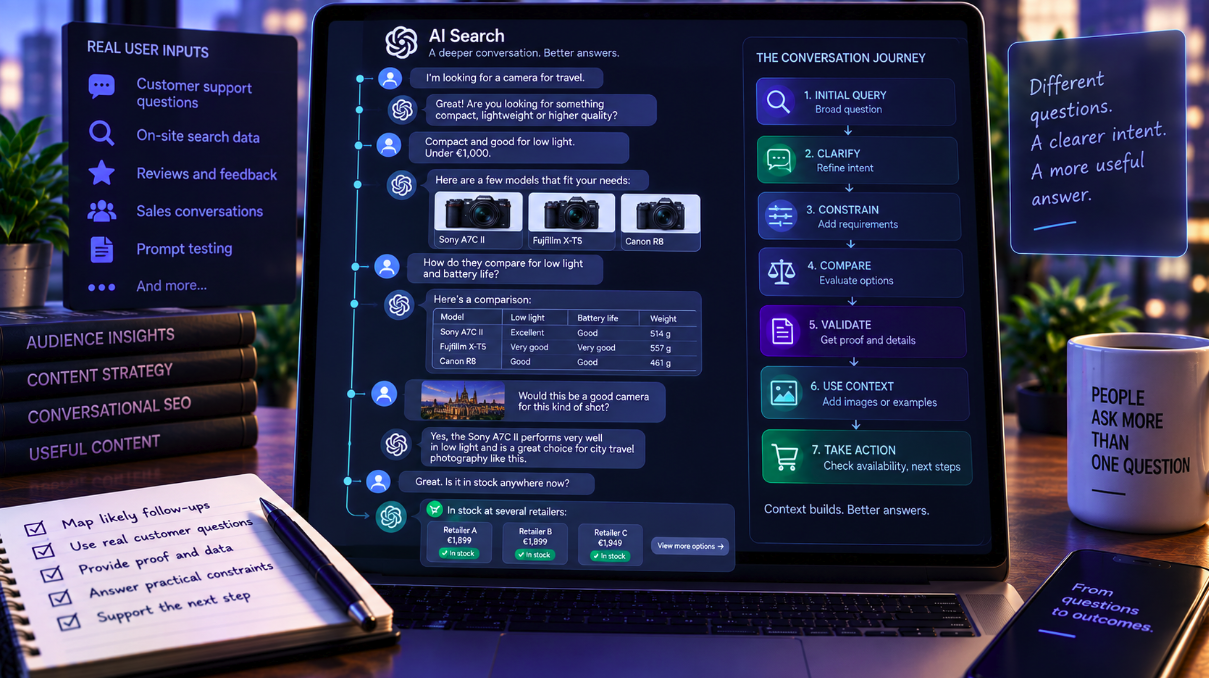
The most commercially revealing search may no longer be the phrase that starts the journey.
In an AI conversation, a user can begin with a broad question, add a budget constraint, request a comparison, upload an image, challenge the evidence and finally ask what is available to buy or book. The initial prompt identifies the subject. The follow-up questions reveal what the person actually needs.
That is the central argument in Louisa Frahm’s September 15 Search Engine Land guide to conversational search. The article proposes expanding SEO strategy from optimizing isolated keywords and landing pages toward supporting the entire sequence of questions, evidence and actions that can unfold inside a contextual interface.
This is a strategic framework, not a new controlled experiment measuring the performance of conversational SEO. Its value lies in reorganizing familiar SEO, content, UX and customer-research practices around a search journey whose context no longer resets after every query.
The first query is increasingly only the opening move
Traditional keyword research tends to treat a query as a self-contained expression of intent.
A user searches “best carry-on luggage,” the SEO team estimates demand, analyzes the SERP and builds or improves a page designed to satisfy that phrase and related variants.
Conversational interfaces change the unit of analysis.
The next question might be “I need a laptop sleeve and I fly budget airlines.” The user could then upload a photograph and ask whether a specific bag will fit. After that comes a comparison under a defined budget, followed by a delivery deadline.
None of those turns makes complete sense without the context accumulated before it.
Context is what makes a follow-up query different
People have always refined searches.
A user who searched “running shoes” could manually reformulate the query as “women’s stability running shoes for flat feet.” The person carried the context mentally while the search engine received a new string.
Conversational search lets the interface carry more of that context.
A follow-up such as “What about one under $200?” can work because the system remembers what “one” refers to. The user no longer needs to reconstruct the full keyword phrase every time the need changes.
That makes the visible follow-up shorter while potentially making its underlying intent richer.
The most valuable query may be invisible to conventional keyword logic
This creates a gap for keyword tools.
A phrase such as “what about Friday?” has almost no standalone SEO meaning. Inside a conversation about hotel availability, event tickets or product delivery, it can represent the moment when research turns into a transaction.
Conventional keyword datasets can still reveal important demand, but they cannot always reconstruct the context that gives a conversational follow-up its value.
The headline should not be interpreted literally as meaning every follow-up is invisible to every tool. Search Console, first-party logs and specialized AI-monitoring systems can expose portions of this behavior. The strategic point is that a contextual turn may not exist as a meaningful independent keyword at all.
Intent can change without starting a new search
Frahm identifies evolving intent as one of the defining characteristics of conversational search.
A user can begin in learning mode, move into comparison and finish with an action inside one interaction.
That collapses stages that marketers often separate into informational, commercial and transactional keyword buckets.
The system does not need the user to open a fresh tab and type a bottom-of-funnel query. The conversation itself can move down the funnel as new information changes the decision.
SEO therefore needs to understand transitions between intents, not only the intent attached to the first phrase.
The format can change in the middle of the journey
Conversational search is also multimodal.
The user can type a question, speak the next one, upload a photograph, inspect a map, compare a table and then interact with current product or availability data.
That means the best answer asset can change from turn to turn.
A paragraph may explain the concept. A table may handle comparison. A photograph may prove fit or scale. A video may demonstrate movement. A calculator may answer a personalized constraint. A product feed may supply the current price or inventory needed to act.
The conversation is not merely a longer piece of text.
Google’s AI Mode makes the shift explicit
Google has built follow-up behavior directly into AI Mode.
Its original AI Mode announcement described an experience for complex questions, comparisons and reasoning in which users can continue with follow-up questions and supporting web links.
Google also says AI Mode can use query fan-out, issuing multiple related searches across subtopics and data sources to construct an answer.
That means even the first visible prompt can generate several invisible retrieval queries before the user asks a follow-up.
One visible prompt can already represent many searches
Google’s Search Central documentation explains that AI Overviews and AI Mode may use query fan-out to retrieve supporting information across related subtopics.
A lawn-care question, for example, can require evidence about treatment, prevention, timing, climate, cost and safety.
The visible keyword therefore does not define every retrieval opportunity.
A page can become useful because it answers one component of the generated research plan even when its wording does not closely mirror the user’s original prompt.
Follow-up questions add another layer because each turn can alter what the system needs to retrieve next.
Google now lets AI Overviews flow directly into a conversation
The boundary between an answer and a conversation has also weakened.
In January 2026, Google made follow-up questions from AI Overviews flow into AI Mode, preserving the context of the initial search as the user continues exploring.
That product design makes the SEO implication concrete.
A page may contribute to the initial AI Overview, a later comparison, a validation question or the action-oriented part of the conversation. Visibility is no longer necessarily tied to one stable SERP generated from one stable query.
Start conversation mapping with real audience behavior
The Search Engine Land framework does not recommend brainstorming thousands of hypothetical prompts with an LLM and publishing a page for each one.
Instead, it starts with evidence about the audience.
Useful inputs include support tickets, customer-service conversations, sales calls, internal site searches, reviews, community discussions, expert interviews, search data and prompt testing.
These sources reveal the questions people ask after the obvious question has already been answered.
They are particularly valuable because follow-ups often expose objections and constraints that keyword volume hides.
Customer support may contain better follow-ups than a keyword database
Support teams hear questions from people who already know the basics.
Customers ask whether a product works with a specific configuration, what happens when a process fails, whether an exception applies, how to interpret a policy or which option fits an unusual circumstance.
Those questions can represent precisely the later-stage informational needs that conversational systems encourage users to ask.
Mining support transcripts therefore becomes a form of conversational search research.
The objective is not to copy every support ticket into an FAQ. It is to identify recurring decision branches that deserve better public information.
Internal search reveals what the existing content failed to make obvious
On-site search is another high-value source.
When visitors reach a website and immediately search again, they are revealing a gap between the information they arrived with and the information they still need.
Those queries can expose missing comparisons, unclear policies, compatibility questions, local availability, pricing details or terminology the company does not use internally.
In a conversational SEO framework, internal search is not only a website-UX dataset. It is evidence about likely next turns after discovery.
Reviews reveal the criteria people use to decide
Reviews are especially useful because customers naturally describe tradeoffs.
They mention what surprised them, which feature mattered, what failed, what alternative they considered and which circumstances changed their opinion.
Those details can become follow-up categories.
If buyers repeatedly discuss battery life under a particular workload, a generic product specification may not be enough. If hotel guests repeatedly ask about late arrival, the relevant conversational need is not “hotel check-in” in the abstract but what happens under a specific constraint.
Reviews show which constraints deserve evidence.
AI can suggest questions, but humans should validate them
Prompt testing has a role in conversation mapping, but Frahm gives it an important boundary.
AI can generate plausible follow-up questions. That does not prove real users care about them.
Human behavior should determine which branches matter.
This prevents a common GEO failure mode in which teams create enormous prompt lists because an LLM can imagine them, then mistake synthetic possibility for market demand.
The strongest conversation maps combine AI exploration with first-party evidence from actual customers and users.
Map five basic types of follow-up
The framework proposes a simple way to begin.
For one important audience need, map follow-ups that clarify, constrain, compare, validate and act.
A clarification asks what something means. A constraint introduces a budget, deadline, location, compatibility requirement or other boundary. A comparison evaluates alternatives. A validation turn asks for proof. An action turn asks what to buy, book, do or ask next.
These categories turn a vague “optimize for conversations” ambition into a practical content-planning exercise.
Clarification is the first branch
A user may understand the initial answer only partially.
Terms need definitions. Recommendations need explanation. A process may contain a step that assumes knowledge the user does not have.
Content should therefore make important concepts easy to clarify without forcing the user to leave the subject entirely.
Clear definitions, descriptive headings and contextual internal links can support both retrieval systems and human readers when the conversation moves from “what” to “what does that mean for me?”
Constraints reveal the real problem
The initial query often describes an idealized need.
The follow-up introduces reality.
The budget is smaller. The house is older. The trip is shorter. The product must arrive by Friday. The customer lives in a region with different rules. The device needs to work with an existing system.
Constraint questions are strategically valuable because they reveal why a generic answer is insufficient.
Content that clearly states applicability, limitations and exceptions can remain useful deeper into the conversation.
Comparison turns information into a decision
Once users understand the options, they need tradeoffs.
Comparison content should therefore do more than repeat specifications in two columns.
It should explain when each option is better, what evidence supports the distinction and which conditions could change the recommendation.
This is where firsthand testing, expert analysis and transparent methodology become especially valuable.
An AI system can summarize generic features easily. Distinctive evidence gives both the system and the user something more defensible to work with.
Validation is where trust enters the conversation
A skeptical follow-up may be more valuable than a positive one.
“How do you know?” “What is the source?” “Was this tested?” “Is that still current?” These questions indicate that the user is close enough to the decision to demand proof.
Frahm recommends making key claims easy to verify by stating the answer clearly and then providing the relevant source, date, methodology, conditions and limitations.
That improves usefulness regardless of whether an AI system ultimately cites the page.
Action is where SEO meets operations
The final conversational turn may have little to do with traditional editorial content.
The user wants current availability, a price, an appointment, a booking, a delivery estimate or the next step in a form.
At that point, stale operational data can erase the value created by excellent content.
Search Engine Land argues that product feeds, inventory, policies, local data and conversion paths increasingly belong inside the discoverability conversation because AI interfaces are moving closer to task completion.
A great article cannot compensate for a broken booking flow.
Google’s agentic direction reinforces the action layer
Google has already demonstrated agentic capabilities in AI Mode for tasks such as tickets, restaurant reservations, local appointments and shopping.
The company’s I/O description of AI Mode showed Search using query fan-out to inspect options, pricing and inventory before helping the user move toward a transaction.
That does not mean every AI conversation is transactional.
It does mean SEO teams can no longer assume that the search journey ends when the information has been explained.
Images can become follow-up inputs, not just result assets
Multimodal search creates another kind of conversational branch.
A user can upload an image and ask whether a product fits, what an object is or how to solve a visible problem.
Google’s multimodal AI Mode documentation describes visual query fan-out that analyzes an image and runs multiple searches about the objects and context it contains.
That means visual content should be treated as evidence and utility rather than decoration.
Clear angles, close-ups, labels, demonstrations and captions can answer questions that prose cannot.
Build topic systems, not hundreds of prompt pages
The rise of conversational search does not justify mass-producing a landing page for every possible follow-up.
Frahm explicitly recommends the opposite.
Build a strong hub around the main decision and support it with a limited set of resources that serve genuinely different needs: a comparison, checklist, firsthand case study, visual demonstration, calculator, tool or current product and policy page.
The task should determine whether a follow-up needs a new page, a section, a reusable component or no new content at all.
Minor wording variation is not a content strategy.
Internal links should follow the user’s next question
Site architecture often reflects how a company is organized.
Conversational architecture should also reflect how a user thinks.
An article explaining a product category should naturally lead toward comparison, compatibility, risks or availability if those are common next questions.
Descriptive anchors such as “compare plans” or “check compatibility” tell the user what the next resource will accomplish more clearly than a generic “learn more.”
Internal linking becomes part of the decision journey rather than merely a crawl-distribution technique.
The page needs to offer something the AI summary cannot replace
When an AI answer already explains the basics, a click requires a stronger reason.
That reason might be original testing, a dataset, methodology, calculator, interactive tool, community, primary document or live availability.
Generic explanatory prose is easy to summarize.
Distinctive evidence and utility are harder to substitute because the user may need to inspect or interact with the source directly.
Conversational SEO therefore increases the value of assets that help someone verify, decide or act.
Evidence should be designed for skeptical follow-ups
A useful editorial test is to ask what proof a skeptical reader would require.
“This laptop has all-day battery life” is easy to repeat but difficult to evaluate.
A statement explaining that the device lasted a specific number of hours under a documented test condition, with caveats about heavier workloads, is more useful because the claim has boundaries.
Clear methodology gives search systems structured evidence to assess and gives humans a reason to trust or challenge the conclusion intelligently.
Freshness matters more as conversations move toward action
Some follow-ups depend on stable knowledge. Others decay quickly.
A product specification may remain valid for months. Inventory can change by the minute. A local policy can change by date. A price may vary by location or customer status.
Content systems need to distinguish between facts that can live in editorial copy and facts that should come from maintained operational data.
Conversational search increases the penalty for mixing them carelessly because the user can move from general research to a time-sensitive decision without leaving the interface.
Technical SEO fundamentals still determine whether answers can be retrieved
The framework does not replace conventional SEO.
Important information still needs to be crawlable and indexable. Canonical URLs, descriptive internal links, accessible mobile experiences and structured data that matches visible content remain relevant.
Google’s official generative-AI optimization guidance says there is no special AI markup required for AI Overviews or AI Mode.
From Google’s perspective, optimizing for its generative Search experiences remains an extension of good Search optimization rather than a separate technical trick.
Keep important information in text even when richer formats exist
A video can demonstrate a repair better than prose, but the essential facts should not become inaccessible to retrieval systems or users who cannot consume the video.
Likewise, a graphic can make a comparison easier to understand while captions and surrounding text explain what the visual proves.
Frahm recommends designing simultaneously for retrieval and reading.
The best asset may be multimodal, but its important information should remain understandable and accessible across interfaces.
Multilingual conversation maps need native-language judgment
Translation alone may not reveal how follow-up intent changes across markets.
People express uncertainty, constraints and purchase concerns differently across languages and cultures.
The guide recommends testing important journeys with native-language experts who understand regional phrasing and moments when users switch languages during an exchange.
That matters increasingly as AI interfaces become capable of carrying context across multilingual conversations.
A global conversation map should therefore be localized, not merely translated.
Owned experiences need to continue the conversation rather than restart it
When someone clicks from an AI answer, they may already know the introductory information on the landing page.
Sending that visitor back to a generic top-of-funnel explanation wastes the context that motivated the click.
The site should provide the next layer quickly: comparison after overview, calculator after explanation, methodology after summary, availability after recommendation or booking steps after local advice.
On-site search and chat can reinforce that continuity by preserving useful context and providing escalation when automation reaches its limits.
Privacy becomes part of conversational UX
Context preservation has a boundary.
A helpful interface should remember enough to prevent needless repetition, but it should not retain every personal detail simply because the technology can.
Frahm recommends clear consent, limited retention and an obvious path to human support where sensitive information is involved.
Conversational optimization is therefore not only about making the next answer more relevant. It also requires deciding which context should not be carried forward.
Conversational search is a cross-functional problem
SEO cannot supply every answer branch alone.
Subject-matter experts provide proof. Product and UX teams build useful paths. Support and sales teams know the objections. Ecommerce and operations maintain inventory, pricing and policies. Legal and privacy teams define boundaries. Analytics teams connect discovery to outcomes.
The strongest conversation journey crosses those organizational lines.
If every team optimizes only its own surface, the user can receive a coherent AI answer and then hit a fragmented business experience.
Measurement needs to move beyond one ranking position
A conversational journey cannot be summarized by asking where one URL ranks for one keyword.
Teams need to know whether they cover the important branches of the decision, whether AI systems represent their facts accurately, whether authoritative sources are cited, whether users can reach a useful next action and whether those journeys contribute to business outcomes.
No single metric captures all of that.
Traditional rankings and traffic remain useful, but they become components of a larger scorecard rather than a complete measurement system.
Do not confuse conversation mapping with predicting every prompt
The number of possible conversational turns is effectively unlimited.
Trying to enumerate them all would create a content-production trap.
The framework instead looks for recurring decision structures.
People clarify, constrain, compare, validate and act across many topics. Real customer evidence reveals which of those branches matter most for a specific business.
The objective is resilience across likely needs, not perfect coverage of every sentence a user might type.
The keyword still matters—it just no longer defines the whole assignment
Keyword research remains one of the best available ways to understand explicit search demand.
It can identify topics, terminology, seasonality and commercial interest at scale.
Conversational SEO adds another question: what happens after that need is partially satisfied?
The answer may live in customer-support transcripts, reviews, inventory systems, product images or sales objections rather than a keyword database.
The practical change is to combine those sources instead of replacing one with another.
The next SEO opportunity may arrive after the answer
The central insight from Search Engine Land’s framework is that conversational interfaces preserve the part of the search journey that traditional keyword models often discard: what the user asks once they know more.
That follow-up can reveal the budget, risk, deadline, evidence requirement, visual context or operational constraint that actually determines the decision.
Optimizing for that journey does not require a page for every prompt or a new AI-specific markup system.
It requires better audience research, stronger evidence, connected content, useful visuals, accurate operational data and a clear next action.
The first keyword may still earn visibility. The follow-up question increasingly reveals whether the brand can remain useful long enough to earn trust and action.