
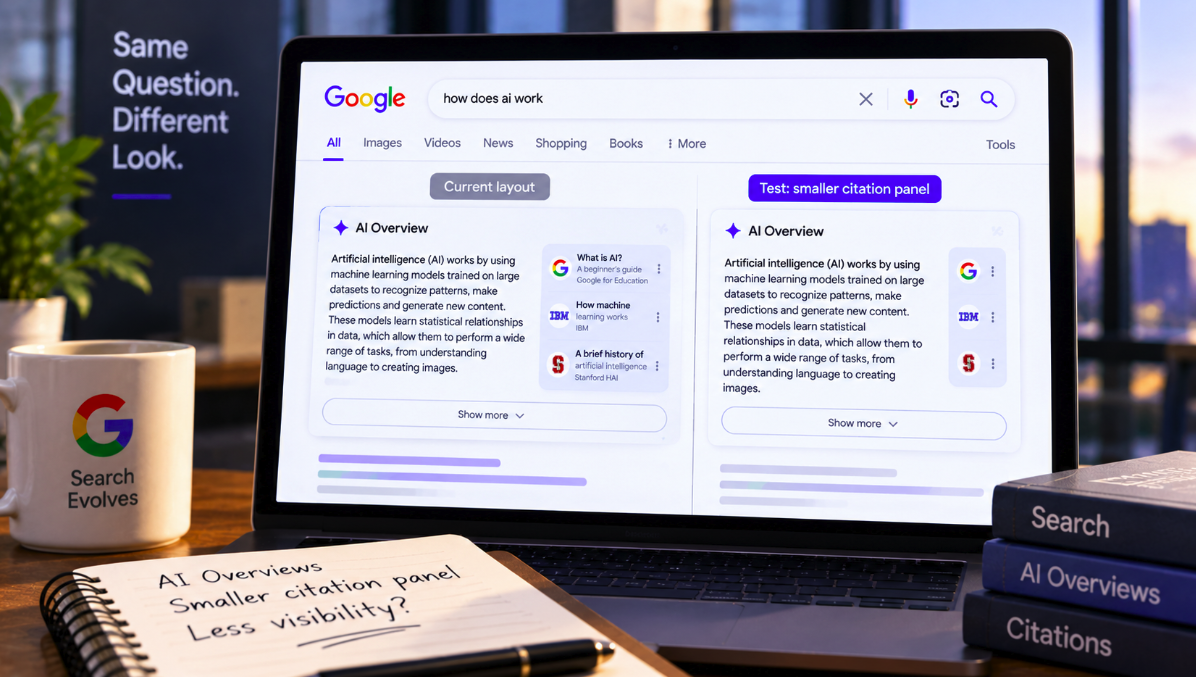
Google is testing another redesign of the links that connect AI-generated answers back to the websites that supplied their supporting information. This time, the citation area is getting smaller.
A new AI Overview experiment uses a noticeably thinner panel for citations on the right side of the generated answer, according to Search Engine Roundtable. The format was first spotted by Khushal Bherwani, and Barry Schwartz reports that he was able to replicate the test himself.
The change is visually modest but strategically important. In AI Overviews, publishers are already competing with a generated answer that can satisfy much of the user’s information need before a click occurs. Reducing the space devoted to sources could make those links less prominent relative to the answer itself.
That does not yet mean the experiment reduces publisher traffic. No click-through-rate data for this specific test has been published, and Google has not announced a broad rollout. What can be observed is narrower: Google is experimenting with a citation interface that gives source cards less horizontal space.
The answer stays prominent while the source panel gets thinner
The tested layout preserves the basic structure familiar from desktop AI Overviews. Google presents a generated response in the main area and places supporting sources beside it. In the new variation, however, the citation panel occupies substantially less width.
That changes the visual balance of the module. A source card has less room for a recognizable title, description and other contextual information that might persuade a user to open the underlying page.
Interface design matters because users do not evaluate every element on a search page equally. Size, position, contrast and descriptive context all influence which elements receive attention.
A citation can technically remain present while becoming less noticeable.
Presence and prominence are different metrics
This distinction is increasingly important for publishers measuring AI Search visibility.
A website can be cited in an AI Overview and therefore count as a successful citation in an SEO monitoring tool. But that metric says nothing about how prominently Google displayed the citation, whether the user noticed it or whether it generated a visit.
If citation interfaces continue to vary, marketers may need to separate three different questions: was the page used as a source, how visible was that source to the searcher, and did the citation produce a click?
Those outcomes are related, but they are not interchangeable.
The thinner-panel test makes the difference easy to understand. A publisher could retain exactly the same citation count while receiving a different amount of visual exposure because Google changed the interface around those citations.
Google has been repeatedly experimenting with citation design
The smaller panel is not an isolated experiment. Google has spent much of the AI Overview era testing how source links should appear around generated answers.
Previous experiments reported by Search Engine Roundtable have included hiding citation controls from the default view, moving citation cards below the AI-generated response, keeping citations visible as users scroll and displaying large blocks of sources beneath the answer. More recently, Google has tested mobile citation cards presented as a sliding carousel.
The direction has not been consistently toward either more or less publisher visibility. Some designs make sources harder to reach, while others make them more persistent or visually prominent.
That suggests Google is still searching for the right balance between a clean generative interface and meaningful access to the web pages supporting the answer.
AI Overviews create a unique attribution problem
Traditional Google results make the publisher’s page the primary object of the interface. A headline, URL and snippet describe the destination, and the user clicks the result to consume the information.
AI Overviews reverse that relationship.
The generated answer becomes the primary information object. Publisher links become supporting evidence around it.
That structural change matters even before any particular citation redesign is tested. If the answer itself resolves the question, the user needs a separate reason to open the source. The citation card therefore has to do more than establish attribution; it also has to create enough curiosity or value to justify another click.
A smaller card has less visual territory in which to perform that job.
There is no evidence yet that the test reduces clicks
The temptation is to translate “smaller citation panel” directly into “less publisher traffic.” The available evidence does not support that conclusion yet.
Search Engine Roundtable notes that the thinner design may make citations less noticeable and raises the possibility of fewer clicks, but this is an interpretation of the interface rather than measured user behavior.
A compact panel could theoretically perform similarly if users already understand the citation controls. It could even improve interaction if the cleaner design makes the relevant source easier to identify. Without controlled click data, those possibilities remain unresolved.
The correct editorial conclusion is therefore about visibility, not traffic: Google is testing a layout in which sources receive less screen space.
Publishers still lack enough AI Overview performance detail
The experiment also highlights a broader analytics problem. Publishers can observe AI Overviews and monitor whether their pages appear as citations, but they have limited ability to isolate the effect of individual citation designs on their own traffic.
A Search Console performance change could reflect many factors at once: ranking changes, query demand, AI Overview prevalence, citation inclusion, interface experiments or user behavior.
Without granular reporting that separates these variables, publishers can see the outcome but struggle to identify which product change caused it.
That makes interface tests particularly difficult to evaluate from outside Google. A visually obvious redesign may affect millions of interactions without producing a clean metric that publishers can independently attribute to that redesign.
Source visibility is becoming part of SEO performance
For years, SEO teams treated SERP features as modifiers of ranking visibility. Featured snippets, knowledge panels, image packs and local results could all alter how much attention a conventional organic position received.
AI Overviews push that concept further because the generated response can occupy a large amount of screen space while directly synthesizing information from multiple sources.
Being cited therefore does not necessarily resemble ranking first in a traditional search result.
A publisher may be one of several sources supporting an answer. Its card may appear first, later in the panel or behind another interaction. The card itself may be wide, narrow, persistent, hidden or moved to another part of the interface depending on the experiment Google is running.
SEO visibility increasingly includes the presentation of the citation, not merely its existence.
Google is simultaneously experimenting with ways to highlight preferred publishers
The thinner citation test also sits alongside other Google efforts that can increase the prominence of selected sources.
Google’s Preferred Sources documentation says publishers chosen by users as preferred sources can be highlighted in AI Overviews and AI Mode where those features are available.
That creates an interesting tension in the product. Google is testing more compact general citation presentation while also developing mechanisms that can visually distinguish publishers users explicitly choose to prioritize.
The two approaches are not necessarily contradictory. Google may be trying to reduce interface clutter while making a smaller subset of personally relevant sources more recognizable.
For publishers, however, it reinforces the importance of brand demand. If users can influence which sources receive additional emphasis, being a publication people deliberately recognize and select becomes more valuable.
Smaller citations could increase the gap between citation value and traffic value
The SEO industry is increasingly measuring AI citations as an outcome in their own right. That makes sense because citations reveal which sources an AI system considers useful enough to surface.
But citation value and traffic value can diverge.
A source may influence millions of generated answers while receiving relatively few visits. Another may be cited less frequently but receive more clicks because its brand, headline or presentation makes users want the original material.
Changes to citation UI can widen or narrow that gap without changing the underlying source selection.
This is why AI visibility dashboards should avoid implying that every citation has equal commercial value. Citation frequency is one measurement layer. User exposure and downstream behavior are others.
The test matters most for informational publishers
The potential consequences are particularly relevant for sites whose value historically depended on users clicking through to read explanatory information.
An ecommerce result can still give users a reason to leave Google because a transaction must happen somewhere. A hotel or restaurant result can lead to a booking. A software service can lead to a signup.
Informational publishers face a different challenge. If Google summarizes the relevant facts directly in an AI Overview, visiting the source can become optional.
For those sites, the citation panel is not merely attribution. It may be one of the few remaining interface elements capable of converting their contribution to the answer into an actual visit.
Its design therefore deserves scrutiny even when the change appears small.
This is a test, not a new permanent AI Overview format
As with other Google Search experiments, the thinner citation panel should not be treated as a confirmed redesign for all users.
Schwartz was able to reproduce it, which makes the observation stronger than an isolated screenshot, but Google routinely runs interface tests that never become permanent products.
The company could widen the panel again, alter card contents, combine this design with another citation treatment or abandon the experiment entirely.
SEO teams should therefore monitor the change rather than redesign reporting assumptions around it immediately.
The useful signal is that citation presentation remains unsettled.
The battle for AI Search traffic increasingly happens in the interface
The smaller-panel experiment illustrates why the future of publisher traffic cannot be understood only through ranking systems and citation selection.
Google controls a second layer after deciding which sources support an AI Overview: how those sources are presented to the user.
A publisher can do everything required to become a trusted source and still depend on the interface to turn that source status into a visit.
That makes citation design a consequential part of AI Search economics. Width, placement, labels and interaction patterns can influence the distance between being credited and being clicked.
Google’s latest test does not prove that publishers will receive less traffic. It does show that the company is willing to experiment with giving their citations less visual space.
In a search experience where the AI answer is already competing with the original source for the user’s attention, even a thinner panel is worth watching.