
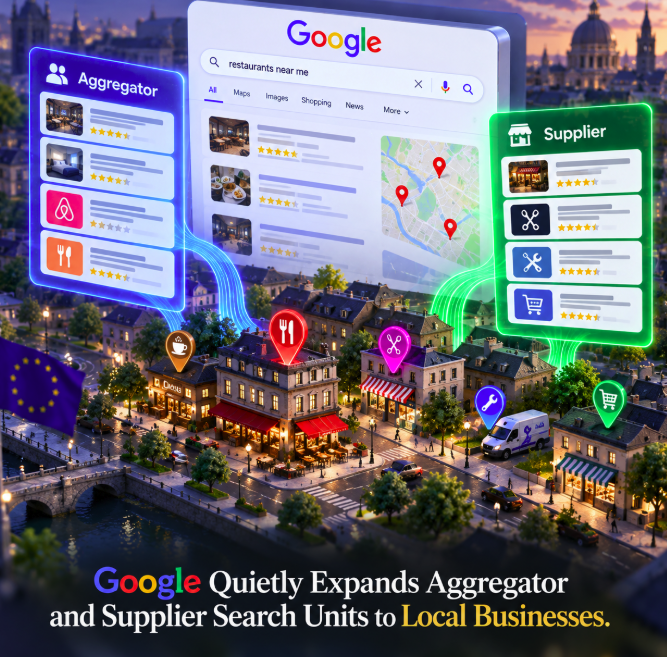
Google has expanded its Aggregator and Supplier Search Units to a major new category: local business queries. The change, documented on September 18, 2026, means Google's EEA-specific search framework for giving vertical search services and direct providers dedicated SERP visibility now explicitly covers local businesses alongside hotels, flights, ground transportation and products.
This is not merely an inference from a newly observed search result. Google's own Search Central documentation changelog states that it added local business query support to the aggregator and supplier units because both features now support local business queries. Barry Schwartz highlighted the update at Search Engine Roundtable, noting that Google added references to local businesses throughout both sets of documentation.
Local Search joins Google's EEA aggregator framework
The Aggregator Unit is a multi-provider Search feature designed for Vertical Search Services, or VSSs. Google lists online travel agencies, Comparison Shopping Services, metasearch engines and directories as examples. For supported queries, eligible aggregators can populate a dedicated unit with results relevant to the user's search, with the highest-ranked provider expanded by default and alternative providers available for selection.
Google now explicitly lists local businesses among the query categories supported by the Aggregator Unit in the European Economic Area. That creates a route for directories and other qualifying local vertical search services to surface their own sets of businesses directly inside a dedicated Google Search unit. A click within that unit leads to the aggregator's website rather than simply opening a Google-owned destination.
The accompanying Supplier Unit addresses the other side of the ecosystem: direct providers. Google now describes eligible suppliers as including brick-and-mortar business owners and service providers such as plumbers, alongside examples such as individual hotels and airlines. The Supplier Unit appears alongside the Aggregator Unit and only appears when the Aggregator Unit is present.
Restaurants, salons and service businesses are explicitly in scope
Google's supporting documentation makes the meaning of “local businesses” concrete. Its Local Vertical Search Service documentation says local searches include entities involved in dining, services such as beauty salons, and things to do such as attractions. The new framework is therefore relevant well beyond conventional retail stores.
The Aggregator Unit for local queries is powered by a standardized Point of Interest feed. Google says the feed can contain core information about physical businesses, including names, addresses and phone numbers, together with metadata such as categories and photos. Importantly, Google says data submitted through the feed is used exclusively to populate the participating partner's own unit and will not be used to enrich Google's own services or competing units.
For eligible aggregators, participation requires more than ordinary crawling. Google's Aggregator Unit documentation directs businesses interested in local queries to its Search Aggregator Features process and points participants to the Local Point of Interest Feed documentation. Google says lodging and local-business aggregator units are populated through direct data-feed integrations.
Direct local businesses have a different participation path
The Supplier Unit works differently. Google's documentation says direct providers do not need to submit additional data beyond information accessible through normal web crawling in order to be eligible, although supplier results can be enhanced with feeds where available. This distinction matters because a local directory participating as an aggregator and a restaurant, salon or plumber appearing as a direct supplier occupy different roles in the new SERP architecture.
For local businesses, that means ordinary website accessibility remains relevant even as Google creates new EEA-specific search surfaces. A business does not automatically need to become a data-feed partner simply because local queries can trigger Supplier Units. Google can use crawlable information for direct supplier eligibility, while richer feed integrations can supplement the result.
This is another important DMA-era change to European Search
The expansion arrives within the same regional Search framework behind Google's recent EEA changes for products and other verticals. Google's regional differences documentation says the company is evolving the results page for certain query types to provide new opportunities for Vertical Search Services, Comparison Shopping Services, direct suppliers and content providers. It now lists both Aggregator and Supplier Units in the EEA for local-business queries.
The regulatory backdrop is the European Union's Digital Markets Act, which has pushed designated gatekeepers toward changes intended to give competing services more opportunities and limit self-preferencing. The practical Search consequence is increasingly visible: European SERPs are developing dedicated surfaces where intermediaries and direct businesses can appear under rules that differ from those in other markets.
That context is especially relevant because Google simultaneously removed free product listing formats from EEA Search. Taken together, the September changes show that Google's response is not limited to shopping. The same aggregator-versus-direct-supplier model is now extending deeper into local discovery, where directories, marketplaces, booking platforms and physical businesses all compete for attention.
Local SEO now has another visibility layer to monitor
For local SEO teams, the immediate implication is not that the traditional local pack or Google Business Profile has disappeared. Google's documentation does not say that Aggregator and Supplier Units universally replace every existing local result. The safer conclusion is that local-business queries in the EEA now have an additional documented Search architecture that can alter which surfaces appear and who can populate them.
That makes SERP monitoring more complicated. A restaurant or service company may have visibility through its own website, Google Business Profile-related experiences, conventional organic results and now potentially a Supplier Unit, while an aggregator covering the same category can compete through the Aggregator Unit. Measuring only a traditional organic position may therefore miss an increasingly important part of the European local-search interface.
Aggregators also have a new incentive to think about feed quality as part of SEO. Google's best practices encourage rich entity details, and the POI feed gives participating vertical search services a structured mechanism for describing the local entities shown inside their unit. The quality and completeness of those records can become part of the competitive search-distribution workflow rather than merely an internal directory concern.
Google is turning regional Search into an ecosystem of providers
The broader pattern is becoming clearer. Instead of one uniform Google-owned presentation for every vertical, the EEA Search page is increasingly being designed as an environment in which multiple ecosystem participants can receive dedicated visibility. Aggregator Units represent intermediaries and vertical search services; Supplier Units represent the businesses providing the actual product or service.
Adding local businesses materially widens the scope of that model because local intent touches an enormous range of everyday searches — restaurants, salons, tradespeople, attractions, shops and other businesses with physical or service-area presence. What began as a framework most obviously associated with travel and shopping is now part of local discovery.
For European local SEO, this is therefore more than a documentation footnote. Google has formally brought local-business queries into its Aggregator and Supplier Unit system, giving both vertical search services and direct providers another route into the EEA SERP. The next question is how frequently those units appear across real local queries — and how much user attention they ultimately take from the local-search formats marketers have spent years optimizing.