
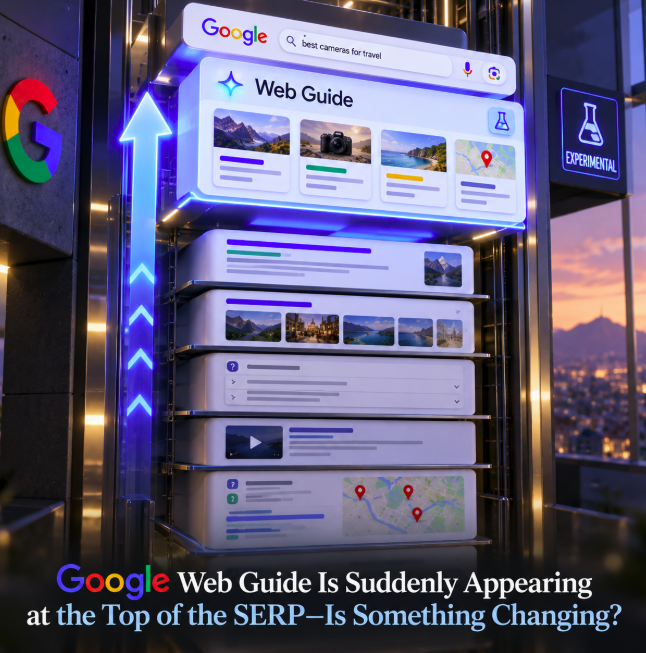
Google's experimental Web Guide may be moving into a much more prominent position in the search results. On September 18, SEO consultant Glenn Gabe reported that Web Guide was appearing right at the top of the SERP for his searches, whereas he had previously seen other non-Web Guide content appear above the AI-organized results. The observation is potentially important for publishers and SEO teams, but the evidence does not yet establish a broad rollout or a permanent Google Search change.
Gabe's observation was highlighted in Barry Schwartz's September 18 Search Engine Roundtable recap. Gabe said that every search he was running was showing Web Guide results starting from the top of the page and explicitly cautioned that he did not know whether that meant something larger was happening with the experiment. That uncertainty is central to interpreting the signal correctly: this is a notable change in one experienced observer's Search Labs environment, not confirmation from Google that Web Guide has received a universal new position.
Web Guide started as an experimental reorganization of web results
Google introduced Web Guide in July 2025 as a Search Labs experiment designed to organize web links into AI-generated topic groups. Instead of presenting a conventional sequence of links, Web Guide uses a custom Gemini model to understand the query and relevant web content, then groups useful pages around different aspects of the search.
The underlying retrieval process uses query fan-out, a technique also associated with AI Mode. Google can issue multiple related searches in parallel and use the results to surface pages that might not have appeared as prominently in a traditional single-query result set. The output is still heavily oriented around links to the web, but the interface changes the way those links are assembled and prioritized for the user.
At launch, Web Guide lived in the Web tab for users who opted into the Search Labs experiment. Google said from the beginning that it planned to learn from the experiment and eventually explore AI-organized results in other parts of Search, including the main “All” tab.
Google has already been expanding Web Guide beyond its original position
The appearance at the top of the SERP would not come out of nowhere. Google has progressively expanded the experiment. By late 2025, Web Guide had begun appearing in the All tab for opted-in users, and Google later confirmed that it was showing Web Guide on more searches there.
In an official update on the web ecosystem, Google said it had made Web Guide twice as fast and was displaying it for more queries in the All tab among people enrolled in the experiment. Google described the feature as particularly useful for complex and open-ended searches because it can organize links into topic groups and help users discover pages they may not otherwise have found.
That history makes Gabe's observation plausible as another stage of experimentation. The significant part is not simply that Web Guide can appear in All — that was already established — but that the AI-organized block was reportedly beginning immediately at the top of the results rather than after other search features.
Top-of-SERP placement would materially change the experiment
Position matters enormously in Search. A module placed below several conventional results competes for attention after the user has already encountered other answers, links or SERP features. The same module placed at the top becomes the first framework through which the user encounters the query.
If Google's test is intentionally moving Web Guide upward, it could therefore change click distribution even without changing which pages Web Guide ultimately selects. A publisher included in one of the first AI-generated topic groups could gain unusually prominent exposure, while a conventional organic result that previously occupied the visual top of the page could begin lower in the viewport.
It would also reinforce a broader transformation in Search: Google increasingly organizes information before the user evaluates individual results. AI Overviews synthesize information, AI Mode creates a conversational research environment, and Web Guide restructures the link layer itself. A Web Guide block occupying the top of the SERP would make that organizational role especially visible.
But this is not evidence of a confirmed ranking update
There are several reasons to avoid overinterpreting the observation. Web Guide remains an experimental experience associated with Search Labs, and Google routinely tests interfaces, positions and triggering behavior across subsets of users and queries. Gabe's report describes what he was seeing, but it does not establish the size of the test, the countries involved, the account conditions required or whether Google intends to keep the placement.
There is also no indication that traditional organic ranking systems have been replaced. Web Guide represents a different presentation and retrieval layer that can use query fan-out to find and organize relevant pages. A change in the location of that module should therefore be distinguished from an algorithm update that directly changes the ranking order of conventional blue-link results.
For the same reason, SEO teams should not interpret an isolated ranking-tool movement as proof that Web Guide is responsible. Unless a tracking platform explicitly identifies Web Guide modules and their position, changes in the visual SERP and changes in conventional rank measurements can easily become conflated.
Web Guide creates a different kind of SEO visibility
The experiment matters because Web Guide can surface sites through topical groups rather than only through a single linear ranking. For an open-ended query, Google may decompose the information need into several related areas and retrieve pages for each one. A site can therefore become visible because it is especially useful for one branch of the expanded query, even if it would not have occupied one of the most prominent positions for the original wording alone.
That creates measurement challenges. Traditional SEO reporting is built around concepts such as position one, position five or page one. AI-organized result groups can make that vocabulary less precise. A page might appear in the first Web Guide group, in a later group, or in a group generated around a subtopic that has no direct equivalent in the standard SERP.
If Web Guide is indeed moving to the top more frequently, those distinctions become more important because the AI-organized layer could receive attention before conventional organic listings. Search teams will need SERP-monitoring systems capable of distinguishing the module itself, its placement and the links contained within its individual groups.
Google is actively trying to make AI Search send users to the web
Web Guide also fits Google's broader effort to emphasize web discovery inside generative Search. In May 2026, Google announced several updates designed to surface more links, original content and useful websites across its AI experiences. The company has repeatedly framed Web Guide as a way to help people find pages they might not otherwise discover rather than as a purely answer-generating replacement for external websites.
That does not guarantee publishers more traffic. A more prominent AI-organized interface can redistribute clicks in ways that vary sharply by query and source. But it does mean Web Guide should be evaluated differently from a feature that simply generates an answer with no visible discovery path: its central object is still a collection of web links, reorganized by AI.
Watch the signal, but do not call it a rollout yet
Gabe's report is worth monitoring precisely because it comes after a steady expansion of Web Guide from the Web tab into more All-tab searches. Seeing the feature begin at the top of every SERP in his test environment could indicate that Google is experimenting with a stronger default position for the module. It could also be a temporary interface test, an account-specific treatment or another limited Labs configuration.
The next evidence to watch is repetition: whether more opted-in users report the same placement, whether the behavior persists across different query classes, and whether Google updates its official description of Web Guide's availability or positioning. Until then, the responsible characterization is a signal rather than a launch.
What has changed is observable: Web Guide has been seen occupying the very top of the SERP where it previously appeared below other content. What has not been established is why, how broadly, or for how long. For SEO teams tracking the evolution of AI Search, that makes this exactly the kind of small SERP movement worth documenting before it potentially becomes a much larger one.