
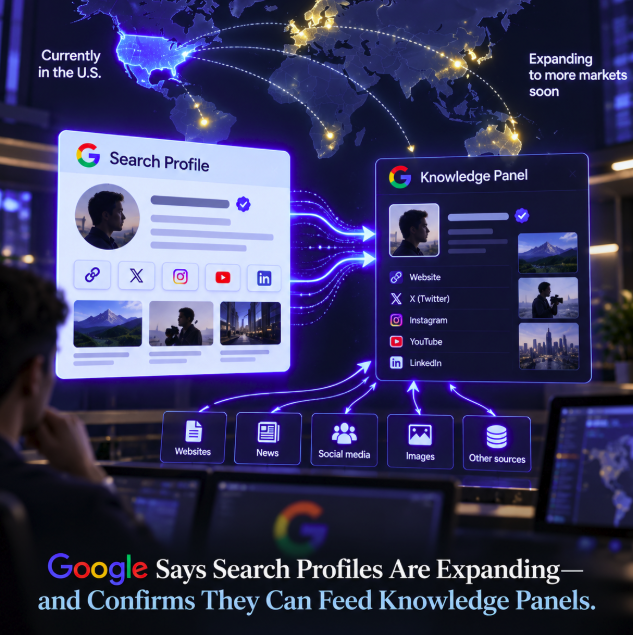
Google Search Profiles are preparing to move beyond their initial U.S. launch, while Google is also clarifying how the new profile system interacts with one of Search's most important entity surfaces: the Knowledge Panel. Robby Stein, Google's VP of Product for Search, says expansion into additional markets will begin soon, adding a geographic dimension to a product that has quickly become relevant for publishers, creators and brands managing how they appear across Google.
The second part of the story is just as important for entity SEO. Google's own Search Profile help documentation says information from a Search Profile — including a name, bio and social links — may be integrated directly into a Knowledge Panel. At the same time, Google continues to stress that Knowledge Panels themselves are automatically generated from multiple sources rather than being manually created from a Search Profile alone.
Search Profiles are still U.S.-only, but that is set to change
Google officially launched Search Profiles in June 2026 as a dedicated, shareable destination for publishers and creators. The profile can bring together articles, videos, social posts, a website, a bio and links to other content platforms, giving audiences a central Google-hosted page through which they can explore and follow a source.
Current Google help documentation still states that Search Profiles are available only in the United States. The original launch announcement, however, explicitly said Google intended to expand the feature to more publishers and creators around the world. Stein's latest comment that new-market rollout will begin soon gives that previously open-ended international plan a more immediate timeframe, although Google has not yet published a country list or exact rollout schedule.
That distinction matters. “Soon” signals expansion, but it should not be interpreted as confirmation that Search Profiles are already available globally. Until Google updates the eligibility documentation or announces individual markets, publishers outside the U.S. should treat international access as forthcoming rather than live.
Google has just broadened Search Profile eligibility in the U.S.
The international signal arrives only days after Google expanded access domestically. In a September 16 update, Google lowered the eligibility threshold so that more U.S. publishers and creators can claim Search Profiles if they have at least 10,000 followers on a supported major platform such as YouTube, Instagram, X or TikTok.
Google also added multi-account management for media organizations operating multiple publications and improved the way articles appear inside profiles, including larger image treatment and longer visible headlines. Those changes indicate that Search Profiles are moving beyond an early-profile experiment toward a more operational publishing surface.
Google's Search Central documentation has also introduced a Search Profile badge that publishers and creators can add to their own websites. The badge gives audiences a direct route to the Google-hosted profile, reinforcing the idea that Search Profiles are intended to function as a persistent identity and discovery layer rather than a one-off SERP feature.
Search Profiles and Knowledge Panels are connected, but they are not the same thing
The relationship between Search Profiles and Knowledge Panels can be confusing because the two surfaces are visibly connected. Google says a Search Profile can be accessed from a creator or publisher's Knowledge Panel, and its launch documentation notes that claiming a Search Profile may trigger the creation of a Knowledge Panel for eligible publishers and creators. If a Knowledge Panel already exists, Google says the profile can enhance it with an updated avatar, recent content and a direct profile link.
Google's help documentation goes further by saying that content from the profile — including the entity's name, bio and social links — may appear directly in the Knowledge Panel. A separate help page for claiming existing Search Profiles says changes made to a Search Profile may be reflected in the corresponding Knowledge Panel.
That does not mean the Search Profile becomes the sole source of truth for the panel. Google's Knowledge Panel documentation states that panels are generated automatically and that the information shown can come from a variety of sources across the web. Google may also use authoritative data partners for particular topics and can consider information or corrections supplied by verified entities.
The Knowledge Graph still depends on a broader web of evidence
Google's documentation on how the Knowledge Graph works reinforces the same model. Facts can come from public sources, licensed datasets and information supplied by content owners. Knowledge Panels are then generated automatically when Google's systems determine that sufficient information exists and that the panel is relevant to the user's query.
For publishers and creators, the Search Profile should therefore be understood as an additional first-party-like input into Google's entity understanding, not a replacement for the open web. A verified profile gives the entity a direct place to organize its identity, links and content, but Google can continue reconciling that information with websites, social platforms, news coverage, structured sources and other evidence available to its systems.
This distinction is important for SEO because it prevents an overly simplistic optimization strategy. Creating or claiming a Search Profile does not mean a publisher can ignore consistency elsewhere on the web. If the profile says one thing while the official site, social accounts and authoritative third-party sources communicate something different, Google's broader entity systems still have to resolve those signals.
Search Profiles create a more direct entity-management layer
What is new is the degree of control Google is giving eligible publishers and creators over a dedicated Search surface. A claimed profile can include a customized avatar, bio, website and connected content platforms. Google automatically imports content from linked platforms, and profile owners can suggest changes to factual information such as their name, social links and bio, subject to Google's review.
Google also says Search Profile creation does not directly affect content ranking in Search. Following a profile can, however, make that source's content more likely to appear for the follower in Discover. The product therefore sits at the intersection of entity identity, audience following and content discovery rather than functioning as a conventional ranking lever.
For publishers, this makes profile accuracy strategically important even without a direct ranking boost. The profile can influence what users see when they investigate the publisher or creator, can supply information that appears in a Knowledge Panel and can become the place where a user chooses to follow that source on Google.
International expansion will make entity consistency more important
If Search Profiles begin reaching additional markets, publishers and creators will need to consider how their identity data travels across languages and regional versions of the web. Google has not yet detailed how international profiles will handle localization, market-specific eligibility or multilingual bios, so those implementation questions remain open.
The core preparation is simpler: organizations should make sure their official website, social profiles, author or publisher information and existing Knowledge Panel data are internally consistent. When Search Profiles become available, the profile can then reinforce an already coherent entity footprint rather than introducing another conflicting representation.
Publishers managing several brands should also pay attention to Google's new multi-account capabilities. A media group may need distinct profiles for individual publications, while creators with multiple online personas can have separate profiles generated for those identities. Google's help documentation explicitly warns users to check whether a profile has already been automatically created before starting a new one.
Search Profiles are becoming part of Google's entity infrastructure
The important takeaway is not that Search Profiles now control Knowledge Panels. They do not. The stronger and more accurate conclusion is that Google has created a managed profile layer whose information can flow into Knowledge Panels while those panels remain products of Google's automated Knowledge Graph systems and multiple web sources.
That makes Stein's expansion signal particularly relevant. As Search Profiles move into more countries, a larger group of publishers and creators will gain a direct Google surface for consolidating their identity and content. The feature will sit alongside — and feed into — an entity ecosystem that still depends on the wider web.
Search Profiles are therefore becoming more than profile pages: they are a new input into how publishers and creators are represented across Google. The next major development to watch is the market rollout itself — which countries receive access first, what eligibility rules Google applies outside the U.S., and how quickly the profile-to-Knowledge-Panel relationship becomes visible internationally.