
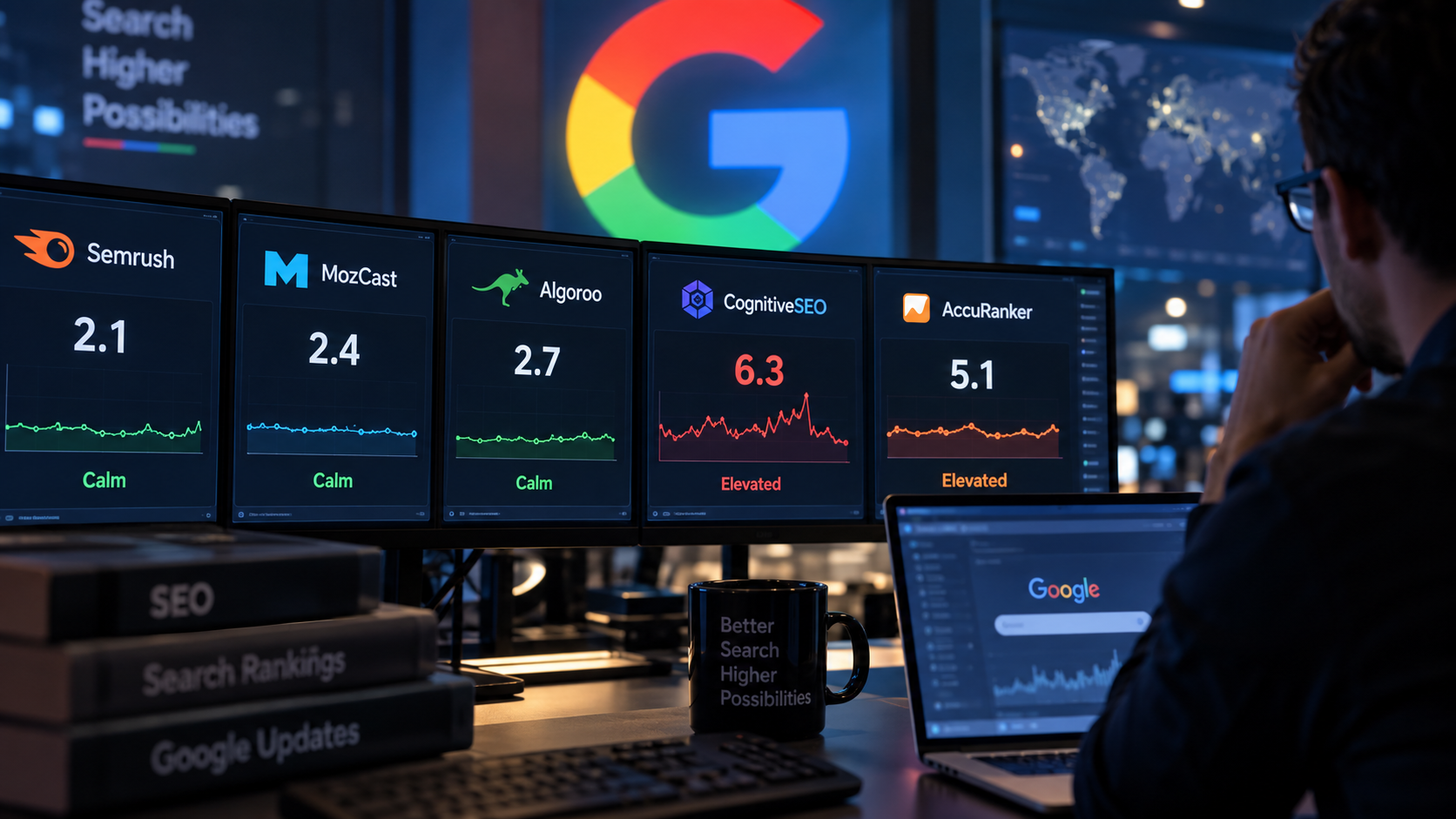
Google rankings are moving, but the usual alarm system is not speaking with one voice. A fresh cross-check of popular SEO volatility trackers shows a split picture: an aggregated consensus score of 2.6 out of 10, which falls in the normal range, with only 57% agreement among the monitored sensors. Semrush, MozCast and Algoroo appear calm in the supplied snapshot, while CognitiveSEO reports a much warmer 6.3 and AccuRanker’s Google Grump sits at 5.1. That combination points to localized or methodology-specific movement rather than a clearly shared signal of a broad Google update.
The key takeaway for SEO teams is not that nothing is happening. It is that the available evidence does not yet support the stronger claim that Google has launched a generalized ranking update affecting the wider search ecosystem. In practice, this is the uncomfortable middle ground where some sites may be seeing real movement, some verticals may be changing faster than others, and third-party sensors may disagree because they track different keyword sets, markets, devices and SERP features.
What the sensors are showing
The user-supplied snapshot puts the aggregate consensus at 2.6/10, which should be read as a normal-volatility baseline rather than an update alert. Semrush Sensor, which describes itself as a tool for measuring volatility in Google search results, is part of the calm group in this reading, alongside MozCast and Algoroo. Semrush Sensor is built around daily SERP movement signals, while Algoroo says it monitors selected keywords and combines positive and negative movement into a single “roo” metric, with high values indicating higher volatility and low values usually reflecting ordinary days.
The dissenting signals come from CognitiveSEO Signals, which reports a 6.3 in the supplied data, and AccuRanker’s Google Grump, which reports 5.1. CognitiveSEO says it monitors more than 170,000 keywords across desktop, mobile and local rankings, comparing SERPs day to day. AccuRanker says its Google Grump rating is calculated from changes across the top 30 results for around one million selected keywords. Those different sampling models help explain why one dashboard can see meaningful heat while another remains quiet.
| Sensor | Signal in the supplied snapshot | Interpretation |
|---|---|---|
| Semrush Sensor | Calm | No broad volatility signal in this reading |
| MozCast | Calm | Search “weather” does not indicate a major spike |
| Algoroo | Calm | Low SERP flux signal in the monitored keyword set |
| CognitiveSEO | 6.3 | Elevated movement in its monitored data |
| AccuRanker | 5.1 | Moderate unrest rather than a universal alarm |
Why disagreement matters
SEO volatility trackers are useful early-warning systems, but they are not official Google telemetry. Each tool turns rank movement into a proprietary score, and the result depends heavily on the keywords being watched, the geography, the device mix, the SERP features included and how the tool normalizes day-to-day changes. A tracker weighted toward volatile commercial queries can look noisy while a broader or differently sampled tool looks stable. A tracker focused on one country or device can also detect movement that does not appear in a global average.
This is why the 57% agreement figure matters. When most sensors move together, SEOs have a stronger reason to suspect a broad change in Google Search. When the group is split, the safer interpretation is narrower: there may be volatility in particular keyword groups, markets or result types, but the data does not yet amount to a shared market-wide update signal. The distinction is important because misreading a partial tremor as a confirmed update can lead teams to make rushed content, technical or internal-linking changes before they have enough evidence.
Google’s own Search Status Dashboard remains the reference point for confirmed ranking updates. At the time of this analysis, Google’s 2026 ranking history lists several confirmed events, including the March 2026 core update, the May 2026 core update, and spam updates in March, June and August. But a confirmed historical update does not automatically explain every later ranking fluctuation, and a quiet official dashboard does not mean individual sites cannot experience substantial movement.
How SEO teams should respond
The practical response is to avoid panic and narrow the diagnosis. Start by checking whether the movement is visible in first-party data, especially Google Search Console. If impressions, clicks and average positions are stable across core landing pages, the sensor disagreement is probably not an urgent site-level event. If movement is visible, segment it by country, device, query type, page template and search appearance. A ranking dip concentrated in one topic cluster is a different problem from a sitewide decline across multiple commercial and informational sections.
Google’s own guidance on core updates is also a useful guardrail even when an update is not confirmed. Google advises site owners to compare the right date ranges after an update has completed, review top pages and queries, and avoid quick-fix changes that are not useful for users. That advice applies especially well to mixed-sensor moments: do not rewrite a performing site just because one volatility dashboard has turned orange.
For publishers, ecommerce sites and agencies, the better play is to create an evidence log. Record the sensor readings, the date, the affected URLs, the query groups and the Search Console trend lines. If the same movement is later confirmed by more sensors or by Google, the log becomes a useful timeline. If the movement fades, it prevents overreaction and helps separate normal SERP churn from a material ranking event.
The bottom line
The current picture is mixed, not conclusive. An aggregate score of 2.6/10 with 57% agreement suggests normal volatility overall, while CognitiveSEO at 6.3 and AccuRanker at 5.1 show that some monitored SERPs are not entirely quiet. That is enough to justify watching the data closely, but not enough to call a broad Google update. Until more sensors align or Google confirms a new ranking event, the most defensible conclusion is simple: rankings are moving, but the SEO sensors cannot yet agree why.