
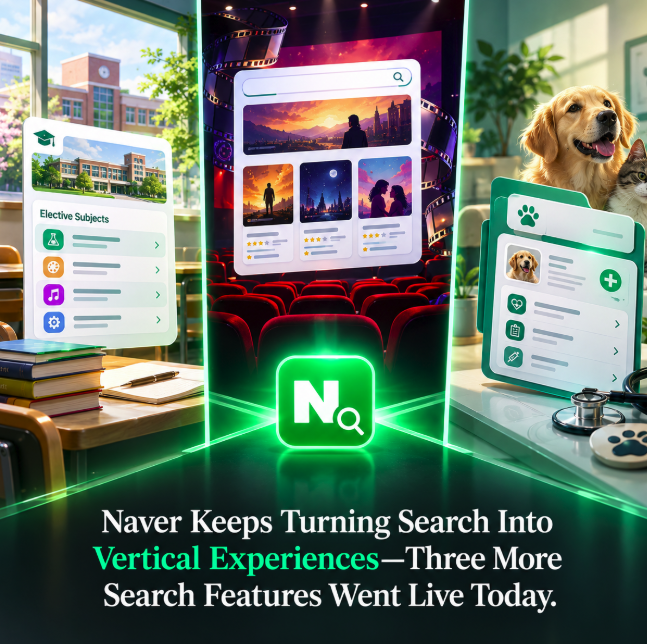
Naver rolled out three Search updates on September 17, 2026 that illustrate how the Korean search engine continues to build specialized experiences around individual types of information. The changes cover three very different verticals: school information, movie search and veterinary records for companion animals. None is a sweeping redesign of Naver Search on its own, but together they provide a useful snapshot of a search strategy in which the results page increasingly becomes a purpose-built interface rather than a generic collection of links.
The updates are visible in Naver's official Search Advisor news feed, which on September 17 published three Search Blog announcements: one promising easier access to information ranging from elective subjects to school details, another introducing more vivid movie search results, and a third designed to bring previously scattered pet hospital records together in Naver. Because these are first-party Naver announcements, they offer a particularly useful view of product changes that can receive relatively little attention outside the Korean search market.
School search is becoming a dedicated information experience
The first update focuses on education. Naver says users can now check information ranging from elective subjects to school information more conveniently through Search. The significance is less about a single new data point than about presentation: school-related queries are being treated as a distinct information task that benefits from a structured search experience rather than requiring users to assemble details manually across separate pages.
This approach is consistent with Naver's broader distinction between ordinary web results and specialized content-information areas. Its Search Advisor documentation notes that entities such as companies, schools, attractions and games can appear in dedicated content-information areas rather than being treated simply as conventional web-search results. The September school update reinforces that model by making Search itself a more useful interface for exploring education-specific information.
Movie results are getting more visual
Naver's second September 17 announcement concerns movies and promises a more vivid search-results experience. Film is an obvious category for richer visual presentation: posters, imagery, cast information and other structured attributes can communicate more quickly than a conventional blue-link result. Naver already supports Movie structured data in its Search Advisor documentation, including fields for a film's name, actors, director, genre, representative image and description.
The documentation also makes an important qualification for publishers: structured data can help Naver analyze web documents, but using the markup does not guarantee that information will appear in a particular search-result format. The new movie experience should therefore be understood as a Search product update, not as a promise that any site adding Movie markup will automatically receive the same presentation.
Pet hospital records move toward a unified view
The third update may be the most unusual from a Western search perspective. Naver says pet hospital records that had previously been scattered across different places can now be viewed together in Naver. The announcement points toward Search becoming an organizational layer for a user's companion-animal information, bringing veterinary history into a more consolidated experience instead of leaving people to retrieve records independently from multiple sources or contexts.
That is a different kind of search feature from a richer movie result. Movie search primarily improves discovery and presentation, while consolidated veterinary records move closer to personal information management. Grouping both under the same day's Search updates shows how broadly Naver defines the role of Search: it can be a discovery engine, a structured reference interface and, where appropriate, an access point for information tied to the user's own activities or records.
Three small releases reveal a larger Search pattern
It would be easy to dismiss these changes as minor vertical features, especially compared with major AI announcements or ranking-system updates. For search monitoring, however, the accumulation is precisely what makes them interesting. Search products evolve through hundreds of changes to individual modules, entity types and query journeys. A school information panel, a richer movie result and a veterinary-record experience each alter what users can accomplish without navigating the open web in the traditional way.
Naver's own description of its search mission emphasizes using technologies including AI to improve search quality while helping users reach authoritative information quickly and accurately. These September 17 releases show another side of that strategy: not every improvement needs to be presented as an AI feature. Better structured interfaces, richer visual results and vertical-specific information organization can change the search experience just as materially for the queries they serve.
For publishers and search professionals watching Naver, the lesson is to monitor the individual verticals rather than looking only for headline algorithm updates. The search engine's interface increasingly reflects the type of task behind the query. Education gets education-specific controls and information, entertainment gets a visual discovery treatment, and pet care gets a record-oriented experience. Search is not becoming one universal interface; it is becoming a collection of specialized interfaces assembled around intent.
That makes September 17 a useful example of Naver's product direction. Three seemingly unrelated releases went live on the same day, yet all point toward the same idea: when Naver recognizes a vertical with distinct information needs, it is increasingly willing to turn the SERP itself into the application for that task.