
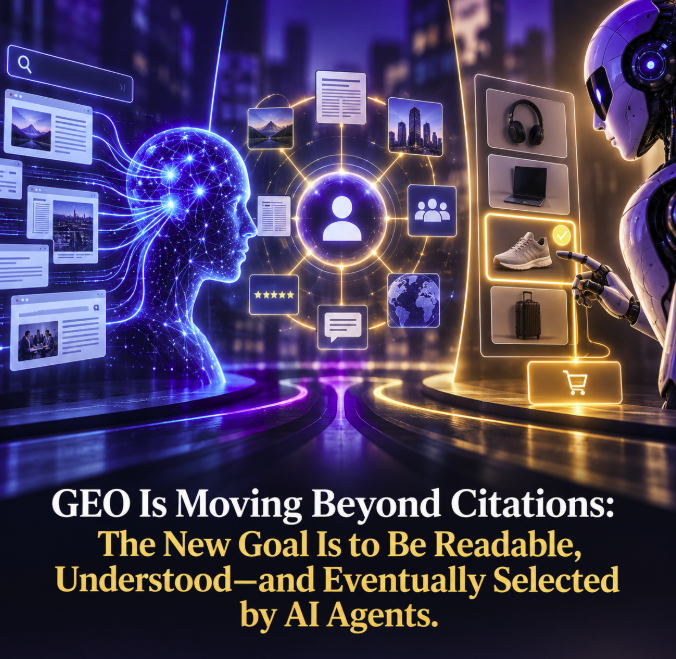
Generative Engine Optimization is starting to outgrow one of its earliest success metrics: whether an AI system cites a website. A new framework published by Search Engine Land on September 16 argues that visibility in generative systems should instead be understood across three connected layers — LLM readability, brand context and agentic commerce. Together, they describe a progression from making information accessible to AI, to making a brand understandable, and ultimately to making products and services selectable by AI agents.
The framework, developed by GEO specialist Olaf Kopp and published as “3 GEO pillars: LLM readability, brand context, agentic commerce”, is useful because it moves the conversation beyond the increasingly narrow question of how to earn citations in ChatGPT, Google AI Overviews, Gemini or other generative interfaces. Citations still matter, but they represent only one observable output of systems that are becoming capable of researching, comparing, recommending and increasingly acting on behalf of users.
The first pillar: LLM readability
The first requirement is deceptively simple: an AI system has to be able to retrieve, parse and interpret the information a business publishes. Traditional SEO already taught publishers to care about crawlability and indexability, but LLM readability extends the problem. Content can be technically accessible while still being difficult for a generative system to extract, segment or associate with a specific question.
This changes how publishers should think about structure. Clear passages, explicit relationships between entities, descriptive headings, useful factual statements and coherent topical organization make it easier for retrieval systems to isolate the information needed to answer a prompt. Technical accessibility remains foundational, but the goal is no longer merely to ensure that a crawler reaches the page. The information has to survive the next stage, where a model attempts to understand what the passage actually says and whether it is useful for the current task.
That distinction helps explain why simply producing more content is unlikely to solve AI visibility problems. A large archive of vague, repetitive or poorly structured pages may offer less usable evidence to an LLM than a smaller body of material in which claims, entities and relationships are explicit. GEO therefore brings information architecture, semantics and editorial clarity closer together.
The second pillar: brand context
Readable content does not automatically produce a well-understood brand. Generative systems encounter companies and products across many sources: official websites, journalism, reviews, marketplaces, directories, community discussions, social platforms and structured databases. The surrounding information helps systems build context about what an entity is, what it is associated with and whether those associations are consistent enough to support a recommendation.
This is the second pillar of the framework. Brand context optimization treats visibility as an ecosystem problem rather than something controlled entirely by a company's own domain. If an organization describes itself one way but external sources repeatedly associate it with different topics, categories or attributes, the broader information environment can influence how an AI system understands that entity.
Recent Search Engine Land coverage reinforces this point. Its September 16 discussion of entity gaps in content strategy notes that schema can tell a search engine what a brand says it is, but that does not guarantee natural-language systems will recognize the same entities and relationships in practice. The gap between declared structure and inferred understanding is becoming an important part of AI-search optimization.
For marketers, that means digital PR, reviews, expert mentions, third-party descriptions and consistent entity information are not separate from GEO. They contribute to the context from which generative systems may infer brand meaning. A company cannot directly control every source that mentions it, but it can influence the quality, consistency and authority of the evidence surrounding the brand.
The third pillar: agentic commerce
The third pillar is where GEO begins to diverge most clearly from conventional search optimization. AI systems are moving from answering questions toward completing tasks. In commerce, that means an assistant may not simply tell a user which product appears suitable; it may compare options, select one according to constraints, add it to a cart or participate in checkout.
This creates a new optimization target. A product can be visible in search and even mentioned by an AI while still being unusable by an agent. Product identifiers, attributes, inventory, pricing, shipping information, merchant policies and transactional interfaces increasingly need to be represented in forms that software agents can interpret reliably.
Google's latest commerce updates make this transition tangible. On September 16, Search Engine Land reported that Google is expanding its agentic commerce tools, including Universal Commerce Protocol capabilities designed to help AI agents and commerce platforms support shopping transactions. Google is also giving merchants more visibility into how they appear across AI experiences and emphasizing the importance of accurate, detailed product feeds.
The implication is significant: the next competitive surface may be an AI-generated shortlist rather than a traditional search results page. When an agent is instructed to find a suitable running shoe, business software package or hotel according to a set of constraints, brands may compete to become one of the options the system considers eligible before the user ever sees a conventional list of links.
From ranking to eligibility
This suggests a useful way to reinterpret GEO. SEO has historically focused heavily on ranking: among pages considered relevant to a query, which ones appear highest? Agentic systems introduce an earlier and potentially more consequential question: is the brand, product or service represented clearly enough to enter the AI's consideration set at all?
Eligibility depends on several layers working together. The system needs accessible information. It needs enough semantic clarity to understand the content. It needs contextual evidence that identifies and characterizes the brand. For transactional tasks, it may also need structured, current product information and a technical pathway through which an action can be completed.
A weakness at any layer can interrupt the chain. Excellent content that cannot be reliably retrieved is ineffective. A technically perfect website surrounded by weak or contradictory brand signals can be difficult to contextualize. A well-known product with incomplete inventory or transactional data may be easy for an AI to recommend but difficult for an agent to purchase.
Citations remain useful, but they are no longer the destination
None of this makes citations irrelevant. They remain valuable evidence that a system retrieved and considered a source, and they can generate referral traffic, brand exposure and authority. But treating citation count as the final measure of GEO success risks optimizing for the current interface rather than the direction in which AI systems are moving.
A citation is fundamentally an information-layer outcome. A recommendation is a decision-layer outcome. An agent selecting and using a product or service is an action-layer outcome. As AI interfaces move across those layers, marketers will need measurement that distinguishes between being retrieved, being mentioned, being recommended and being selected.
This is also why GEO cannot be reduced to a collection of prompt-writing tricks or schema modifications. Technical optimization matters, but so do editorial quality, entity clarity, reputation, product data, distribution and the architecture required for agentic interaction. The discipline increasingly touches SEO, digital PR, brand management, ecommerce operations and product engineering at the same time.
The new objective: readable, understood and actionable
The three-pillar framework captures a broader change in what online visibility means. The web was optimized first for people navigating links, then for search engines ranking documents. Generative systems add another intermediary: software that reads information, synthesizes it and may make decisions before presenting anything to the user.
For brands, the practical goal is therefore becoming more demanding. Content must be readable by AI systems, the brand must be understandable within the wider information ecosystem, and products or services increasingly need to be structured so agents can act on them. Winning a citation may still be valuable, but the more consequential future outcome could be something quieter: an AI agent understanding that a brand fits the user's requirements and selecting it before the traditional search journey even begins.