
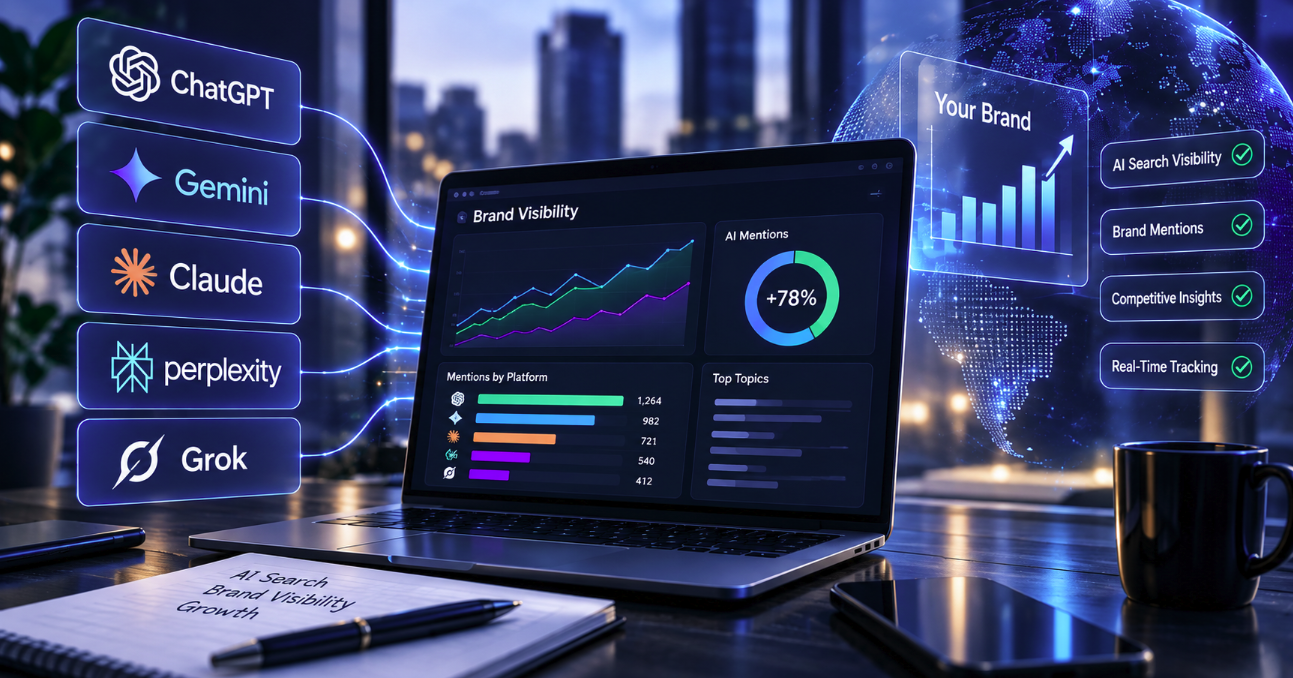
PilotDeck is advancing its AI visibility platform with a broader focus on tracking how brands appear across AI-generated search and discovery experiences. Announced September 16, 2026, the initiative reflects a measurement challenge that is becoming increasingly important for marketers: a company can perform well in conventional search while still having limited presence in answers generated by AI systems.
According to PilotDeck’s announcement distributed through IssueWire, the platform is designed to monitor signals such as brand mentions, citations, source inclusion and how a company is represented inside generated answers. The company names ChatGPT, Google AI Overviews, Perplexity, Gemini, Claude and Copilot among the discovery environments it aims to help businesses monitor.
AI visibility adds a new layer to search measurement
Traditional SEO reporting has long revolved around rankings, impressions, clicks and organic traffic. AI-generated answers create a different set of questions. Marketers increasingly want to know whether their brand is named in an answer, which sources the system cites, how competitors appear for the same topics and whether the information presented about the company is accurate.
PilotDeck is positioning AI visibility as a complement to traditional search measurement rather than a replacement for it. On its official website, the company says its workflow reads rankings and AI citations together, using those signals to inform recurring research and content decisions. The site also lists “LLM brand visibility” among the capabilities included in its content-focused offering.
This combined view is significant because rankings and AI mentions are not interchangeable metrics. A page may earn organic visibility without being selected as a source in a generated answer. Conversely, an AI system may mention or cite a brand based on sources that do not correspond neatly to the company’s highest-ranking pages. Tracking both can therefore reveal gaps that a conventional keyword report would miss.
Monitoring mentions, citations and brand representation
The company says its platform can help teams analyze brand mentions and citations across AI search channels and identify opportunities to strengthen their presence. Citation analysis is particularly useful because it can show which sources AI systems rely on when constructing answers about a category, product or company.
That information can support several types of decisions. A business may discover that an authoritative third-party source is repeatedly cited while its own website is absent. It may find that competitors are mentioned for important commercial questions where its brand does not appear. It may also identify outdated descriptions or missing context that could guide improvements to first-party content and structured information.
AI visibility metrics should still be interpreted carefully. Generative systems can vary their responses depending on the model, prompt wording, geography, personalization, retrieval system and timing. A single query result is therefore not a stable equivalent of a traditional search ranking. Useful monitoring requires repeated observations and clear methodology rather than treating one generated response as a permanent position.
PilotDeck combines visibility data with content workflows
PilotDeck’s broader proposition goes beyond monitoring. The IssueWire release describes five connected capabilities: SEO and GEO-oriented website optimization, a keyword-driven content engine, content funnel strategy, AI image generation and social media distribution. The company’s goal is to connect measurement with the workflows used to change a website and distribute content.
Its SEO and GEO feature page says pages can include JSON-LD structured data, semantic heading structures, internal links and machine-readable metadata, while the platform monitors AI citations. PilotDeck also describes support for llms.txt and llms-full.txt files as part of its approach to making site information easier for AI crawlers to interpret.
Some of the company’s statements about AI optimization, citation improvements and how particular AI systems select sources are marketing claims and should not be treated as guarantees of visibility. AI platforms do not provide publishers with a universal mechanism that ensures a brand will be cited. Structured content, clear first-party information and technical accessibility can make content easier to discover and understand, but external systems ultimately control retrieval and answer generation.
From keyword rankings to answer-engine presence
The larger trend behind PilotDeck’s announcement is a change in what search teams may need to measure. Search visibility increasingly spans conventional results pages, AI summaries embedded in search engines and standalone assistants that synthesize information from multiple sources. That makes brand presence a multidimensional problem rather than a single ranking position.
For marketing teams, this creates a need for reporting that separates several signals instead of collapsing them into one score. Brand mentions indicate whether a company appears at all. Citations indicate whether an AI response points users toward a particular source. Sentiment and descriptive accuracy address how the brand is represented. Competitive share can show how frequently rival brands appear across a controlled set of prompts. Referral traffic, where measurable, adds another layer by showing whether visibility produces site visits.
PilotDeck’s approach is to connect these signals with ongoing search research and publishing. Its website describes a monthly feedback loop in which rankings and AI citations are reviewed together and used to adjust subsequent research and content. That moves AI visibility away from a standalone dashboard metric and toward a recurring optimization process.
AI search tracking is still an evolving discipline
The growth of AI-generated discovery does not eliminate the fundamentals of search. Crawlability, useful content, topical authority, clear entity information, strong first-party sources and technically sound pages remain relevant. What is changing is the number of interfaces through which that information can reach users and the difficulty of measuring presence consistently across them.
Platforms such as PilotDeck are responding by extending SEO analytics into AI answer monitoring. The value of these systems will depend on the breadth and repeatability of their measurements, transparency about how prompts and platforms are sampled, and whether the resulting data leads to actions that improve business outcomes rather than simply producing another visibility score.
For brands, the practical takeaway is that AI search is becoming measurable enough to warrant dedicated attention, but the metrics need context. Tracking where a company is mentioned, which sources are cited and how that picture changes over time can add useful information alongside Search Console, rankings and traffic data. PilotDeck’s expanded platform is one example of how marketing software is adapting to that broader definition of search visibility.