
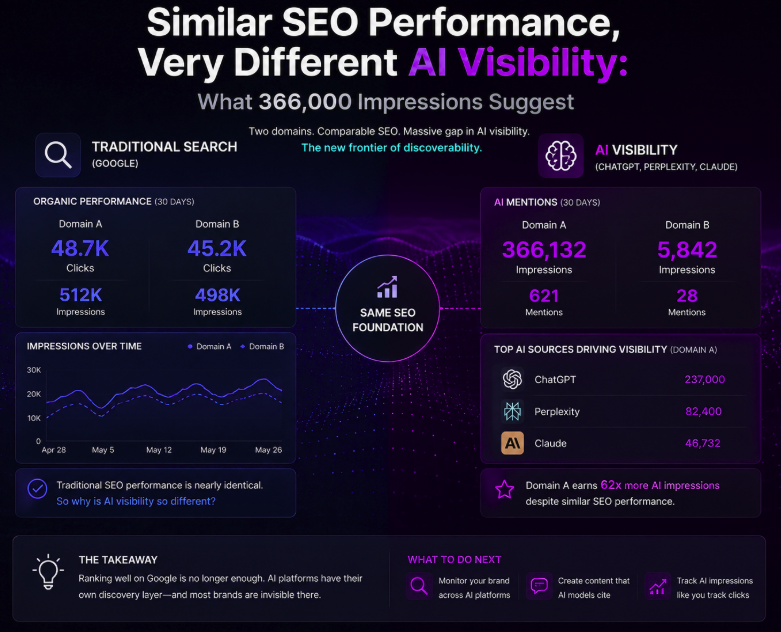
For most of SEO’s history, two pages with almost the same Google impressions and almost the same average position would be described as having broadly similar search visibility. Google’s new generative AI reporting is beginning to show why that description may no longer be enough.
A new case study from Hog the Web analyzed almost 366,000 first-party Google Search Console impressions from AI Overviews and AI Mode. The headline result was not simply that pages performing well in conventional Search also appeared in Google’s generative experiences. That relationship was expected. The more interesting finding was what happened when pages with remarkably similar traditional Search footprints were compared with one another: their AI visibility could still differ by multiples.
In one comparison, two articles generated approximately 70,000 Search impressions each, with average positions of 6.83 and 7.49. One accumulated 23,275 generative AI impressions. The other received 8,696. Their conventional exposure differed by less than 0.2%, but their AI exposure differed by roughly 2.7 times.
Another pair had about 11,000 Search impressions each and reasonably similar average positions. Their AI impressions were 3,354 versus 756 — a 4.4-fold difference. A third pair was even more striking: approximately 162,000 versus 156,000 Search impressions, virtually identical average positions of 3.96 and 3.92, but 4,624 versus 895 AI impressions. Traditional visibility looked almost interchangeable. Generative visibility did not.
That does not prove that AI search has an entirely separate ranking algorithm that SEOs can manipulate with a new checklist. In fact, the study is unusually valuable because it explains why that conclusion would be premature. What the data suggests is subtler: SEO appears to establish eligibility and a strong discovery foundation, while the generative layer can distribute exposure very differently among pages that look similar through conventional SEO metrics.
Google has finally made AI visibility measurable
Until June 2026, much of the discussion around “AI SEO,” AEO and GEO suffered from a basic measurement problem. Publishers could observe referrals, manually inspect AI answers or rely on third-party monitoring, but Google did not provide a dedicated first-party view showing how often a site appeared inside its own generative search experiences.
That changed when Google introduced the Generative AI Performance reports in Search Console. The reports show impressions from generative AI features including AI Overviews and AI Mode, along with pages, countries, devices and dates. Google initially rolled the feature out to a subset of websites while gathering feedback.
This matters because it creates a new measurable layer between ranking and traffic. A page can now be visible inside an AI-generated experience even when the user does not click it. Publishers can begin asking not only whether a URL ranks in Search, but how frequently Google’s generative systems surface that URL as part of an answer-driven experience.
That distinction is foundational. SEO reporting has traditionally centered on impressions, positions, clicks and conversions. Generative search adds another question: when Google constructs an answer, which of the eligible pages does it actually choose to expose?
The 366,000-impression dataset
The Hog the Web study examined a large established health-information website over the same 99-day period, from May 18 through August 24, 2026. At property level, the site recorded 1,505,180 standard Google Search impressions and 365,994 Generative AI impressions.
At page level, the exports contained 2,181,402 Search impressions and 427,271 AI impressions. The difference between property-level and summed page-level totals is expected because Search Console can attribute impressions differently when data is grouped by URL. The researchers therefore compared property with property for site-level observations and page with page for URL-level analysis.
After normalizing obvious URL variants, the conventional Search dataset contained 155 URLs. Of those, 136 had reportable generative AI impressions. The 19 pages without reported AI visibility were overwhelmingly low-volume Search pages. Most had fewer than 100 conventional impressions, and the highest-volume page without reported AI impressions had only 366.
Every URL in the dataset with at least 1,000 Search impressions also appeared in the generative AI report.
That finding supports an important point Google itself has repeatedly made: conventional SEO remains relevant. Generative AI Search is not operating on an unrelated universe of documents.
But Search visibility and AI visibility are not independent datasets
This is where careless analysis can produce a misleading headline. The study found a very high correlation between conventional Search exposure and generative AI exposure. It would be tempting to say that strong SEO therefore causes strong AI visibility.
Google’s reporting architecture prevents that conclusion.
Google explicitly says impressions and clicks from AI Overviews and AI Mode are already included within the ordinary Web Search performance data. The dedicated Generative AI report is a separate view into part of that broader Search activity; it is not a completely independent traffic channel.
If AI impressions are already contained within total Search impressions, some positive relationship between the two variables is mathematically inevitable. A page with enormous Search exposure has more opportunities to accumulate exposure inside the subset of Search experiences involving generative AI.
The researchers acknowledge this directly and avoid presenting their approximately 0.94 correlation as proof that SEO performance causes AI visibility. That methodological restraint is important because the strongest evidence in the dataset is not the correlation. It is the divergence among pages with comparable Search performance.
Similar SEO footprints produced very different AI exposure
The researchers calculated a descriptive “AI impression ratio” by dividing each page’s generative AI impressions by its total page-level Search impressions. This is not an official Google metric, and because AI impressions are contained within Search impressions, it should not be interpreted as a separate channel share. It is simply a useful way to compare relative AI exposure across URLs.
Among 59 pages with at least 1,000 Search impressions, the median ratio was 23.3%. The 25th percentile was 14.4%, while the 75th percentile was 31.6%. The observed range extended from 0.4% to 76.6%.
That spread is enormous. It means that even among pages with meaningful organic visibility, the amount of generative exposure relative to their overall Search footprint varied dramatically.
The paired examples make the point clearer than any aggregate statistic. A liver-health article and an article about dark chocolate and heavy metals received 69,872 and 70,000 Search impressions respectively. Their AI impressions were 23,275 and 8,696. A food-dosage article and a processed-food article received 11,339 and 11,192 Search impressions, yet their AI totals were 3,354 and 756. A diet-book page and a masterclass page had almost identical average positions around 3.9 and similarly large Search impression totals, but the first accumulated almost five times as many AI impressions.
If conventional Search metrics fully described generative visibility, differences of that magnitude would be difficult to explain.
The missing variable may be the query, not the page
Before declaring the lower-AI pages “underoptimized,” there is a major unresolved variable: Google’s Generative AI Performance report currently does not expose the queries responsible for AI impressions.
That means two pages can have similar total Search impressions while ranking for completely different types of searches. One page may receive most of its exposure from complex informational questions that frequently trigger AI Overviews. Another may receive exposure from navigational, transactional or simple factual queries where Google rarely decides that a generative answer adds value.
Google’s own documentation on AI features says AI Overviews are shown when its systems determine that they provide additional value beyond classic Search. AI Mode is particularly oriented toward nuanced questions, exploration, reasoning and complex comparisons. Both experiences can use query fan-out, issuing multiple related searches across subtopics and data sources before constructing an answer.
Query mix could therefore explain a substantial part of the difference between two otherwise similar pages. Without AI-level query data, the current Search Console report cannot separate “this page is unusually attractive to generative systems” from “this page happens to rank for searches that frequently invoke generative systems.”
That is not a minor limitation. It is arguably the central unanswered question in first-party AI visibility analysis.
AI visibility appears highly concentrated
The study also found that generative exposure was not distributed evenly across the site. Of 136 URLs with reported AI impressions, the top page alone accounted for 35.3% of page-attributed AI visibility. The top five generated 61.7%, the top ten 74.4%, and the top fourteen approximately 81%.
The homepage was unusually dominant, so the researchers repeated the calculation without it. Concentration remained substantial: 18 of the remaining 135 pages produced about 80.4% of non-homepage AI impressions.
Organic Search has always been capable of producing power-law distributions where a small number of pages account for much of a site’s traffic. The significance here is not that concentration itself is novel. It is that publishers now have a second distribution to inspect.
A page can be a conventional organic winner without being an equally strong generative winner. Another can receive disproportionate AI exposure relative to its Search footprint. Those outliers are likely more useful for research than a site-wide average.
This changes how an AI visibility audit should begin
The first generation of GEO advice often started with tactics: rewrite headings as questions, add summaries, create FAQ sections, publish llms.txt, increase entity mentions or break text into supposedly “AI-friendly” chunks.
Google’s current guidance is notably skeptical of that approach. Its 2026 generative AI optimization guide says foundational SEO remains the basis for visibility and explicitly warns against chasing supposed AEO/GEO hacks. Google recommends unique, reliable, non-commodity content, technical accessibility, useful media and conventional Search best practices.
The new data suggests a better research workflow. Start with pages that already have meaningful Search exposure. Calculate their relative generative visibility. Identify extreme high and low outliers. Then investigate why those pages differ.
That investigation should begin with the queries and intent those pages serve, not with arbitrary formatting changes. Do the topics naturally invite synthesis? Do users ask multi-part questions? Are the pages useful as supporting evidence within a larger answer? Does one page contain original information while another largely restates common knowledge? Are entities and relationships unusually clear? Does one page cover subquestions likely to appear during query fan-out?
Those are hypotheses to test, not established ranking factors.
AI visibility may be a retrieval problem before it is a ranking problem
Traditional SEO encourages us to imagine a page competing for a numbered position against other pages for a query. Generative systems introduce another stage. The system may need to retrieve multiple documents, understand which portions support different aspects of the user’s question, reconcile those sources and decide which links are useful enough to expose in the generated response.
That can create visibility patterns that conventional average position does not describe well.
A page can rank because it is a strong direct answer to a conventional query. Another page may be especially useful as supporting evidence during a multi-step generative answer. The second property is not necessarily visible in the page’s ordinary ranking metrics.
This is closely related to an experiment we recently published on how six AI models reconstructed Net Content SEO. The same entity produced very different levels of recognition across ChatGPT, Gemini, Perplexity, Grok, Gemma and Llama. The web footprint had not changed between tests; the retrieval and reconstruction systems had.
Google’s AI Search is obviously not identical to those independent LLMs, but the conceptual lesson is useful. Being indexable is not the same as being retrieved for every generative task, and being retrieved is not the same as being selected as visible support in the final answer.
Authority may not be enough to explain the divergence
The page comparisons in this dataset come from the same website. That controls, imperfectly but usefully, for many site-level variables. The pages share a domain, publishing environment and broad authority context. Yet generative exposure still diverges sharply.
This makes simplistic domain-authority explanations less satisfying. If the site itself were the dominant determinant, comparable pages on that site should be more similar than the study observed.
Page-level usefulness, topic, intent and information structure may therefore matter substantially after domain-level eligibility is established. Authorship and recognizable expertise could also be relevant in some contexts, especially for health information, although this dataset does not test that hypothesis directly. We explored that open question separately in our analysis of recognizable authors and AI Search.
The important discipline is to keep possible explanations separate from demonstrated effects. Nothing in the 366,000-impression study establishes that adding author schema, changing headings or increasing entity density will raise AI impressions.
CTR becomes harder to interpret in AI-enhanced Search
Another striking pattern in the dataset involves click-through rate. One page about fish and longevity accumulated 111,244 Search impressions, held an average position of 2.97 and received 55,579 AI impressions — yet its overall Search CTR was only 0.15%.
That sounds like compelling evidence that AI Overviews destroy clicks. The rest of the dataset immediately complicates that conclusion. A “foods to eat / foods to avoid” page had an even higher relative level of AI exposure, with 10,043 AI impressions from 13,955 total Search impressions, but produced an 8.89% overall CTR. Meanwhile, a guava article had much lower relative AI exposure and still recorded a CTR around 0.16%.
There is no clean relationship here between more AI exposure and fewer clicks.
Query intent, result layout, images, videos, knowledge features and brand behavior can all influence CTR. Average position itself has also become more difficult to interpret. Google explains that links inside an AI Overview receive position data as part of the Search result, meaning a reported average position should no longer automatically be read as the location of a conventional blue link.
The practical consequence is that SEO dashboards built around position and CTR need more context in an AI-enhanced SERP.
366,000 impressions do not tell us whether the AI recommended the site
An AI impression is useful, but its meaning should remain narrow. In the dedicated Search Console report, it indicates that a URL from the site appeared in a supported generative AI feature. It does not prove that the site was quoted prominently, endorsed by the AI, clicked by the user or responsible for a conversion.
This distinction matters because “AI visibility” is becoming an overloaded term. One analytics product may define it as a brand mention in ChatGPT. Another may count citations. Search Console is measuring Google-specific URL exposure inside AI Overviews and AI Mode. These metrics should not be treated as interchangeable.
For Google, the new report is best understood as an additional visibility layer. It answers: how often did our URLs appear within Google’s generative experiences? It does not yet answer the equally valuable questions of exactly which prompt triggered the appearance, how prominently the source influenced the generated answer or why Google selected that page.
The geographic data raises another unanswered question
The site’s AI exposure also differed by country. The United States generated 53.8% of AI impressions and 51.6% of total Search impressions. India generated 10.5% of AI impressions but only 6.7% of total Search impressions. The United Kingdom, Canada and Australia completed the top five AI markets.
One website cannot explain that difference. It could reflect topic demand, query patterns, device behavior, feature availability, Google experimentation or differences in how users interact with AI-enhanced Search.
But it creates another dimension publishers should monitor. AI visibility may not merely differ by page; it may differ geographically even when conventional organic visibility looks relatively stable.
As Google expands the report, cross-country comparisons across multiple sites could become one of the most useful areas for independent research.
What the study actually suggests
The most defensible conclusion is not that SEO and AEO are separate disciplines. The data points in almost the opposite direction. Every page with meaningful conventional exposure in this dataset also appeared in Google’s generative reporting, and Google says explicitly that the same technical and quality foundations remain relevant.
SEO appears to create the foundation for participation.
But participation does not guarantee equal exposure. Once pages enter generative search, traditional metrics alone do not predict how frequently they will appear. Two URLs can have almost identical Search impressions and similar average positions while one accumulates several times more AI visibility.
That gap is where legitimate AEO research begins.
Not with a new schema type. Not with a prompt-engineering trick. Not with a claim that conventional SEO is dead. It begins by measuring the difference between ordinary Search visibility and generative visibility, finding the outliers and asking what the existing metrics fail to explain.
The next useful dataset needs queries
Google has already made a major step by exposing first-party generative AI impressions. The missing query dimension now limits what publishers can infer from those impressions.
If Google eventually shows which searches generated AI visibility, researchers could compare pages at a much more meaningful level. They could distinguish a page effect from an intent effect, measure whether certain query classes disproportionately generate AI exposure and investigate whether content characteristics predict source selection after controlling for query type.
Until then, claims about “AI ranking factors” should be treated cautiously. The 366,000-impression study is observational, covers one established health-information website and includes a known five-day Google logging issue in August that underreported generative impressions. Health is also a YMYL category whose source-selection patterns may differ from ecommerce, SaaS, travel or local Search.
Those limitations do not weaken the most interesting result. They define it correctly.
SEO still gets you into the game. It no longer describes the whole game.
The emergence of first-party AI reporting makes one thing increasingly difficult to ignore: a single “organic visibility” number is beginning to hide materially different experiences.
A page can rank. It can generate impressions. It can appear in an AI Overview. It can be selected during query fan-out. It can become a visible supporting link. It can be cited but not clicked. It can receive a click after the AI has already answered most of the question. Each stage represents a different relationship between the publisher and the user.
Traditional SEO remains the foundation because Google’s generative systems still need discoverable, indexable, useful web content. Google itself says there are no special technical requirements for appearing in AI Overviews or AI Mode beyond normal Search eligibility.
But the new Search Console data shows why “we rank well” is no longer a complete visibility report. Among pages that already rank and already earn meaningful exposure, generative systems can distribute attention very differently.
Nearly 366,000 AI impressions cannot tell us exactly why. They can tell us where to look.
And for SEO in 2026, that may be the important methodological shift: stop assuming that similar rankings imply similar visibility. Measure the generative layer separately, investigate the pages that behave differently, and resist turning correlations into ranking factors before the data can support them.