
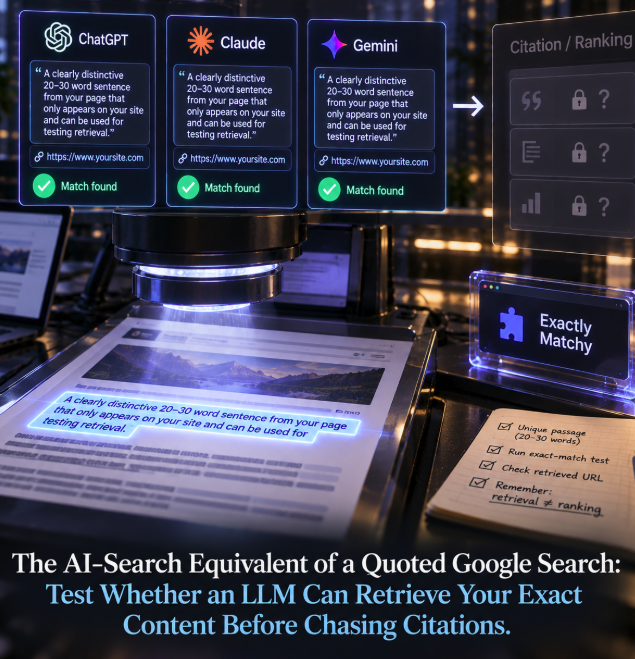
AI-search teams spend a growing amount of time measuring citations, mentions and visibility, but a page cannot win any of those outcomes if the system cannot retrieve it in the first place. A new experimental workflow from technical SEO consultant Chris Green proposes a surprisingly simple diagnostic: take a distinctive passage from a page, ask a web-connected AI assistant to return results containing that exact text, and see whether it can find and correctly attribute the URL.
The method, described in Search Engine Journal, is essentially the AI-search equivalent of putting a sentence in quotation marks in Google. It does not reveal a proprietary AI index, prove that a page will be cited, or establish how highly the source will be ranked for a real user prompt. What it can do is test a more basic prerequisite: whether the assistant's available search or retrieval pipeline can locate the exact content and associate it with the correct page.
Retrieval is a different question from citation
This distinction is easy to lose in AI visibility reporting. If a brand is absent from a ChatGPT, Claude or Gemini answer, teams may immediately conclude that the content lacks authority or that competitors have stronger entity signals. But the failure may happen much earlier. The page may not be discoverable, fetchable, crawlable, indexable or available through whatever search source the assistant uses for that request.
Green's test tries to isolate that first hurdle. The suggested prompt asks the assistant to search for a pasted snippet and return only results containing that exact text. If the expected URL appears with the passage correctly attributed, the test provides evidence that the content can be retrieved through the search tooling used in that interaction. That narrows the diagnostic problem considerably.
If the page can be retrieved exactly but still does not appear in normal AI answers, the investigation can move toward a different set of questions: whether the page is relevant enough for the prompt, whether competing sources are more authoritative or useful, how the system selects passages, and whether the answer needs that source at all.
The passage needs to be distinctive
A generic sentence is a poor diagnostic because many pages may contain similar wording. The methodology favors distinctive passages of roughly 20 to 30 words, especially text containing specific names, numbers, claims or uncommon phrasing. The objective is to create a textual fingerprint that should point back to one page rather than force the assistant to choose among dozens of near matches.
The test can be repeated with multiple snippets when the result is unclear. Green also recommends running uncertain checks several times because an AI assistant may call different search sources or behave differently between requests. That variability is itself a reminder that this is an experimental diagnostic rather than a deterministic equivalent of Google Search Console.
A positive result should therefore be phrased carefully. It demonstrates that the assistant, in that test, was able to retrieve the content and attribute it to the URL. It does not prove that every future request will use the same retrieval source or that the page exists in some universal “ChatGPT index,” “Claude index” or “Gemini index.”
A failed exact match creates a technical troubleshooting list
The method becomes particularly useful when the expected page does not appear. Instead of treating the absence as a vague “GEO problem,” teams can return to familiar technical SEO questions. Can crawlers discover the URL through internal links or a sitemap? Is a firewall or WAF blocking relevant bots? Can the main text be fetched and rendered? Is a noindex directive present? Does the canonical point elsewhere? Has the page had enough time to be discovered and processed?
Those are not exotic AI optimizations. They are variations on the same discovery, crawling and indexability checks that technical SEO has used for years. The difference is that web-connected AI assistants add another retrieval layer whose behavior is much less transparent than Google Search Console or Bing Webmaster Tools.
A failed test can also mean the passage itself is not distinctive enough, or that the search source used by the assistant does not currently surface the page. For that reason, one failure should not be treated as definitive proof of exclusion. Changing the snippet and repeating the test across assistants can provide a more useful pattern.
Exactly Matchy turns the manual test into a small workflow
Green also published an experimental Chrome extension called Exactly Matchy to reduce the copy-and-paste work. According to the methodology, the extension reads the rendered page currently open in the browser, extracts visible headings, paragraphs and list content, and filters obvious boilerplate such as menus, cookie notices and footers.
It then looks for distinctive 20–30-word passages, favoring candidates with specific names, numbers, claims and uncommon language. Chrome's on-device language model can be used to rank the candidate passages without rewriting them; if that capability is unavailable, the extension falls back to a simpler scoring approach. Each selected passage can then become an exact-match prompt with one-click paths into ChatGPT, Claude and Gemini.
The tool is experimental rather than a polished commercial product. Green says it currently has to be downloaded or forked and loaded into Chrome in developer mode. He also explicitly recommends reviewing the code before installing an unpacked extension. That caveat matters: the value of the idea does not depend on installing the extension, because the underlying test can be performed manually in any suitable web-connected assistant.
A successful retrieval test does not mean the page “ranks” in AI
This is the most important limitation. AI answer generation is not a traditional search results page with a stable position that follows directly from retrieval. A system can retrieve a page and then decide not to cite it. It can use information from other sources. It can generate an answer without needing the tested passage. Different prompts can produce different source sets, and repeated runs can vary.
Green explicitly separates retrieval from ranking and traffic. His workflow is designed to determine whether the first technical hurdle is catching a page out, not to explain why a retrievable page fails to earn citations. Once retrieval works, questions of authority, relevance, usefulness and competition become more important.
That separation is valuable because AI-search measurement often collapses several stages into a single visibility score. Discovery, retrieval, passage selection, source selection, citation and click-through are different events. A page can succeed at one and fail at the next.
The test is best treated as a diagnostic probe, not an index checker
The quoted-search analogy is useful but imperfect. Traditional search engines expose relatively stable indexes and webmaster tools that can tell site owners whether URLs are indexed and sometimes why they are excluded. AI assistants can combine model knowledge, live web search, third-party search infrastructure and other retrieval mechanisms depending on the product and request.
That means an exact-match response is evidence about the retrieval path available during the test, not a complete map of the assistant's architecture. The source an assistant uses today may differ tomorrow, and two assistants can reach the same URL through different systems. Even the same assistant can vary between runs.
For practical SEO work, however, a probe does not need to reveal the entire architecture to be useful. If several distinctive passages repeatedly fail across web-connected assistants while the same passages are easily found in conventional search, that is a signal worth investigating. If they repeatedly succeed, teams can stop blaming basic retrievability and focus farther down the AI-selection funnel.
AI-search testing needs more stage-specific diagnostics
The larger value of the methodology may be conceptual. GEO and AI-search optimization are still frequently measured from the final answer backward: did the brand appear, was the URL cited, and did a referral arrive? Those outcomes matter, but they provide limited information about where a failure occurred.
Exact-match retrieval testing introduces a simple intermediate checkpoint. Before asking why an LLM did not cite a page for a competitive query, ask whether the system can retrieve a uniquely identifiable passage from that page at all. If the answer is no, technical discovery and accessibility deserve attention. If the answer is yes, the problem has moved beyond the first gate.
This does not create a Search Console for ChatGPT, Claude or Gemini. It does create a reproducible question that SEO teams can ask of them. In an ecosystem where first-party diagnostic tools remain uneven, that can be enough to make troubleshooting more disciplined.
The practical lesson is simple: test retrievability before optimizing for citations. A distinctive exact-match passage cannot tell you whether an AI assistant will choose your page in a real answer, but it can help establish whether the page is available to be chosen in the first place. That is a smaller claim than “AI ranking,” and precisely why the test can be useful.