
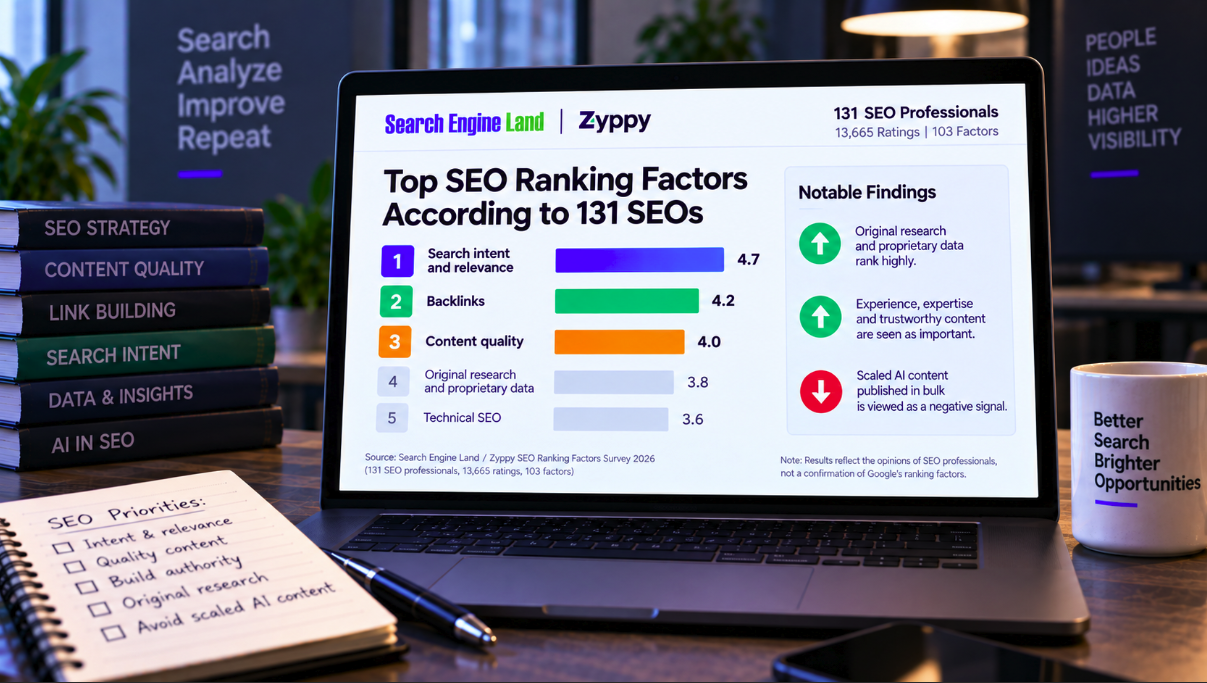
Backlinks have supposedly been dying for most of modern SEO, yet practitioners still refuse to bury them. A new survey of 131 SEO professionals puts backlinks second among the factors respondents believe matter most for Google rankings, behind relevance and ahead of content quality. At the same time, the same group gave strong marks to original research and first-party data while treating AI-generated content published at scale with little added value as a negative.
The findings come from Zyppy’s 2026 Google Ranking Factors Expert Survey, summarized by Search Engine Land on September 9. The study collected 13,665 ratings across 103 potential ranking factors, making it a useful snapshot of how experienced search practitioners currently think about Google after years of algorithm updates, AI-generated content, antitrust disclosures and debate over user signals.
It is crucial, however, to describe the study correctly. Zyppy did not measure Google’s ranking algorithm, and 131 practitioners cannot vote a ranking factor into existence. The results measure professional beliefs about ranking impact, informed by experience and available evidence. They are valuable as an industry consensus map, not as a leaked Google weighting table.
Relevance, backlinks and content quality form the survey’s top three
Zyppy asked respondents two related but different questions. Participants rated more than 100 potential factors on a seven-point scale running from +3, strongly positive, to -3, strongly negative. They were then given an open-ended question asking them to name what they believed were Google’s three most important ranking factors, without being restricted to a predefined answer list.
When Zyppy grouped those open-ended responses, relevance finished first, selected by 57.1% of respondents as a top-three factor. Backlinks followed closely at 54.8%, while content quality reached 47.6%. Authority and trust came next at 36.5%, followed by behavior or click signals at 29.4% and brand signals at 27%.
User satisfaction was selected by 19.8%, technical SEO health by 17.5%, topical authority by 14.3% and internal links by 11.1%. These percentages are not estimates of how much each signal contributes to Google’s algorithm; they represent the share of respondents whose open-ended answers placed the category among their three most important factors.
Search intent wins because keyword matching is no longer enough
At the individual-factor level, Search Intent Match received the highest rating in the survey. Zyppy defined it around how well a page satisfies the type of result or task a searcher appears to want, making the concept broader than simply placing relevant words on a page. Respondents repeatedly framed relevance as solving the user’s underlying problem rather than mechanically matching a query.
That distinction helps explain why information gain also appeared in practitioner comments. Once several pages cover the same topic and satisfy the same basic intent, additional usefulness can come from providing something the competing pages do not. The survey therefore places relevance and originality in complementary roles: first answer the right question, then give the searcher a reason for this page to exist alongside all the others.
Meta descriptions, by contrast, sat near the bottom of the relevance discussion. Most respondents assigned them little or no direct ranking impact, reinforcing the familiar distinction between elements that can affect how a result is presented or clicked and signals practitioners believe directly influence ranking.
Backlinks remain powerful in practitioner thinking
The second-place finish for backlinks is notable because Google representatives have repeatedly pushed back on simplistic claims that links sit among a fixed set of its top ranking signals. Search Engine Land specifically contrasts the survey with comments from Google’s Gary Illyes saying links are not among Google’s top three ranking signals. That disagreement is precisely why the study should be read as practitioner opinion rather than Google documentation.
Within the survey, respondents did not treat every backlink as equivalent. Links from highly trusted domains and topically relevant pages received some of the strongest ratings, while practitioners also emphasized links from pages that attract real visitors. Spammy backlinks, meanwhile, were placed among the strongest negative factors.
The resulting picture is less “more links equals higher rankings” than a belief that source quality, relevance and authenticity matter. Whether Google implements those concepts exactly as respondents imagine is a separate question, but the survey suggests link acquisition remains deeply embedded in how experienced SEOs diagnose competitive rankings in 2026.
Original research gains value as commodity content gets cheaper
Content quality ranked third overall, with 47.6% of respondents naming some form of it among their three most important factors. Within the detailed ratings, original research and first-party data led the content-quality category. Zyppy interprets that result through the changing economics of publishing: generative AI has made it dramatically easier to produce large quantities of competent, derivative text, increasing the relative scarcity of information that only one organization can provide.
That does not mean every page needs a proprietary study. Original value can come from measurements, experiments, customer data, expert analysis, firsthand experience or a synthesis that materially advances the reader’s understanding. The underlying practitioner preference is for content that contributes evidence rather than merely rearranging information already available across competing pages.
This is also where the survey’s AI finding becomes more nuanced than a simple anti-AI verdict. Respondents were negative about AI-generated content when it was published at scale with little added value, but the report includes more favorable practitioner experiences where AI output received intensive human editorial review and existed alongside genuinely unique material. The perceived problem is therefore commoditization and low incremental value, not the mere presence of an AI tool in the workflow.
Scaled AI publishing lands on the wrong side of the quality equation
The negative rating for low-value scaled AI content matters because it captures a major change in SEO production. The cost of producing a thousand passable articles has fallen sharply, which means publication volume by itself signals less effort or differentiation than it once did. If competitors can generate essentially the same page from the same public sources, scale can increase indexable inventory without increasing informational value.
The survey does not prove that Google detects “AI content” and applies a dedicated negative ranking factor. That conclusion would go far beyond the methodology. Instead, it shows that many practitioners believe mass-generated content with little unique contribution tends to correlate with characteristics Google does not reward, while reviewed and genuinely useful AI-assisted work can perform differently.
For publishers, that is a more actionable distinction. The strategic question is not whether a draft touched a language model; it is whether the finished page offers accurate, useful and differentiated information worthy of ranking against established alternatives.
Brand and user signals have moved closer to the center of SEO thinking
The survey also reflects how industry thinking has changed around brand and user behavior. Branded search volume and online reputation or trust received high ratings within the brand category, while satisfaction and task completion led the user-signal category. Returning quickly to the search results after visiting a page received a negative rating from respondents.
Zyppy says this year’s survey was designed in part to reflect information that entered public SEO discussion through Google’s API leak material and testimony from antitrust proceedings. Those developments have encouraged practitioners to think more explicitly about how user interactions and brand demand might fit into search systems. Again, the survey captures their interpretation of that evidence rather than independently validating the mechanics or weight of any particular Google system.
The practical implication is that SEO professionals increasingly see ranking performance as connected to what happens beyond static on-page optimization. A page can match a query semantically while still failing to satisfy the user, and a technically imperfect site attached to a widely known and trusted brand may compete differently from an unknown publisher with immaculate markup.
Technical SEO remains infrastructure rather than a magic accelerator
Technical SEO did not top the open-ended ranking, but respondents consistently treated it as foundational. Crawling and indexing make every other optimization possible, while technical failures can prevent otherwise excellent pages from competing at all. The survey describes this layer as table stakes: strong technical execution may not rescue mediocre content, but severe technical problems can absolutely suppress good content.
Internal linking also received positive treatment. Respondents emphasized its role in signaling important pages, distributing internal equity and explaining how topics connect across a site. Unlike external backlinks, internal links are a lever publishers control directly, which makes them particularly useful even if practitioners generally consider strong external links more powerful.
This framing avoids the false choice between technical and content SEO. Infrastructure determines whether search engines can reliably access and interpret the site; relevance, quality, authority and user response determine whether accessible pages deserve to outperform alternatives.
The methodology is useful precisely because its limits are clear
Zyppy says it considered hundreds of possible factors before narrowing the questionnaire to 103. The 131 participants collectively contributed 13,665 factor data points and spent 2,620 minutes completing the survey. The contributor list includes practitioners from agencies, publishers, software companies and independent consultancies, giving the exercise substantial professional breadth even though it is not a representative scientific sample of every SEO practitioner.
Expert surveys have a particular strength: they aggregate years of observations that would be difficult for one researcher to collect. They also have an unavoidable weakness: experts can share the same misconceptions, infer causality from correlated changes or be influenced by the same industry narratives. A high consensus score therefore means “many experienced SEOs believe this,” not “Google has confirmed this.”
That caveat is especially important when comparing categories. A 54.8% top-three selection rate for backlinks does not contradict Google by mathematically proving links are its second-most-weighted signal. It demonstrates that backlinks remain the second-most-common answer among this respondent group when asked what matters most.
The survey reveals a conservative core underneath a rapidly changing industry
For all the upheaval surrounding AI search, the leading answers are strikingly familiar. Match the user’s intent. Earn meaningful links. Publish high-quality content. Build trust. Make the site crawlable and useful. Those priorities would have sounded recognizable years ago, even if the evidence practitioners use to justify them has evolved.
The more interesting change sits inside the definition of quality. When generic information can be generated almost instantly, original research and first-party data become more valuable because they cannot be reproduced simply by asking another model to summarize the same web corpus. Human review also matters less as a ceremonial step than as a mechanism for adding judgment, verification and genuine information gain.
Zyppy says a separate survey will address ranking in Google’s generative AI responses, so the organic-search findings should not be casually transferred to AI Overviews or AI Mode. Citation and recommendation systems may share some inputs with traditional search while introducing different retrieval and selection dynamics.
For now, the 2026 survey offers a useful reading of the SEO profession itself. Despite years of predictions that links no longer matter, 131 practitioners still put backlinks narrowly behind relevance. Despite the rush to automate publishing, they reward original evidence and penalize low-value AI scale. That does not tell us Google’s secret formula, but it does show where experienced practitioners are placing their bets.