
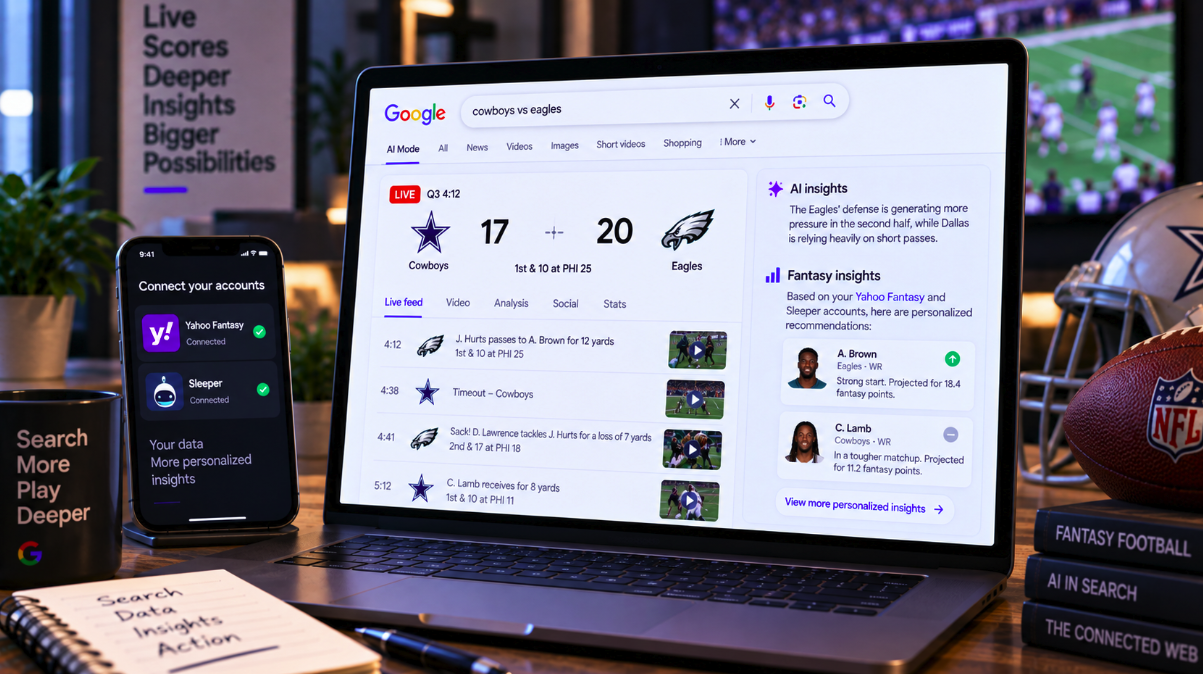
Google Search has spent decades personalizing results with signals such as location, language and search context. Its newest football features push personalization into a more consequential territory: AI Mode can now use information from a private, user-authorized external account to generate recommendations that would be impossible from the public web alone.
In an announcement published September 9, Google introduced a Live Game Feed for football alongside new statistics and fantasy-sports integrations. U.S. users can link Yahoo Fantasy or Sleeper to Search, allowing AI Mode to read the context of their live roster and leagues and answer questions about who to start, which players to target on waivers, how their draft looks or what happened across the league during the week.
The sports use case is narrow, but the product architecture is not. Search is increasingly becoming a place where public information, real-time data and private connected-account context can be combined into one personalized answer. For marketers and GEO teams, that changes the visibility question: the same public information can lead to different recommendations because the user brings private context into the search.
Google is turning the sports SERP into a live information surface
The first part of the September update is the new Live Game Feed. When a professional football game is underway, users can search for it on mobile and look for a red Live indicator. Google says the resulting experience provides an overall recap plus a dynamic timeline containing play-by-play updates, social commentary, video highlights and AI-powered insights.
The professional-football feed is initially available in English in the United States. Google says collegiate teams will be added later in September and that the feed will expand to more users around the world. Search is also adding a carousel for scores from other games, deeper player statistics such as sacks, fumbles and yards after catch, and future championship-favorite and playoff-bracket information.
Taken together, the features continue a familiar Search trend: the results page is becoming a destination for consuming the underlying information rather than merely a list of links pointing somewhere else. A football query can now contain the evolving event, commentary, video and analysis inside Search itself.
Fantasy recommendations add a private data layer
The more significant AI change appears before kickoff. A user can ask AI Mode for help with a fantasy lineup and receive an option to connect a Yahoo Fantasy or Sleeper account. Once the connection is authorized, Google says Search can bring in the person’s live roster and league context without requiring screenshots or manual data entry.
That private context makes questions dramatically more specific. “Who should I start this week?” is not useful unless the system knows which players the user owns, the league in which they compete and the alternatives available to them. “Who should I pick up?” similarly depends on roster and league information that cannot be inferred reliably from the open web.
AI Mode can now combine that account-specific information with broader football knowledge to generate start/sit advice, waiver-wire targets, draft assessments and weekly recaps. The recommendation is therefore no longer produced only from the query and publicly retrievable sources; it can be conditioned on data the user has explicitly connected.
This is an extension of Google’s connected-app strategy
The football launch is not the first time Google has brought external services into AI Mode. In a July announcement about connected apps, Google said U.S. users could link services directly to AI Mode and interact with them from Search. The initial examples included Instacart, Canva and YouTube Music.
Those integrations already blurred the boundary between finding information and doing something with it. AI Mode can help create a grocery list and send ingredients into an Instacart cart, surface Canva templates for a project or build and save a YouTube Music playlist. Google explicitly said that Personal Intelligence combined with connected apps could produce more tailored responses.
Yahoo Fantasy and Sleeper extend that model in an interesting direction because the connected data is not merely an action endpoint. The account becomes context for the recommendation itself. Search first understands the user’s private situation, then uses that understanding to decide what advice is relevant.
Personalization is moving from inferred context to declared context
Traditional search personalization often works through signals Google can infer: where the user is, which language they use, what they searched previously or what device they are using. Connected accounts provide a different category of context because the user deliberately authorizes access to information held by another service.
For fantasy football, that can mean the exact roster and league state. In other domains, the same architectural idea could theoretically involve shopping lists, project assets, music libraries or other connected-service data where Google offers integrations. The September announcement does not establish that every category will work this way, but the direction is already visible across the connected-app features Google has publicly launched.
This matters because two people asking the same natural-language question may legitimately receive different recommendations. The public query is no longer enough to reproduce the result; the connected personal context can change the answer.
The GEO problem becomes contextual rather than purely positional
Traditional SEO is built around observable queries and public results. Even when rankings vary, marketers can usually test a query and study the pages competing for it. AI personalization based on private account data makes that model less complete.
Imagine two users asking an AI system for the best option in the same category. One person’s connected context indicates a strict budget, an existing subscription or a compatibility requirement; the other person’s data indicates something different. The same set of brands can be filtered or ranked differently because suitability is conditional on private context.
Google has not documented a general ranking methodology explaining how AI Mode combines public sources with connected data, and the football launch should not be treated as evidence for any specific GEO factor. The strategic implication is narrower but important: brands may increasingly compete to be eligible for personalized recommendation rather than to occupy one universal answer.
Public data still matters because private context cannot answer everything
A fantasy roster can tell Google which players a person owns. It cannot by itself determine which player is the better start this week. The system still needs current information about matchups, injuries, performance and other relevant factors to produce useful advice.
This illustrates the complementary roles of private and public data. Connected-account information defines the user’s situation, while external information helps evaluate the available choices. AI Mode can synthesize the two into a recommendation tailored to that particular user.
For GEO, this suggests that public discoverability remains important even as personalization deepens. A brand, product or information source still needs to be understandable within the broader evidence layer before personal context can make it more or less relevant to an individual.
Connected data is not the same as a public ranking signal
It is important not to overstate what Google announced. Yahoo Fantasy and Sleeper account data should not be described as a new general Google ranking factor. The feature uses user-authorized account context to personalize fantasy recommendations inside AI Mode; Google has not said that those private records affect ordinary public web rankings.
Nor has Google disclosed in the football announcement exactly how much influence connected roster data has relative to particular public sources, how source selection works for the resulting recommendation or which retrieval systems provide the supporting football information. Those questions will require further documentation and testing.
The safe conclusion is that Search now has an explicit mechanism for using linked external-account context to tailor an AI answer. The broader ranking consequences remain unknown.
Privacy and permissions become part of the search product
The phrase “private account data” can sound more expansive than the actual feature. Google says users choose to link their fantasy account when AI Mode offers the option, after which Search can use roster and league context for the requested assistance. The announcement describes the connection as secure.
However, the football post does not provide a complete technical account of permission scopes, retention, model training or every aspect of data governance for the Yahoo Fantasy and Sleeper integrations. Those details should not be inferred from the product description. Users and organizations evaluating connected Search features will need to examine the applicable account and privacy controls as Google documents them.
The larger product shift is that privacy controls increasingly sit inside the search journey itself. Search is no longer interacting only with public pages and information Google already has; users can intentionally introduce data from services they use elsewhere.
Search is becoming an orchestration layer
The combination of the Live Game Feed and fantasy integration shows two directions converging. On one side, Google is pulling more public and real-time information directly into Search: scores, plays, video, social commentary, statistics and AI analysis. On the other, it is letting users bring private external context into AI Mode.
Connected apps add a third element: action. The July integrations showed AI Mode moving information into grocery carts, design workflows and playlists. The fantasy feature is less transactional, but its start/sit and waiver recommendations are designed to support a concrete decision rather than simply explain a topic.
That makes Search look less like a retrieval interface and more like an orchestration layer between information, personal context and external services. The user asks for an outcome; Search assembles the relevant pieces.
Measurement becomes harder when every answer can have a different context
This architecture creates a difficult problem for AI visibility platforms. Monitoring tools can run standardized prompts and record which brands, domains or sources appear. That remains useful for understanding the public information layer, but it cannot necessarily reproduce answers shaped by private account state that the monitoring system does not possess.
A fantasy recommendation generated for one roster may be completely inappropriate for another. In future connected-app scenarios, the same principle could apply whenever user-specific constraints determine which option is suitable. Visibility then becomes conditional rather than absolute.
Marketers may eventually need to test representative scenarios instead of only representative prompts. The question changes from “Do we appear for this query?” to “Under which user conditions do we become the recommended option?”
The football feature is small, but the search model behind it is much bigger
Google’s September launch is, on its face, a set of football features timed for the new season. The Live Game Feed gives fans a richer way to follow games, while Yahoo Fantasy and Sleeper connections make AI Mode more useful to fantasy players in the United States.
But the architecture illustrates a broader transformation already underway in Search. Public web information can be combined with live event data, connected-service context and AI-generated recommendations inside the same product. The answer can be personalized not only because Google understands the query, but because the user has authorized Search to understand part of their situation.
For SEO and GEO teams, that weakens the idea of one stable result that every user competes to see. A brand can be perfectly visible in the public information layer and still be excluded from a recommendation because it does not fit the individual context. Another can become highly relevant precisely because the connected data reveals that it does.
The next phase of search optimization may therefore be less about winning a universal position and more about becoming a credible option across many possible contexts. Google’s fantasy-football experiment makes that future unusually easy to see: the search box knows the question, the web supplies the evidence, the connected account supplies the user’s reality, and AI Mode turns all three into a recommendation.