
Fashion has spent years trying to turn attention into a number. Social engagement became measurable, influencer exposure became comparable and Launchmetrics’ Media Impact Value gave brands a proprietary way to translate press, celebrity, influencer and social visibility into a common benchmark.
Now the industry wants a number for something harder to see: what artificial intelligence says about a brand.
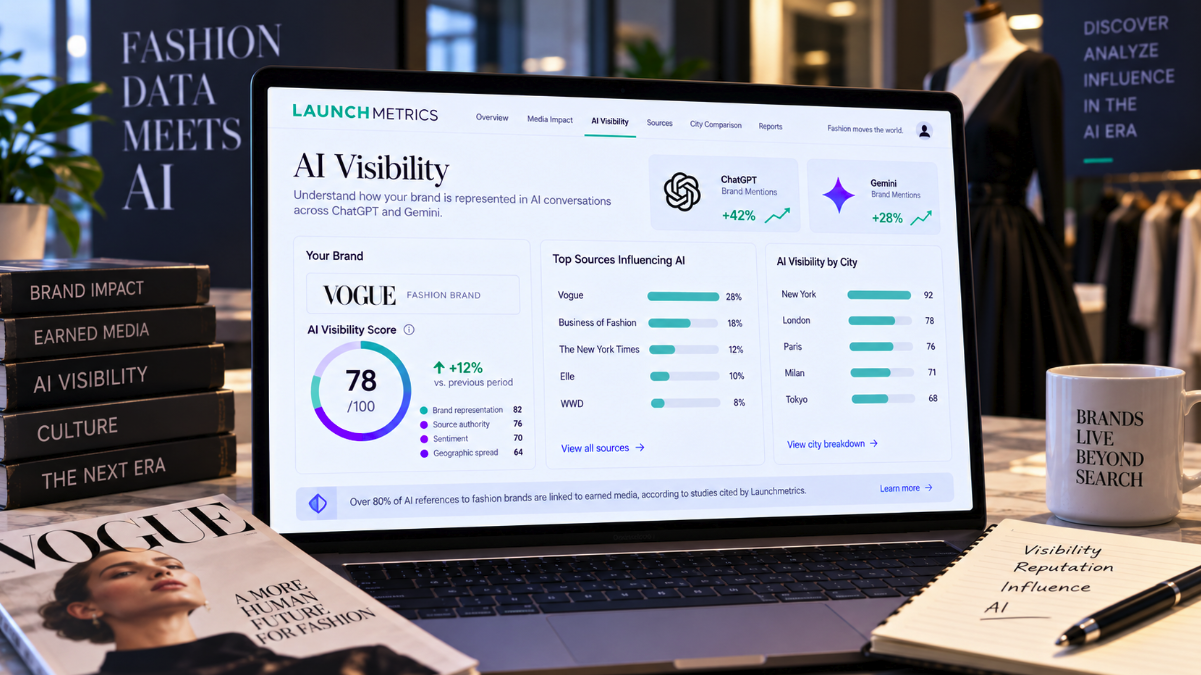
Launchmetrics has introduced AI Visibility, or AIV, a new measurement layer designed to track how fashion, lifestyle and beauty brands appear in generative AI answers. The launch was reported by Vogue Business on September 9, alongside New York Fashion Week.
The concept is straightforward but potentially consequential. Instead of measuring only how much attention a brand receives in conventional media and social channels, Launchmetrics wants brands to measure how that accumulated public narrative is represented when consumers ask ChatGPT, Gemini and other AI systems about fashion.
For an industry built around perception, that creates a new kind of visibility problem: a brand can control its campaigns, but it cannot directly control the answer an AI system gives about it.
AI Visibility is designed to sit alongside Media Impact Value
Launchmetrics is not abandoning its established Media Impact Value framework.
The company describes Media Impact Value, or MIV, as a proprietary metric for measuring and benchmarking media placements and brand mentions across different “Voices,” including celebrities, influencers, media, owned media and partners. It is widely used in fashion, lifestyle and beauty reporting to compare the impact of coverage across channels and markets.
AIV adds a different question.
Rather than asking how much media impact a brand generated, AI Visibility asks how visible that brand is inside AI-generated responses and what narrative those systems present to consumers.
According to Vogue Business, Launchmetrics’ brand rankings around major fashion events will now be able to show both MIV and AIV, as well as the relative contribution of traditional media impact and AI visibility.
That makes AIV a companion metric rather than a replacement for MIV.
The dashboard tries to measure what AI actually says about a brand
Simple AI mention tracking is already becoming common in SEO and GEO platforms. A prompt is run through an AI model, brands are detected in the response and visibility is compared with competitors.
Launchmetrics is attempting to go further by connecting those answers to the fashion media ecosystem it already measures.
Vogue reports that the dashboard can identify editorial voices associated with a brand’s AI visibility, highlight brands performing strongly in AI search and compare how results change between cities.
Launchmetrics’ current AI Visibility product documentation describes an even broader system. It says the platform tracks ChatGPT, Claude, Gemini and Perplexity across 10 markets every week and benchmarks brands against fashion, lifestyle and beauty competitors.
The Brand Dashboard is designed to expose narratives, themes and earned sources associated with the brand. An Events Dashboard measures changes around major moments such as Watches & Wonders, the Met Gala or Cannes.
The result is closer to brand-intelligence monitoring than conventional rank tracking.
A fashion brand can rank differently in New York and Milan
One of the more interesting parts of the Vogue report is geographic comparison.
Launchmetrics says brands can compare AI search results between cities.
That matters because an AI answer is not necessarily a universal result. The same brand can have different cultural relevance, media coverage, product availability and competitive context in New York, Paris, Milan, London or Tokyo.
Generative systems can also vary their answers according to model, prompt, location, freshness and sampling.
For a global fashion house, a single worldwide “AI rank” could therefore hide more than it reveals.
A city- or market-level view can instead expose whether the brand’s narrative is strong in one fashion market but weak or materially different in another.
That is particularly relevant during Fashion Month, when coverage, shows, celebrity appearances and local press can change quickly across cities.
The most valuable feature may be identifying the sources behind the score
An AI Visibility score is easy to put on an executive dashboard. The harder question is what a brand should do when the number moves.
Launchmetrics says its platform attempts to answer that by identifying the publications, journalists, topics and other sources associated with AI visibility.
The company describes a prioritized “AI activation map” that points teams toward sources, narratives and voices connected with the AI citations it observes.
That is strategically more useful than a standalone percentage.
If a luxury brand falls behind a competitor in generative answers about craftsmanship, sustainability or a major event, knowing that it ranks lower is only the beginning. Communications teams need to understand which public sources are contributing to the competing narrative and whether their own message exists in sufficiently authoritative, retrievable coverage.
This is where AI visibility starts overlapping directly with PR.
Launchmetrics says earned media shapes most AI brand references — but the figure needs context
The strongest claim in the Vogue Business story is that more than 80% of what large language models cite about brands can be traced to earned media.
Launchmetrics CMO Alison Bringé attributes that conclusion to multiple industry studies.
The accessible Vogue article does not identify those studies individually, so the percentage should not be presented as an independently established law of AI search.
Launchmetrics’ own current product page goes further, stating that 89% of what AI says about a brand comes from earned media. The public page does not provide the underlying methodology beside that figure.
Both numbers should therefore be treated as vendor-attributed evidence rather than universal measurements.
Launchmetrics also uses a broad definition of earned media. It includes what voices outside a brand’s paid channels say about it: press coverage, podcasts, Substack writers, celebrities, influencers and consumer conversations.
That is a much wider information ecosystem than traditional newspaper and magazine PR.
“PR is the new SEO” is a useful provocation, not a literal replacement
Bringé tells Vogue that “PR is definitely the new SEO,” reflecting Launchmetrics’ view that editorial narratives increasingly shape how brands surface in AI answers.
The phrase captures an important change but should not be interpreted literally.
Technical discoverability still matters. Search indexes, structured data, crawlability, product feeds, official websites and direct brand information remain relevant inputs across different AI and search systems.
What is changing is that a brand’s own website is only one part of its machine-readable reputation.
When an AI system answers a subjective question such as which fashion labels are influential, sustainable, desirable or relevant to a particular style, independent editorial coverage can provide context that a brand’s own marketing claims cannot.
That makes PR and SEO more interconnected rather than making one replace the other.
AI visibility measures representation, not just mentions
The most interesting aspect of AIV may be its emphasis on narrative.
A brand being mentioned is not necessarily a positive outcome.
An AI assistant could surface a luxury house frequently while associating it with an outdated controversy, a sustainability criticism or a product category the company is trying to move beyond.
Launchmetrics says its Brand Dashboard is intended to track the themes, tone and narratives AI systems associate with a brand and how those associations change over time.
For communications teams, this creates a distinction between visibility and representation.
Traditional search analytics can tell a company whether a page ranks. Social analytics can count reach and engagement. AI brand monitoring increasingly needs to ask whether the system is telling the story the company expects consumers to encounter.
Fashion is unusually suited to this kind of AI measurement
Fashion is a particularly interesting testing ground because discovery is highly mediated.
Consumers do not learn about brands only from official product pages. Fashion magazines, runway reviews, celebrity styling, influencers, critics, retailers, podcasts and cultural commentary all contribute to what a label means.
Vogue Business has already documented growing consumer use of AI for fashion research. In a separate 2026 analysis, Vogue tested 40 luxury-shopping prompts across ChatGPT, Gemini and DeepSeek and found that AI brand visibility was concentrated among a relatively small group of labels.
That does not prove AI assistants are replacing conventional fashion discovery. It does show why fashion companies increasingly want to measure this channel separately.
If consumers ask an assistant what to wear, which brands fit a particular aesthetic or which labels are associated with a trend, the answer can function as a new recommendation surface.
Event measurement could reveal how quickly AI narratives respond
Launchmetrics’ Events Dashboard introduces another potentially useful experiment.
Fashion brands already measure the media impact of runway shows, celebrity dressing, collaborations and cultural events. AIV is designed to add a before-and-after view of how AI visibility changes around those moments.
In principle, a brand could compare its AI representation before and after the Met Gala, a Fashion Week show or a major campaign.
But this is an area where causal claims require discipline.
If AI Visibility rises after an event, the event may have contributed through press coverage and public conversation. The timing alone does not prove that one activation caused the change. Other media stories, model updates, prompt variation and changes in retrieval can occur simultaneously.
The dashboard is therefore best understood as an observational measurement system unless Launchmetrics provides controlled evidence establishing causality.
An AI Visibility Score is not a permanent ranking
AIV also inherits a fundamental limitation shared by every generative-engine visibility tool.
AI responses are not conventional SERPs.
The same prompt can produce different answers at different times. Models change, retrieval sources change and providers update their systems. Location can matter, as Launchmetrics itself acknowledges through its market comparisons.
A weekly competitive score can make this volatile environment easier to monitor, but it does not turn generative output into a fixed ranking position.
The choice of prompts matters too.
Launchmetrics says brands do not need to create their own monitoring prompts because the platform uses category-level questions built around topics, events and editorial moments relevant to fashion, lifestyle and beauty.
That reduces setup friction and makes competitor comparisons more consistent. It also means the resulting score reflects Launchmetrics’ measurement framework and prompt panel.
Different questions or models could produce different visibility patterns.
The new metric could reshape how PR performance is reported
The practical attraction of AIV is easy to understand.
Communications teams have traditionally struggled to demonstrate how a feature article, journalist relationship or cultural narrative affects digital discovery beyond direct referral traffic.
Generative AI creates a new potential connection.
If independent coverage becomes retrievable evidence used in AI answers, a piece of journalism may continue influencing brand representation after the original publication window has passed.
A tool that can connect an AI narrative back to recurring sources gives PR teams a new way to argue that editorial coverage has downstream value.
That argument should still be tested carefully. Citation does not equal consumer exposure, and exposure does not equal purchase. A higher AI Visibility score is not automatically revenue or ROI.
But it is a measurable intermediate outcome that did not exist in most fashion dashboards a few years ago.
MIV and AIV measure two different stages of influence
The combination of Media Impact Value and AI Visibility is conceptually interesting because the metrics sit at different stages of the information cycle.
MIV attempts to quantify the impact of media placements and mentions themselves.
AIV attempts to measure what happens when AI systems subsequently encounter the broader information environment and represent a brand in generated answers.
One measures media impact; the other measures AI-mediated visibility.
The relationship between them may ultimately be more informative than either score alone.
A brand could theoretically generate enormous conventional media impact but have weak AI representation for strategically important questions. Another could have a smaller media footprint but appear consistently in a specific generative-search niche.
Those are different marketing problems.
The bigger shift is from controlling messages to measuring machine interpretation
Fashion brands have always tried to shape perception through campaigns, runway shows, celebrity relationships and editorial access.
Generative AI adds an intermediary.
The consumer can now ask a model to summarize a brand, compare it with competitors, recommend it for an occasion or explain what it represents. The resulting answer is assembled from an information environment the brand only partially controls.
Launchmetrics’ AI Visibility metric is an attempt to quantify that machine interpretation and connect it back to the media ecosystem fashion marketers already understand.
Whether AIV becomes as widely used as Media Impact Value will depend on transparency, methodology, stability and whether brands can connect changes in the score to meaningful business outcomes.
For now, its launch is evidence of a broader change in marketing measurement.
Fashion brands are no longer asking only how much media attention they earned.
They increasingly want to know what that attention taught the machines that are now answering consumers’ questions.