
SEO automation is moving beyond isolated prompts and into repeatable workflows, but Semrush’s latest guidance makes an important distinction: an agent does not have to be autonomous to be useful.
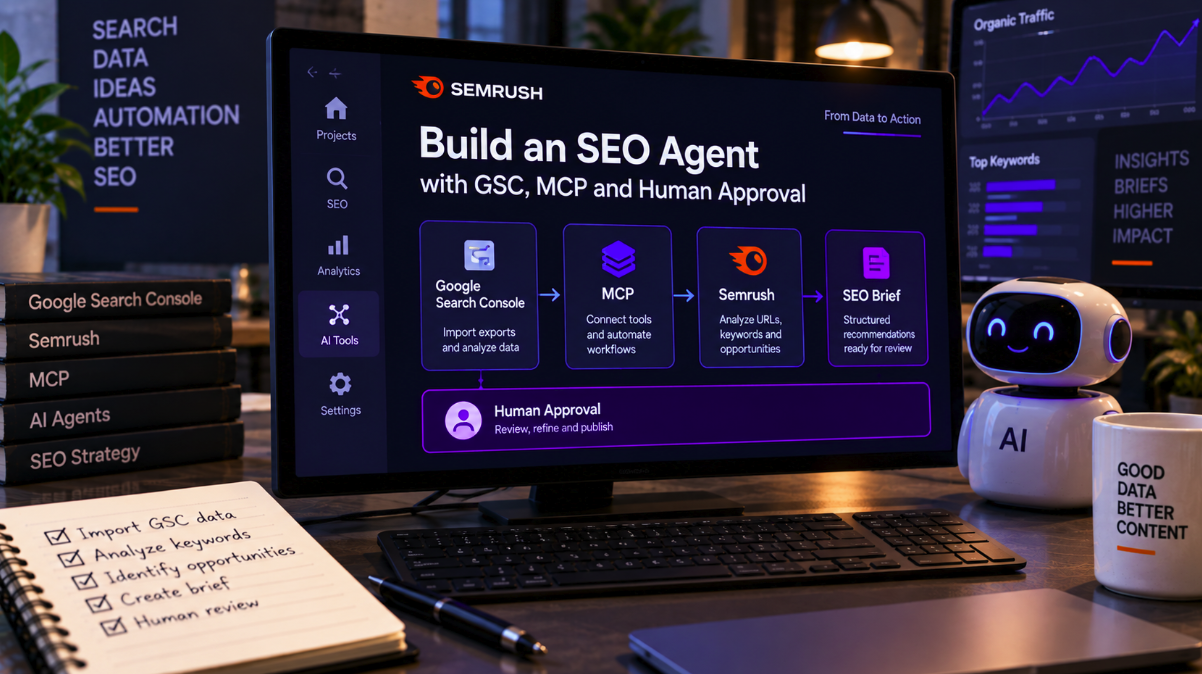
In a step-by-step guide published September 9, Semrush shows how an SEO team can turn an existing human process into an AI agent that checks Google Search Console data, performs keyword research through the Semrush Model Context Protocol connection, clusters opportunities and prepares content briefs for review.
The workflow is notable less because of any individual task than because of how the tasks are connected. Search performance data provides site-specific context, Semrush supplies external keyword and SERP data, an AI tool orchestrates the process and a human remains responsible for consequential decisions.
This is not the launch of a new Semrush SEO-agent product. It is an operational tutorial showing marketers how to assemble an agent from existing AI capabilities, data exports and Semrush’s MCP connection.
The agent starts with a repeatable human workflow
Semrush’s first recommendation is deliberately unglamorous: do not start by asking an AI system to “do SEO.”
Start with one clearly defined process.
The guide argues that a useful first agent should have clear inputs, predictable outputs and success criteria that are easy for a human to validate. Complex end-to-end automation introduces too many failure points and can also consume API units quickly during experimentation.
For the tutorial, Semrush chooses a workflow that ends with one concrete deliverable: a content brief.
The agent takes a seed keyword, checks the site’s existing Google Search Console data, researches related keywords using Semrush, groups them into topic clusters and then creates a brief for the topic the user chooses to pursue.
That narrow scope is central to the design.
Google Search Console prevents the agent from treating every keyword as a new-page opportunity
The Google Search Console step adds information that a generic keyword tool cannot provide.
Before proposing a new content asset, the workflow checks whether the website already has pages receiving impressions or clicks for related queries.
That can reveal an optimization opportunity on an existing URL rather than automatically recommending another article.
In the tutorial, GSC data is exported and uploaded as CSV files. Semrush describes this as a manual but relatively lightweight setup step that can be refreshed monthly. The company also points to a separate workflow for teams that want to connect Search Console more directly.
This distinction matters because the agent shown in the guide is not continuously synchronized with GSC by default. Its view of first-party search performance is only as current as the data supplied to it.
The setup also includes the site’s existing URLs and business context
Search Console is only one of the local inputs.
Semrush recommends giving the agent a list of existing site URLs so it can recognize current content and suggest internal linking opportunities in the final brief.
The example also includes a business-context file.
That file can contain information the model would not reliably infer from public keyword data, such as the company’s products, positioning, audience and upcoming launches.
In Semrush’s test, that context allowed the agent to add writer notes related to products that had not yet launched.
This is a useful pattern for agent design: external market data can identify demand, but private business context determines whether an opportunity actually makes sense for the company.
Semrush MCP supplies the external keyword data
The second major data source is Semrush itself.
The guide connects the AI environment to Semrush through Model Context Protocol, or MCP. MCP provides a structured way for an AI application to communicate with external data and tools instead of relying only on information inside the model’s context.
In this workflow, the connection allows the agent to query Semrush keyword data while researching the seed topic and building clusters.
Semrush says its current SEO and SEO + AI subscriptions include a monthly allowance of MCP API units. That is a vendor plan entitlement and can change over time, so teams building production workflows should verify current limits rather than treating the tutorial’s allowance as permanent infrastructure.
The more important architectural idea is that the language model is not asked to invent search volumes, keyword difficulty or other SEO metrics. Those values should come from connected data sources.
Verified data is an anti-hallucination layer
Semrush explicitly recommends connecting verified sources of truth because AI agents can hallucinate metrics and facts.
Potential sources can include Semrush, Google Search Console, Google Analytics, a content management system and manually maintained keyword or URL lists.
This is one of the clearest differences between a casual SEO prompt and an operational agent.
A prompt such as “find me good keywords for this topic” leaves the model considerable freedom to generate plausible-looking suggestions. A tool-connected workflow can require the model to retrieve actual keyword metrics and preserve the evidence behind its recommendations.
The agent still interprets the data, and that interpretation can be wrong. But grounding narrows the class of errors from fabricated inputs toward debatable analysis — a much more manageable review problem.
The human process becomes the agent’s operating instructions
Before configuring the AI tool, Semrush recommends documenting how a skilled SEO would perform the process manually.
That documentation should include the data sources used, rules and filters applied, exceptions handled and expected outputs.
The document is then converted into instructions the agent can repeatedly follow.
This is effectively process engineering rather than prompt engineering.
The value comes from capturing decisions that would otherwise live in an SEO specialist’s head: when an existing page should be optimized, which keyword thresholds matter, what should be excluded, how clusters should be separated and what evidence must appear in the final brief.
The more explicit those rules are, the less the workflow depends on a model improvising a different process each time.
The tutorial breaks the agent into three stages
Semrush’s example uses a staged architecture rather than one giant request.
The first stage is setup. The user provides business context, Google Search Console data and the list of existing URLs. The agent processes the GSC information into a reusable CSV of clustered queries.
The second stage begins when the user supplies a seed keyword or topic. The agent uses the connected data to research the market and outputs another CSV containing clustered topic opportunities.
The third stage remains user-directed. The human chooses which topic from that output should be pursued, and the agent creates the content brief.
Semrush specifies a DOCX brief in its example, but notes that the output could instead be Markdown, PDF or a Google document if the appropriate connection is available.
The structure is significant because the agent does not autonomously choose every strategic action. It prepares choices, then waits for human direction before proceeding.
Human approval is part of the architecture, not an emergency fallback
Semrush repeatedly argues against treating autonomy as the goal.
The guide says SEO agents can still hallucinate and make mistakes even when they are properly configured. For high-impact actions, the recommended pattern is therefore to insert explicit approval gates.
Publishing is one example.
Redirects and code deployments are others.
An agent can prepare the brief, recommend an internal link or identify a redirect opportunity. A human should review the evidence and decide whether to implement actions that can affect the live site, brand or revenue.
This is a more conservative design than the “fully autonomous SEO employee” narrative sometimes attached to agents, but it is also easier to audit.
Some SEO work is a poor fit for agents
The guide also identifies cases where building an agent can create more overhead than value.
One-off tasks are an obvious example. If a process will happen once, a normal prompt can be faster and cheaper than designing, testing and maintaining a reusable agent.
Constantly changing workflows are another poor candidate. If the instructions need to be rewritten on every run, the automation has not actually captured a repeatable process.
Semrush also warns about tasks requiring heavy editorial judgment or brand-risk assessment.
Those workflows may require so much oversight that the economics of automation deteriorate. The point is not that AI cannot contribute to them, but that turning them into an autonomous agent may solve the wrong problem.
The agent is demonstrated in Claude, but the pattern is not Claude-specific
Semrush uses Claude in the walkthrough and demonstrates saving the instructions as a reusable skill.
The guide says the underlying data connection can also be used from other AI environments. It specifically notes that ChatGPT users can find the Semrush connection through Plugins.
The important component is therefore not the model brand.
The architecture consists of an AI environment capable of following reusable instructions, connected external data, persistent business context and review checkpoints.
Teams can reproduce that pattern in different platforms as long as the necessary integrations and controls are available.
Tool instructions can control both quality and cost
Agents introduce a resource problem that ordinary prompts often hide.
Every external lookup can consume API or MCP units. Long reasoning chains consume model tokens. Repeated testing multiplies both.
Semrush therefore recommends specifying which tools the agent should use and at which stages.
That constraint can improve reliability because the model has less freedom to select unnecessary data sources. It can also reduce the cost of a badly scoped workflow repeatedly making expensive calls.
This becomes particularly important when an agent is shared with a larger team. Semrush warns that many users running the same workflow across different models can consume token and API allowances quickly.
The output should preserve evidence, not just recommendations
One of the stronger governance ideas in the guide is to require the agent to show why it made a recommendation.
In Semrush’s example, suggested keywords in the content brief are accompanied by source evidence.
A reviewer can therefore inspect whether a proposed heading came from competitor analysis, whether a keyword was included because Semrush reported meaningful volume or whether an internal link was suggested because the target URL appeared in the site inventory.
This makes human approval materially different from simply reading polished AI copy and deciding whether it “looks right.”
The reviewer has an audit trail.
For production SEO agents, that traceability can be more valuable than another layer of autonomous decision-making.
Testing multiple inputs is essential before deployment
A workflow that succeeds on one seed keyword is not necessarily reliable.
Semrush recommends testing the agent with multiple inputs and examining both the output and the reasoning or evidence behind it.
The example is run across different content types, including list-style topics and comprehensive guides, before being treated as reusable.
This is effectively acceptance testing for an AI workflow.
The goal is to discover where the instructions are ambiguous, where data is missing and where the model makes decisions that an experienced SEO would reject.
The instructions can then be revised and the tests repeated.
The workflow can extend into project management without extending into automatic publishing
Once the core process works, Semrush says the agent can be connected to communication and project-management systems such as Slack or Monday.com.
That creates a useful distinction between automating workflow administration and automating consequential site changes.
An agent can generate a brief, deliver it to the team and create a task automatically. The content can then move through the normal editorial process.
Publishing remains a separate action requiring approval.
This pattern can also apply to technical SEO: detection and task creation can be automated while redirects, templates or code changes remain controlled.
This is a workflow guide, not evidence that agents improve rankings
Semrush has a commercial interest in encouraging use of its data and MCP connection, and the September article should be read accordingly.
The guide does not present a controlled study showing that its agent produces better rankings, more organic traffic or higher-quality briefs than an experienced SEO working manually.
It also does not quantify time savings across a production team.
What it provides is an implementation pattern.
That pattern is useful because it exposes the operational decisions often skipped in discussions of AI agents: data freshness, tool permissions, input formats, API costs, validation, auditability and human responsibility.
The value of a specific implementation still needs to be measured by the organization using it.
The real automation opportunity is the repeatable middle of SEO work
The Semrush walkthrough points toward a pragmatic role for agents in SEO.
They are well suited to the repeatable middle of a workflow: collecting known inputs, querying approved data sources, applying documented rules, organizing results and preparing a structured deliverable.
The beginning and end remain more human.
An SEO professional defines the process and business constraints. A reviewer then decides whether the output is strategically sound and whether anything should be published or changed on the live site.
That division is less dramatic than handing an AI agent the keys to a CMS, but it is far more defensible.
Semrush’s guide is therefore not really a story about replacing SEO work. It is a blueprint for converting a recurring SEO procedure into software-like instructions while keeping the decisions with real consequences behind an approval gate.
For teams experimenting with agents, that may be the most useful starting point: automate the repetition, connect the data, preserve the evidence — and keep a human between the recommendation and the publish button.