
A UK publisher’s domain migration looked severe in conventional SEO tools. When the same move was measured against the fast-changing queries that drive Google News and Top Stories visibility, it looked almost catastrophic.
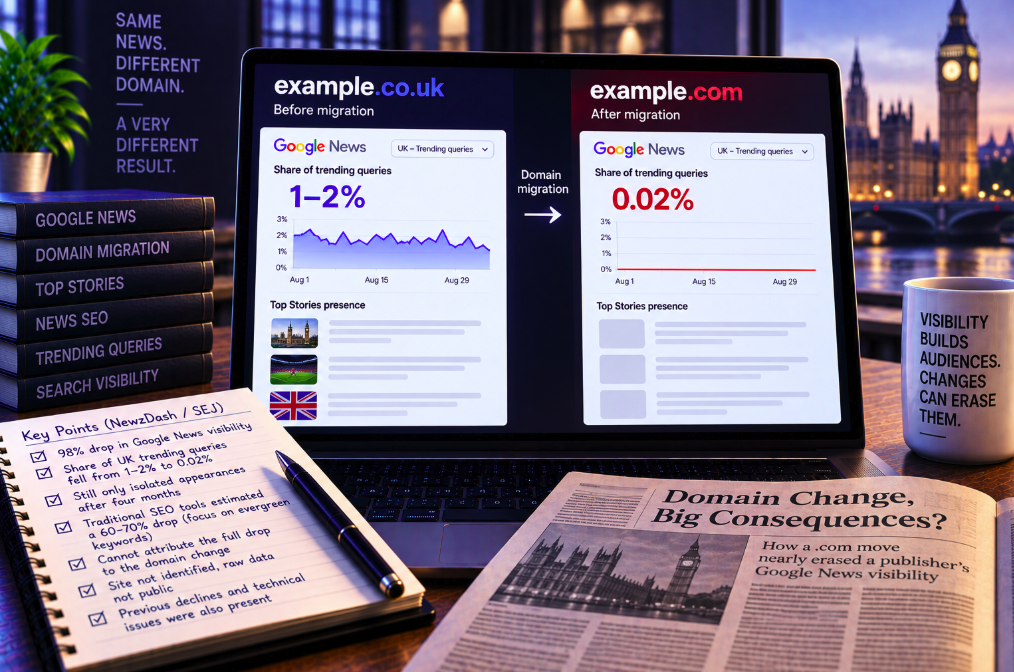
According to Search Engine Journal’s September 8 report on NewzDash data, an unnamed publisher that moved from a .co.uk domain to a .com saw its share of monitored UK trending-news visibility collapse from roughly 1–2% to 0.02% within two weeks. NewzDash describes that as a 98% decline.
Four months after the migration, the new domain was still producing only isolated appearances in the monitored news results rather than recovering the old domain’s footprint. Yet ordinary SEO tools reportedly showed a smaller 60–70% decline, illustrating how dramatically a migration can look different depending on which queries the measurement system follows.
The case is striking, but it is not a controlled experiment. The publisher has not been identified, the underlying data is not public, and NewzDash founder John Shehata says the site had already been losing visibility during core updates and was dealing with technical problems. The evidence therefore cannot establish that changing from .co.uk to .com caused the entire loss.
The old domain had 14 months of measured news visibility
NewzDash monitored the publisher’s .co.uk domain for 14 months before the migration.
During that period, Shehata says the site generally held between 1% and 2% of the Search Visibility measured across the news queries NewzDash tracks. For context, he says publishers of comparable size would often fall in a 3–6% range, meaning the site was not an unusually dominant news property before the move.
Visibility had also been weakening before the domain switch. That pre-existing decline becomes crucial when interpreting what happened afterward because the migration did not begin from a perfectly stable baseline.
The publisher nevertheless still had a measurable recurring presence across UK trending-news results under the old hostname.
Two weeks after the move, visibility was down to 0.02%
The publisher reportedly migrated its entire site overnight from the country-code domain to the global .com.
NewzDash’s monitored Search Visibility fell to 0.02% within two weeks, a decline of approximately 98% from the prior level.
The important detail is that the new domain did not simply replace the old one in the monitored news surfaces. The visibility accumulated by the .co.uk largely disappeared without an equivalent footprint appearing on the .com.
Four months later, according to the case report, the new hostname still appeared only sporadically.
For a news publisher, four months is a very different problem from the temporary volatility commonly expected during a conventional migration. News value is highly time-sensitive: a story that fails to surface during its first hours cannot recover that lost opportunity months later.
The 98% figure is a visibility estimate, not measured traffic
The headline number needs a precise definition.
NewzDash’s Search Visibility metric is not a direct count of clicks from Google. It is an estimated click-share score derived from variables including ranking position, estimated click-through rate, how long the result ranks and the number of URLs appearing for the monitored queries.
In other words, the metric estimates likely search exposure and click opportunity. It does not prove that the publisher’s actual Google traffic fell by exactly 98%.
This distinction is particularly important for news because user behavior can vary substantially between query types, SERP layouts and breaking-news events.
The case is best described as a 98% collapse in NewzDash’s trending-news Search Visibility measure, not as independently verified evidence that the publisher lost 98% of all Google News traffic.
Why conventional SEO tools saw only a 60–70% decline
The most useful part of the case may be the disagreement between measurement systems.
According to Shehata, conventional SEO platforms estimated that the migration had produced a 60–70% decline. That would already qualify as a serious migration failure.
NewzDash’s news-focused measurement was considerably worse because it was observing a different search universe.
Traditional rank-tracking platforms commonly monitor a fixed or relatively stable keyword set. Those keywords often include evergreen topics whose search demand and SERP composition change gradually.
News visibility behaves differently. Yesterday’s important query may be irrelevant tomorrow, while a phrase that did not exist this morning can dominate search demand by the afternoon.
Trending-query tracking measures a moving target
NewzDash is built specifically around news and editorial search visibility. Its platform tracks trending keywords and publisher performance across Google Search surfaces including Top Stories, organic results and other news-oriented SERP features.
That methodology continuously changes the query set as the news cycle changes.
For a publisher, this can reveal losses that an evergreen keyword tracker misses entirely. A site may retain rankings for established informational pages while disappearing from the high-velocity queries responsible for its daily newsroom traffic.
Both measurements can be accurate within their own scope. The traditional tool may correctly report that evergreen visibility fell 60–70%, while the news-specific tracker correctly reports that visibility across its trending query universe fell approximately 98%.
The apparent contradiction is actually a measurement lesson: a migration does not have one universal “visibility loss.” It has different effects across different query populations.
Top Stories makes news SEO unusually sensitive to timing
For evergreen search, losing a ranking temporarily can be painful but recoverable. A page that returns to position three next month can continue attracting traffic for years.
Top Stories does not offer that luxury.
Breaking-news queries have short commercial and editorial half-lives. If a publisher disappears from Top Stories during an election result, sports final, celebrity announcement or major breaking event, the missed visibility cannot simply be reclaimed when the domain stabilizes weeks later.
That makes migration risk asymmetric for publishers. Even a technically temporary reprocessing period can destroy permanent traffic opportunities because the underlying demand expires before the site recovers.
A migration plan suitable for an ecommerce catalog or B2B content site may therefore be too aggressive for a newsroom.
NewzDash cannot isolate Top Stories from organic losses in this case
The case also has an important measurement limitation.
NewzDash’s reported visibility includes Top Stories and organic search results, but the published case does not separate how much of the 98% decline came from each surface.
Shehata says the impact was particularly deep in news-oriented results, but the public data does not provide a clean Top Stories-only causal decomposition.
That means it would be too strong to say that the publisher lost exactly 98% of its Top Stories visibility or exactly 98% of its Google News traffic.
The defensible claim is that its estimated visibility across the monitored trending Google news-query environment collapsed by that amount.
The publisher moved the entire site overnight
According to the account summarized by Search Engine Journal, the publisher wanted to consolidate around a single global domain and avoid being classified by advertising systems as specifically British.
Rather than transitioning gradually, it moved the full site overnight.
That decision matters because large domain migrations create multiple simultaneous changes for search engines. URLs change, redirects need to be processed, canonical signals move, sitemaps change and Google must crawl and understand the relationship between the old and new hostnames.
For a constantly publishing newsroom, this happens while hundreds or thousands of new URLs may continue entering the system.
The result is not simply a static transfer from one domain to another. The publisher is asking Google to process the migration while simultaneously evaluating a continuous stream of fresh news content whose ranking window may last only hours.
Google says site moves can take weeks or longer to process
Google’s documentation treats a domain change as a standard type of site move, but it does not promise an instantaneous transfer of search performance.
The company explains that individual URLs are processed separately as Google recrawls the old and new locations. Medium-sized sites can take weeks for new URLs to appear fully in search, while larger sites may take longer.
Google also says permanent redirects do not cause a loss of PageRank, an important clarification because domain migrations are sometimes described as automatically “losing link equity.”
But PageRank transfer is only one part of a migration. Crawling, canonicalization, indexing, freshness and ranking all still have to be processed.
For news publishers, the distinction between preserving link signals and preserving immediate Top Stories eligibility can be commercially enormous.
Google advises large sites to consider moving in sections
Google’s site-move guidance notes that large sites can test a move on one section first, ideally a relatively stable section that does not change frequently.
It also advises against combining a domain migration with other major changes such as a CMS replacement or redesign when possible.
Those recommendations reduce the number of variables changing simultaneously and create an opportunity to identify technical problems before the entire property is exposed.
For a news publisher, a phased approach can also provide evidence that the new hostname is being crawled, indexed and surfaced appropriately before the highest-value breaking-news operation depends on it.
The NewzDash case does not prove that a phased migration would have prevented the decline. It does show why the ability to test the new domain before a full cutover has significant value.
Google News ranking involves more than redirects and PageRank
News visibility is governed by signals beyond the mechanics of transferring URLs.
Google describes factors such as relevance, prominence, authoritativeness, freshness, usability, location and language as important to Google News ranking.
How all of those signals behave during a hostname migration is not publicly documented in enough detail to predict an individual publisher’s outcome.
Shehata argues that news systems may attach meaningful publication history and editorial trust to the hostname, and he uses the term “Google Reset” to describe the broader reevaluation he believes can follow major site changes.
That terminology is his interpretation, not an official Google concept. Google has not documented a special news-domain reset that automatically erases a publication’s history after a migration.
The case therefore raises the hostname-history hypothesis without proving it.
The site already had problems before the migration
The strongest reason not to treat the case as proof of domain-change causation is the publisher’s pre-migration condition.
Shehata says the site had already lost visibility during several Google core updates. Internal technical issues were also present.
Those factors could interact with a migration in several ways. A site already being reevaluated algorithmically may have less stable rankings to transfer. Technical problems can interfere with redirects, crawling, canonicals, sitemaps or rendering. A weakening editorial footprint can continue declining independently of the hostname change.
Without the identity of the site and raw crawl, Search Console and server-log data, outside analysts cannot separate those effects.
The timing makes the migration an obvious suspect, but timing alone is not causal proof.
The publisher is anonymous, preventing independent verification
Unlike a public migration where analysts can inspect redirects, indexation and historical visibility themselves, the publisher in this case is not named.
That protects the organization but limits what the case can establish.
Independent researchers cannot check whether every old URL maps correctly to a new URL, whether redirect chains exist, whether canonicals point to the right hostname, whether robots directives changed or whether important sections were accidentally removed.
They also cannot compare the NewzDash visibility estimate with Search Console clicks, Discover traffic, Google News referral data or server logs.
The 98% figure therefore remains a vendor-reported case metric rather than an independently reproducible measurement.
Raw NewzDash data has not been published
The underlying query-level dataset is also not public.
That means outside analysts cannot inspect which trending queries were monitored before and after the migration, how query composition changed, how the visibility score was aggregated or whether a handful of exceptionally large events influenced the result.
This does not make the analysis invalid. NewzDash specializes in precisely this type of news visibility measurement and has a methodology designed for changing query demand.
It does mean the result should be described with attribution: NewzDash reports a 98% decline under its Search Visibility methodology.
The more dramatic the number, the more important that qualification becomes.
The real lesson is about measurement design
Even if the exact causal contribution of the domain migration remains unresolved, the case exposes a genuine analytics problem for publishers.
An SEO dashboard can show a 60% decline while a newsroom’s most valuable search surface is effectively disappearing.
That happens because the dashboard answers the question encoded in its keyword set. If the tracker monitors evergreen queries, it measures evergreen visibility. It cannot automatically reveal performance on breaking queries that did not exist when the tracking project was configured.
For publishers, a migration benchmark therefore needs multiple layers: stable keyword rankings, trending-query visibility, Top Stories presence, Google News performance, Discover, Search Console clicks and direct traffic or subscription outcomes.
No single visibility index can substitute for all of them.
Newsrooms should establish a trending-query baseline before migrating
The NewzDash case also highlights the value of collecting news-specific data before the first redirect is switched on.
A publisher should know its normal share of Top Stories and trending-query visibility by section, device and market. It should understand how often new stories appear in search, how quickly Google crawls them and how long they remain competitive.
Without that baseline, a post-migration newsroom can see traffic decline without knowing whether the problem is crawling, indexation, ranking, query demand or a broader algorithm update.
Monitoring should also continue at high frequency during the cutover. Waiting for a weekly enterprise SEO report can be too slow when a breaking-news ranking opportunity disappears within hours.
Evergreen rankings can create false reassurance
A publisher may complete a migration and see its major evergreen pages reappear quickly on the new domain.
That can create the impression that Google has successfully transferred the property.
But news systems may behave differently. The site can preserve rankings for established explainers while failing to enter Top Stories for new events. Branded searches can look normal while non-branded trending visibility collapses.
This is why migration QA for a publisher cannot stop at checking a list of historical high-traffic keywords.
The most valuable test may be whether entirely new articles on the new hostname can compete for entirely new queries.
A phased migration may be more valuable for publishers than for ordinary sites
Every migration carries operational cost, and splitting one into stages can make implementation more complex.
For publishers, however, the option value of a staged move is unusually high.
A low-risk section can reveal whether redirects are being processed, whether Google recognizes the new hostname, whether new URLs index quickly and whether news-oriented visibility begins transferring as expected.
If those signals fail, the organization can investigate before moving politics, sports, finance or other high-velocity desks.
This is not a guarantee against ranking loss. It is a way to reduce the amount of the site exposed to an unknown failure mode at one time.
The .com itself should not be treated as inherently harmful
The case also should not be simplified into “Google News prefers .co.uk to .com for UK publishers.”
The evidence does not establish such a rule.
Many major British and international publishers operate successfully on global top-level domains. Google’s documentation supports domain migrations as a normal site operation when implemented correctly.
The relevant change here is the migration of an established publication from one hostname to another, not the inherent quality of the .com extension.
Market relevance can matter in search, but a country-code domain is only one possible signal among many. The failure of one anonymous migration cannot establish a universal ccTLD advantage for Google News.
Four months without recovery makes the case difficult to dismiss
The limitations prevent a clean causal conclusion, but the duration of the reported loss still deserves attention.
A two-week decline could plausibly represent ordinary migration volatility. Four months with only isolated appearances on the new domain suggests that the publisher’s news visibility did not simply transfer after Google completed an initial recrawl.
Something materially changed in the site’s ability to compete across the monitored trending-query environment.
Whether the dominant cause was the hostname switch, technical execution, previous algorithmic decline or an interaction among all three remains unknown.
For publishers considering a similar consolidation, that uncertainty is itself a risk worth planning around.
A migration can look manageable until you measure the queries that matter
The most important conclusion from the NewzDash case is not that every news publisher will lose 98% of visibility after changing domains.
It is that the measurement system used to evaluate a migration can conceal the most commercially important failure.
Traditional tools reportedly showed a 60–70% decline. NewzDash, following a changing set of UK trending queries across Top Stories and organic news results, measured the publisher falling from roughly 1–2% visibility to 0.02% within two weeks. Four months later, the new domain had still not rebuilt the old footprint.
The publisher’s anonymity, unpublished raw data, prior core-update losses and technical problems mean the migration cannot be assigned sole responsibility. The 98% figure is also an estimated visibility metric rather than measured traffic.
But for news SEO, the case demonstrates a crucial principle: evergreen rankings and breaking-news visibility are different systems to measure. A migration can look merely bad in one and almost catastrophic in the other. Publishers need to know which one actually drives their audience before they move the domain—not after.