
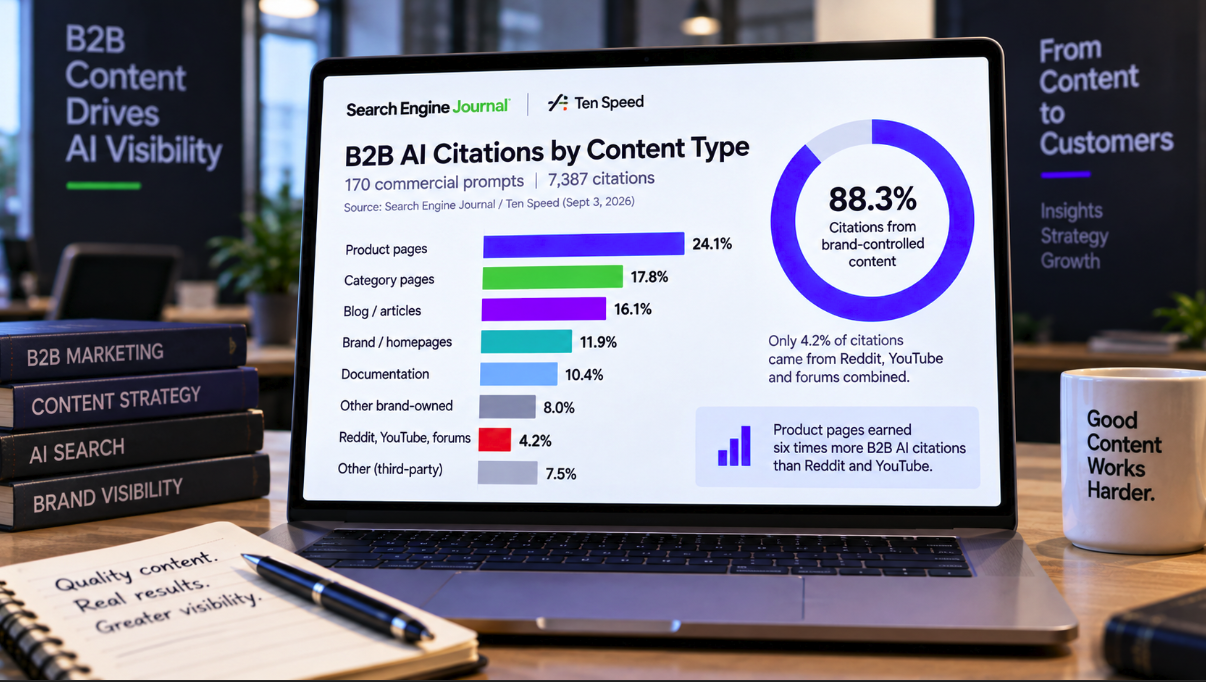
A B2B AI citation study is challenging one of the most repeated assumptions in generative engine optimization: that brands need to prioritize Reddit, YouTube and community discussions if they want to become sources for AI answers.
In a dataset focused specifically on commercial evaluation prompts, product pages were cited far more often.
Ten Speed analyzed 7,387 citation appearances generated from 170 mid- to bottom-of-funnel B2B prompts tracked through Peec AI. Product pages accounted for 24.1% of those citations, making them the largest individual page category. Community-driven sources — including Reddit, YouTube, forums and discussion threads — accounted for 4.2%.
That makes the product-page share roughly 5.7 times the entire community-source share, or about six times as large when rounded.
The finding was examined in detail by Search Engine Journal on September 3, which questioned Ten Speed about its methodology before publishing the result. The underlying Ten Speed analysis reaches an even broader conclusion: content that B2B marketing teams can substantially control accounted for 88.3% of citation volume in this particular dataset.
That is a striking result. It is not a universal benchmark for AI search.
The study looked at buyers evaluating products, not people asking general questions
The most important methodological detail is the type of prompt Ten Speed studied.
The agency deliberately excluded broad informational queries such as “what is a CRM.” Instead, its researchers wrote prompts intended to represent buyers who had moved further down the funnel and were actively evaluating products, integrations and use cases.
Examples included questions resembling “Pipedrive vs. HubSpot for sales-led companies,” questions about how a named product handles SOC 2 reporting, and queries asking which tools fit a particular operational scenario.
That distinction changes what sources an AI assistant is likely to need.
A broad question about the reputation of a software category might benefit from community discussions, videos and independent commentary. A precise question about whether a product supports a feature or integration has an obvious authoritative source: the company’s own product documentation or product page.
The study therefore says something specifically about B2B evaluation-stage retrieval, not AI citations in general.
Product pages led every other page category
Ten Speed’s final page-type breakdown puts product pages at 24.1% of all citation appearances.
Articles — a category covering blog posts, news and PR — followed at 17.4%. Comparison content represented 13.3%, listicles 13.2%, how-to guides 8.9% and homepages 7.8%.
Third-party profiles such as software directories represented 7.2%. Discussion content accounted for 3.7%, alternative pages 2.4%, category pages 1.2%, video 0.5% and residual unclassified material 0.2%.
The dominance of product pages makes intuitive sense in the context of the prompts.
When an AI system needs to answer what a product does, who it serves, which features it contains or whether it supports a particular use case, the page specifically written to explain that product is a natural retrieval candidate.
The useful lesson is not that every company should create more product pages. It is that existing product pages may be performing an AI-retrieval function that marketing teams historically treated as secondary to conversion.
The 4.2% community figure includes more than Reddit and YouTube
The headline comparison needs one technical clarification.
Ten Speed’s 4.2% community bucket includes Reddit, YouTube, forums and similar discussion sources. It is therefore broader than Reddit and YouTube alone.
Search Engine Journal reports that Reddit contributed most of the community activity while YouTube was only around 1% in the version of the analysis it reviewed. Ten Speed’s current page-type chart classifies discussion content at 3.7% and video at 0.5%.
So “six times more than Reddit and YouTube” works as a shorthand for the broader owned-versus-community contrast, but the exact denominator is community-driven sources collectively.
That precision matters because citation studies are especially vulnerable to catchy ratios surviving after their methodological definitions disappear.
Brand-controllable content accounted for 88.3%
The broader number is arguably more strategically important than the product-page result.
Ten Speed groups product pages, articles, comparison pages, listicles, how-to guides and homepages as content a brand can directly produce and control. Together, those surfaces represented 88.3% of citation volume in the evaluation-stage dataset.
This pushes against a common narrative that GEO is primarily an off-site reputation exercise.
Third-party validation still matters. Review sites, community discussions and independent sources can influence both buyers and AI systems. But in this sample, most linked sources came from the kinds of pages B2B marketing teams can create, edit and improve themselves.
That is good news for brands because it makes a large portion of AI visibility operational rather than purely reputational.
The study does not show that AI assistants inherently prefer brand-owned content
The 88.3% figure should not be interpreted as evidence of a universal model preference for first-party sources.
The prompt design itself matters.
If a user asks how a particular vendor handles a specific integration, the vendor’s website is likely to contain the most direct factual answer. If the prompt asks whether customers actually like that integration, an independent review or Reddit discussion may become much more relevant.
Ten Speed acknowledges this limitation. Its study is restricted to evaluation-stage B2B prompts and explicitly warns that informational and top-of-funnel citation patterns can look different.
The research therefore supports a funnel-specific strategy rather than a blanket claim that owned content beats community content everywhere.
The data came from ChatGPT, Perplexity, Claude and Gemini — but they were averaged together
Peec AI tracks citations across multiple AI platforms, including ChatGPT, Perplexity, Claude and Gemini.
That gives the dataset breadth, but it also creates one of its biggest unresolved questions.
Ten Speed did not retain a clean platform-level breakdown for this pull. Search Engine Journal specifically asked about the issue and reported that the underlying data could not show whether the 24.1% product-page share was driven disproportionately by one AI system.
That matters because AI engines do not retrieve and cite sources identically.
A result averaged across four systems can hide substantial differences. Product pages might dominate one engine while comparison articles or third-party sources play a larger role in another.
Ten Speed identifies this as the main question it wants to answer in future research.
The real sample size is harder to judge than 7,387 makes it appear
Seven thousand three hundred eighty-seven citations sounds like a large dataset, but those are citation appearances rather than 7,387 independent companies or URLs.
A source cited repeatedly across multiple responses contributes repeatedly to the count.
The study also draws from Ten Speed’s own B2B SaaS and professional-services client base, supplemented with look-alike competitors. Industries represented include fintech, physical security, hospitality and IT automation.
Search Engine Journal asked how many distinct client brands sat behind the dataset. Ten Speed declined to provide even a range because it said combining that information with the disclosed verticals could risk identifying confidential clients.
That is a legitimate confidentiality constraint, but it prevents outside researchers from fully assessing how diverse the underlying company sample is.
A dataset with thousands of citation events can still be concentrated around a relatively small number of brands.
There was also a prompt-count error that required clarification
Search Engine Journal’s methodological questioning uncovered an inconsistency worth documenting.
One published Ten Speed visual described a 220-prompt set while other parts of the research used 170. Ten Speed confirmed to Search Engine Journal that 170 was the correct denominator and said the mislabeled visual would be corrected.
The current Ten Speed article still contains the 220-prompt label in one prompt-breakdown section while its citation chart and later comparison analysis use 170.
This does not invalidate the citation breakdown, but it illustrates why methodological scrutiny matters before AI-search statistics become industry folklore.
The verified headline dataset is 7,387 citation appearances across 170 prompts.
The 24% versus 4% headline comparison was descriptive, not a statistical test
Another important caveat came from Search Engine Journal’s questions.
Ten Speed says it used nonparametric statistical methods for some comparisons of citation rates across page types. But when asked whether the specific 24% versus roughly 4% contrast behind the headline had itself been statistically tested, the agency said it was a descriptive result.
That means the percentages describe what happened in this sample. They do not establish that the same difference would reliably appear across the broader universe of B2B brands, prompts and AI engines.
Ten Speed is appropriately explicit about this in its methodology. It calls the research practitioner intelligence, notes that it has not been peer reviewed and says the findings should be treated as directional observations rather than definitive industry benchmarks.
That caveat should remain attached to the statistic whenever it is reused.
Comparison pages may be an underused B2B AI surface
One secondary finding deserves attention from content teams.
Comparison-format prompts represented 34 of the 170 prompts, or 20% of the set, but generated 1,970 of the 7,387 citation appearances, or 26.7%.
Ten Speed describes that as a 1.33-times over-index relative to the prompt share.
Again, this is best read directionally. But it fits the evaluation-stage context.
A buyer asking “X versus Y” creates an information need that naturally rewards pages capable of explaining differences between competing products. B2B brands often produce those pages defensively, usually when sales teams repeatedly encounter a particular competitor.
The data suggests comparison content may deserve to be treated as a primary AI retrieval surface rather than a late-stage SEO afterthought.
Homepages are doing more than branding
Homepages accounted for 7.8% of citation appearances, which is notable for a page type often optimized around positioning rather than detailed product facts.
Ten Speed argues that AI systems can use a homepage to establish a baseline definition of a company: what it sells, which category it belongs to and who the product is designed for.
This creates a familiar tension between clever marketing language and machine-readable specificity.
A homepage that says a company “unlocks tomorrow’s potential” may sound polished while communicating almost nothing about the actual product. A sentence stating that the company provides cloud cost-management software for enterprise infrastructure teams gives both buyers and retrieval systems much more usable information.
AI visibility adds another reason for brands to make their core category and product definition explicit.
Review-directory profiles are partly controllable too
Third-party software profiles represented 7.2% of citations in the dataset.
Ten Speed highlights sites such as G2 and Capterra as an unusual middle ground. The brand does not own the platform, but it often controls substantial parts of the profile: product descriptions, categories, integrations and feature information.
That means a stale directory profile can become a stale AI source.
For B2B marketers, review-site management may therefore need to expand beyond monitoring ratings and responding to reviews. Accurate category placement and current product information can influence what an AI system retrieves when assembling a shortlist.
Reddit and YouTube are not disproven — they may answer a different buyer question
The study should not become evidence that Reddit and YouTube do not matter for GEO.
Ten Speed itself says community content may play a different role earlier in the buying journey.
Someone exploring “what is the best way to manage cloud costs?” may value practitioner discussions, videos and independent opinions. Someone asking “does Vendor X support AWS Reserved Instance automation?” is asking a factual product question for which first-party documentation can be the strongest source.
Both behaviors can occur in AI assistants.
The mistake would be allocating content investment as if a citation study built around bottom-of-funnel prompts describes every stage of discovery.
Citations are not clicks, leads or revenue
Perhaps the most commercially important limitation is that the study measures citations.
It does not measure whether users clicked those sources. It does not measure demo requests, opportunities, closed deals or incremental revenue.
Ten Speed explicitly says it does not yet have data connecting the citation patterns to pipeline.
A product page being cited by an AI assistant may increase brand visibility or credibility. It may also satisfy the user without generating a visit. Without downstream behavioral data, the economic value of one citation remains uncertain.
GEO measurement therefore needs to avoid repeating an old SEO mistake: treating visibility metrics as if they were automatically business outcomes.
The actionable lesson is to make product information easy to retrieve
Despite the caveats, the research points toward a low-regret B2B content strategy.
Product pages should answer basic evaluation questions plainly: what the product does, who it is for, which problems it solves, what it integrates with and how major features work.
Comparison pages should contain substantive differences rather than generic claims that the home product wins every category. Homepages should clearly define the company. Directory profiles should be accurate and current.
These improvements help human buyers even if their precise effect on AI citation probability varies by platform.
That makes them more defensible than chasing a single community platform solely because another citation study showed it appearing frequently in a different query set.
The strongest conclusion is narrower than the headline — and more useful
Ten Speed’s research does not prove that product pages universally outperform Reddit or YouTube in ChatGPT, Gemini, Claude and Perplexity. It cannot, because the dataset combines those systems, uses a specific agency client base and deliberately focuses on B2B evaluation-stage prompts.
It also does not establish that 88.3% is the normal share of brand-controllable citations across industries.
What it does show is that in 7,387 citation appearances generated from 170 commercial B2B prompts, owned and controllable content dominated — and product pages were the single largest category at 24.1%.
Community-driven sources collectively accounted for 4.2%.
That is strong enough to challenge a simplistic GEO strategy built around “get mentioned on Reddit and YouTube.” It is not strong enough to replace that slogan with another universal rule.
For B2B marketers, the better conclusion is funnel-specific: when buyers ask AI systems detailed questions about products they are actively evaluating, the pages brands already control may be some of the most important citation assets they have.