
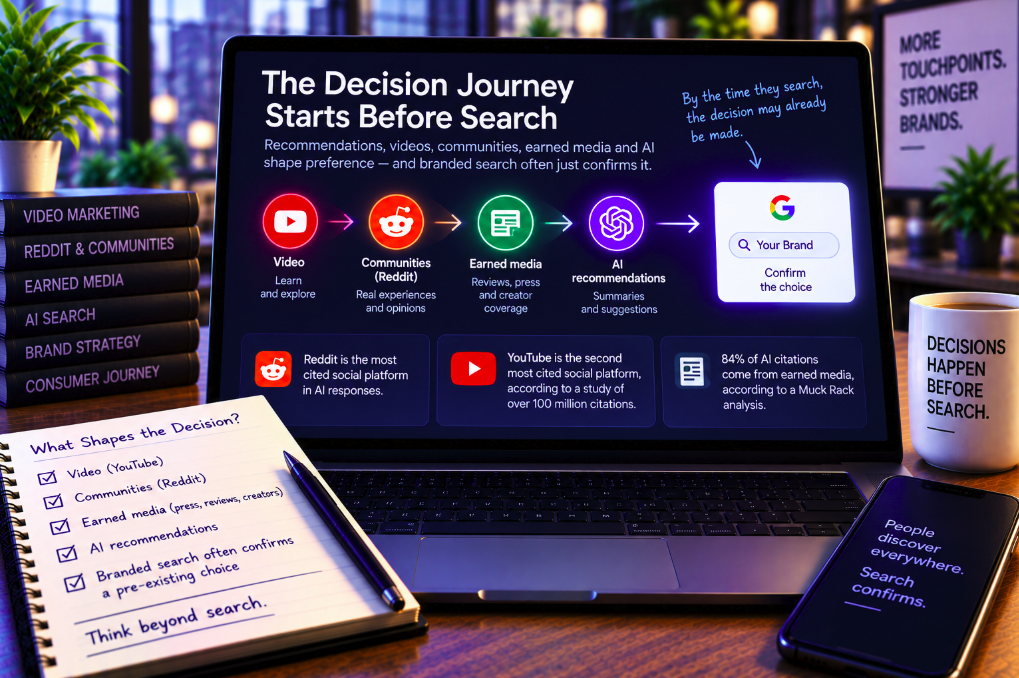
A branded Google search can look like the moment a customer chose a company. Increasingly, it may be the moment the customer merely confirmed a choice that had already been shaped somewhere else.
That is the central argument in a new Search Engine Land analysis by Karly Scott, which describes a purchase journey increasingly influenced by recommendation engines, video, community discussions, earned media and AI before a visible search query ever appears.
The attribution problem is obvious. If a buyer watches product reviews on YouTube, reads Reddit threads, encounters third-party coverage, receives an AI recommendation and then searches the brand name before purchasing, analytics may give the branded search much of the observable credit. The earlier preference-building activity can disappear from the recorded path.
That does not mean branded search is unimportant. It means the query may be doing a different job than marketers assume.
Search can be the confirmation step rather than the discovery step
Traditional funnel models often place search near the middle of the journey, where consumers actively research options and decide what they want.
Scott proposes a different sequence: passive exposure, preference development, confirmation search and purchase.
In that model, recommendation systems perform more of the discovery work. They surface products, creators, reviews and content based on inferred interests before the consumer deliberately opens a search engine.
By the time the visible query arrives, the buyer may already know the brand, product and sometimes even the exact model.
A branded query then functions less like exploration and more like navigation or validation.
Analytics sees the search; it may not see the preference forming
This creates a structural measurement gap.
A marketer can usually observe a Google Ads click, an organic search visit and a website conversion. It is much harder to reconstruct every video watched, recommendation viewed, community discussion read or AI answer consulted before that session.
If those earlier interactions are missing from the attribution chain, the measurable search touchpoint can appear more influential than it really was.
Scott describes this as one reason marketing budgets can remain centered on search even as discovery behavior spreads across other systems.
The data is not necessarily wrong. It may simply begin too late in the customer journey.
A branded search conversion can contain invisible upstream work
Consider a buyer evaluating a software category.
The buyer might first encounter a creator’s comparison video, then see the same vendor recommended in a Reddit thread. Days later, an AI assistant may include that vendor in a shortlist supported by third-party sources. The buyer finally searches the vendor’s name, visits the site and requests a demo.
A last-click or search-heavy attribution model can make the branded query look like the decisive acquisition event.
But the query may have been inevitable by the time it happened.
The commercial challenge is to distinguish demand capture from demand creation.
YouTube occupies an unusual position between human and machine discovery
Search Engine Land highlights YouTube because it can influence both people and AI systems.
For humans, video supports demonstrations, reviews, comparisons, tutorials and creator-led social proof. For AI systems, video pages can provide titles, descriptions, transcripts and other text that can be retrieved or cited.
That makes YouTube more than a video distribution channel. It can operate as a source layer for generative answers while simultaneously influencing the consumer directly.
The two effects are conceptually related, but they should not be confused. A video being cited by an AI system does not prove that it caused a purchase.
A 100-million-citation study placed YouTube behind Reddit among social sources
The Search Engine Land article cites research analyzing more than 100 million AI citations in which YouTube ranked as the second-most-cited social media platform, behind Reddit.
That is a significant visibility signal for video content in the AI information ecosystem.
It is not a purchase-attribution study.
The result tells marketers that YouTube appears frequently among social sources cited in the measured AI responses. It does not establish how often a YouTube citation changes brand preference, produces a later branded search or causes a conversion.
Those are different questions requiring different data.
Reddit’s importance comes from conversations brands do not fully control
Reddit represents the other side of the pre-search discovery problem.
Consumers use community discussions to compare products, investigate weaknesses and look for experiences that feel less controlled by the brand. AI systems can also surface or cite those discussions when answering recommendation and comparison questions.
A company can improve its product information and participate appropriately in relevant communities, but it cannot manage Reddit like an owned landing page.
That makes community reputation part of discoverability.
The information shaping a later branded search may have been written by customers, enthusiasts or critics rather than the marketing team.
Earned media is another major input into AI answers
The Search Engine Land argument also draws on Muck Rack’s research into the sources cited by generative AI.
Muck Rack’s May 2026 “What Is AI Reading?” analysis examined more than 25 million AI-cited links across ChatGPT, Claude and Gemini in 17 industries. The company reported that earned media accounted for 84% of citations, journalism represented 27%, and paid or advertorial material accounted for only 0.3%.
Muck Rack has repeated the 84% finding in its guidance on AI citations, arguing that third-party coverage plays a substantial role in the source environment behind generative answers.
For marketers, that connects PR and AI visibility more directly than traditional traffic reporting often does.
The 84% figure is not a universal model of AI influence
The number needs careful interpretation.
Muck Rack measured the source mix in its own corpus of AI answers. Its methodology uses a designed set of prompts and deliberately focuses on questions where source selection is informative; the company says it avoids transactional and branded prompts such as simple product-availability questions.
The result therefore does not mean that 84% of every AI recommendation on the internet comes from earned media.
It also does not mean earned media causes 84% of AI-influenced purchases.
It is a citation-distribution statistic within a specific research design.
The YouTube and earned-media studies cannot be combined into one attribution funnel
The two headline statistics are tempting to connect mathematically.
One dataset says YouTube is highly cited among social platforms. Another says earned media dominates citations across a large set of AI responses.
But the studies come from different vendors, methodologies, prompt corpora and platform mixes.
They do not track the same users from exposure to search to purchase.
The defensible conclusion is directional: video, communities and third-party media all have measurable visibility inside modern information systems. The studies do not reveal how much revenue each channel caused.
AI can amplify information encountered elsewhere
Generative systems add another layer because they synthesize rather than merely list sources.
A user can ask for the best product for a particular use case and receive a recommendation assembled from information distributed across publisher coverage, company documentation, community discussions and other web sources.
The consumer may never visit those sources individually.
Nevertheless, the sources can influence the generated answer that shapes the consumer’s shortlist.
This creates an attribution challenge unlike a conventional referral path: content can contribute to an answer without receiving the click that analytics would normally use as evidence of influence.
AI citation visibility and consumer influence are different metrics
Brands should therefore resist treating citation counts as a proxy for sales attribution.
A citation demonstrates that a source appeared in a measured AI response. It does not show whether the user noticed it, trusted it, changed preference because of it or eventually purchased.
Likewise, an uncited brand mention can still influence a user, while a cited source may receive no click.
AI visibility is a useful layer of measurement, but it sits upstream from economic outcomes.
The challenge is connecting that layer to later brand demand without claiming causality the data cannot support.
Google has already created one bridge between YouTube exposure and branded search
Search Engine Land points to Google’s Attributed Branded Search measurement for YouTube advertising as evidence that the industry is beginning to recognize this hidden relationship.
The metric is designed to connect eligible YouTube ad exposure with subsequent branded search behavior within a defined timeframe.
Conceptually, that is important because it treats the branded query as a downstream response to earlier media exposure rather than as an isolated discovery event.
But its scope is limited.
It measures YouTube advertising, not every organic review, tutorial, unboxing or creator recommendation a consumer may encounter.
Organic YouTube influence remains much harder to reconstruct
A consumer can watch several unpaid videos about a product without ever clicking the brand’s website.
If that consumer later searches the product by name and buys it, conventional analytics may show no connection to the videos.
This is exactly the kind of hidden upstream influence the Search Engine Land article wants marketers to consider.
The inability to observe it precisely should not be turned into a license to invent attribution.
Instead, brands need experimental and directional measurement that asks whether stronger video exposure is followed by changes in branded search, direct traffic, assisted conversions or market-level demand.
Recommendation engines can create demand without a query
The broader shift goes beyond YouTube.
Algorithmic feeds can expose consumers to products before they consciously decide to research the category. A recommendation can begin the journey without any explicit search intent.
Visual discovery tools can do the same. A user can identify an object through a camera, receive contextual information and move toward purchase without typing a conventional search query.
In these journeys, the first observable keyword may arrive very late.
Search remains valuable because it captures intent, but it may no longer deserve sole credit for creating that intent.
Brand reputation and search visibility are converging
If AI answers draw on third-party coverage and community discussions, reputation management becomes part of search strategy.
A negative Reddit thread, an outdated comparison article or repeated criticism in industry coverage can influence how a brand is represented in AI-generated recommendations.
Conversely, accurate documentation, strong reviews, useful videos and credible earned coverage can create a more consistent information environment around the brand.
This is not classic SEO in the narrow sense of optimizing a page to rank for a keyword.
It is optimization of the broader evidence ecosystem from which both people and machines form impressions.
The brand’s website is only one source of truth
Companies naturally want their own product pages to define how the market understands them.
Modern discovery systems do not operate that way.
Consumers consult creators, communities, reviewers and journalists. AI systems can synthesize many of the same external sources.
A brand can publish the clearest possible description of its product and still be represented differently if the surrounding web consistently says something else.
That makes consistency across owned and earned information increasingly valuable.
Branded search should be split into capture and creation questions
Marketers looking at branded search performance should ask two separate questions.
First, how efficiently are we capturing people who already want us? That remains a search optimization problem involving organic visibility, paid coverage, landing pages and conversion.
Second, what caused those people to want us before they searched?
The second question requires data from media, social, video, AI visibility, brand studies, CRM and other sources that sit outside the search dashboard.
Without that distinction, a brand can optimize the final confirmation step while underfunding the channels that create the preference being confirmed.
Search ROAS can look stronger when upstream influence is invisible
This is a familiar attribution distortion with a new set of channels.
When the upper funnel is poorly measured, the final measurable touchpoint inherits disproportionate credit. Branded paid search can then appear extraordinarily efficient because it reaches users who already know what they want.
That efficiency is real at the capture stage.
What it does not tell the marketer is whether the demand would exist at the same level without video, PR, communities, recommendations or other earlier exposure.
Reducing those upstream investments because branded search has a better last-click return can therefore create a delayed demand problem.
The right response is not to abandon search
Scott explicitly argues against treating the changing funnel as a reason to pull away from Search.
Search still handles enormous query volume and remains one of the clearest signals of active intent.
The strategic mistake is expecting it to perform every role in the funnel.
If Search increasingly captures confirmation behavior, marketers should optimize it for that job while ensuring other channels are funded to create discovery and preference.
The question becomes one of portfolio design rather than channel replacement.
Video libraries can serve both human and machine discovery
One practical implication is to treat useful video as durable information infrastructure rather than only campaign creative.
Product demonstrations, comparisons, tutorials, implementation guidance and expert explanations can help consumers directly while also creating text and metadata that AI systems may retrieve.
The strongest opportunity is not to manufacture videos solely for citation counts.
It is to answer the real questions buyers have in a format people want to consume and machines can understand.
If the same asset contributes to discovery on YouTube, appears in Google, informs an AI answer and improves sales enablement, its value extends well beyond its direct referral sessions.
Brands also need to participate in conversations they do not own
Reddit and other communities are harder to manage because aggressive brand participation can undermine trust.
The objective should not be to flood threads with promotional messages.
Brands can instead monitor recurring questions, correct factual errors where appropriate, support knowledgeable employees or representatives with transparent participation and use community feedback to improve owned content.
The larger point is that those conversations exist whether the company joins them or not.
If they influence both human buyers and AI answers, ignoring them does not make them irrelevant.
Earned media should be measured beyond referral traffic
PR coverage has traditionally been evaluated through reach, mentions, backlinks, referral traffic and sometimes direct pipeline.
AI introduces another possible downstream use: a piece of coverage can become a source for a generated answer long after publication.
Muck Rack’s citation research gives communications teams a reason to monitor which outlets and stories are being cited by AI systems.
That still does not establish sales attribution, but it reveals a distribution channel that referral analytics misses.
Coverage can have informational influence without sending a conventional website visit.
A new measurement stack needs several imperfect signals
No single dashboard can reconstruct the entire pre-search journey described in the article.
Brands can, however, combine multiple indicators: branded search volume, YouTube exposure, creator engagement, community sentiment, earned-media coverage, AI citation and mention visibility, direct traffic, assisted conversions, CRM outcomes and controlled market experiments.
Each metric sees a different part of the journey.
The goal is not to force them into a falsely precise attribution percentage. It is to detect whether upstream visibility and downstream brand demand move together strongly enough to guide investment.
Incrementality tests are especially valuable when the business can vary media exposure across markets or periods.
Marketers should distinguish observation from causation
The Search Engine Land thesis is plausible and operationally useful, but its supporting datasets do not causally reconstruct individual purchase journeys.
The YouTube citation study measures AI citations. Muck Rack measures the source mix of AI answers. Branded search metrics measure search behavior. None of those datasets alone follows the same person from a Reddit thread through an AI recommendation to a purchase.
Connecting them creates a strategic hypothesis, not a causal proof.
That distinction should shape both reporting and budgeting.
Marketers can act on strong directional evidence while still being explicit about what remains unmeasured.
The first visible query may be the last step in an invisible decision
Search has not stopped mattering. Its role is becoming easier to misread.
A branded query is an extraordinarily valuable signal because it shows that a consumer knows what to ask for. But precisely for that reason, it may reveal that the most difficult marketing work happened earlier.
YouTube reviews, Reddit discussions, earned coverage, recommendation feeds and AI answers can all contribute to the information environment in which preference develops. The evidence cited by Search Engine Land shows that those channels are visible to AI systems at meaningful scale, but it does not tell us exactly how much each one caused a later purchase.
That uncertainty should not push marketers back toward the easiest metric.
It should push them toward a more honest model of the journey: search captures an intent signal we can see, while much of the preference behind that signal may have formed in places attribution systems barely observe.
Branded search may still deserve the conversion. It just may not deserve all the credit.