
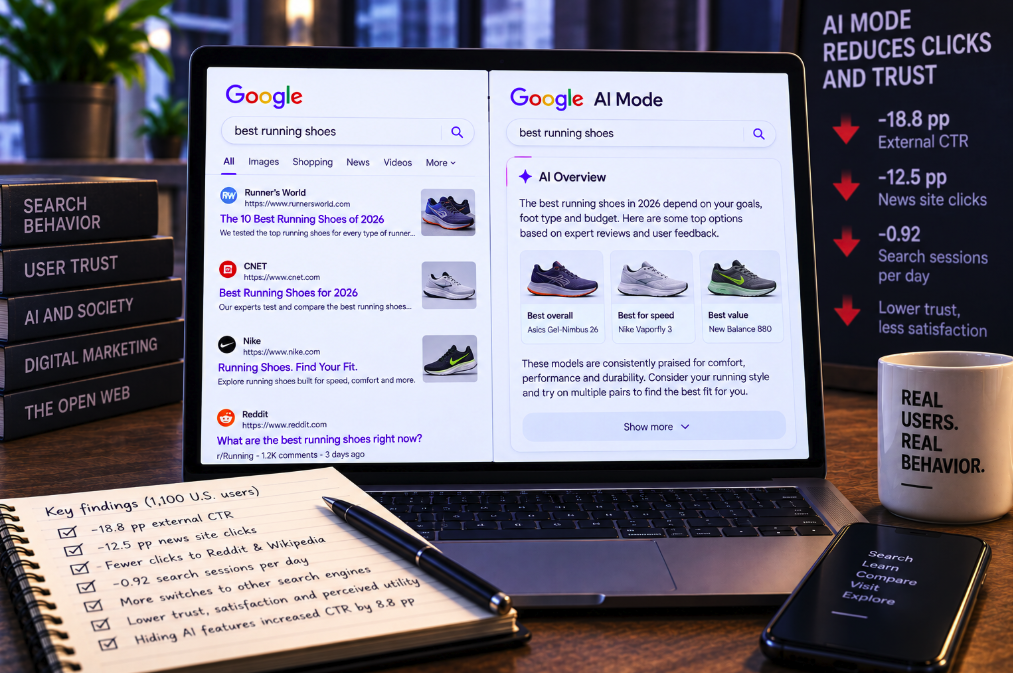
Google’s AI Mode did more than reduce clicks to the open web in a randomized field experiment. It also reduced how often people searched, pushed more users toward rival search engines and lowered their trust, satisfaction and perceived usefulness of Google Search.
Those findings come from a preregistered study submitted to arXiv on August 18, 2026 by Stephanie T. Wang, Jeffrey Gleason, Yakov Bart, Christo Wilson and Danaé Metaxa. Instead of inferring AI search behavior from aggregate traffic data, the researchers modified the real Google Search experience used by participants and randomly assigned them to different versions for seven days.
The headline result is unusually direct: assignment to an AI Mode-only experience reduced click-through to external websites by 18.8 percentage points compared with normal Google Search. At the same time, the experiment found significant declines in user trust and several measures of search experience, challenging the idea that fewer outbound clicks necessarily reflect a better experience because users are simply getting what they need directly from AI.
A randomized test inside participants’ everyday Google use
The researchers recruited U.S.-based adults who used Chrome as their primary browser and Google as their primary search engine. Participants first experienced three days of unmodified Google Search to establish baseline behavior. They were then randomly assigned to one of three conditions for seven days.
The Current Search group continued using Google normally, meaning AI Overviews could appear and AI Mode remained available. The AI Mode Search group had searches redirected into Google’s conversational AI Mode. The No AI Search group used an intervention intended to hide AI Overviews and redirect AI Mode searches back to conventional results.
A total of 1,100 participants made at least one search during the randomized treatment period and were included in behavioral estimates; 956 completed the post-experiment survey. Because the browser extension observed real browsing rather than a laboratory simulation, the researchers could measure what people actually clicked, how often they searched and whether they moved to competing search engines.
AI Mode cut external click-through by 18.8 percentage points
Compared with Current Search, assignment to AI Mode reduced external click-through rate by 18.8 percentage points, with a 95% confidence interval from -22.2 to -15.3 percentage points. The result was statistically significant at p<0.001.
The effect extended to several major categories of external destinations. The fraction of users clicking news sites fell by 12.5 percentage points. Reddit clicks fell by 21.2 points and Wikipedia clicks by 9.9 points. In other words, the reduction was not limited to a particular kind of commercial publisher; AI Mode reduced navigation toward news, community content and reference information alike.
That distinction matters for the debate over zero-click search. Observational traffic studies can show that clicks are declining, but they struggle to establish whether AI caused the decline because search behavior and query mixes change at the same time. Random assignment gives this experiment stronger causal leverage: users assigned to AI Mode clicked out less than comparable users assigned to the ordinary Google experience.
Hiding AI features moved clicks in the opposite direction
The No AI Search condition produced the reverse pattern. Exposure to the intervention increased external CTR by an estimated 8.8 percentage points compared with Current Search. That result supports the researchers’ hypothesis that Google’s AI features substitute, at least partly, for visits to third-party publishers.
However, the No AI estimate comes with an important technical caveat. The researchers’ extension initially hid about 90% of AI Overviews, but Google changed the HTML structure of AI Overviews during the experiment and broke the extension’s detection logic. Across the treatment period, only 51.1% of AI Overviews were successfully hidden overall.
Because of that non-compliance, the paper reports local average treatment effect estimates for exposure to the No AI condition rather than treating assignment alone as perfect removal of Google’s AI features. The AI Mode intervention was much cleaner: 94.7% of searches in that group were successfully routed to AI Mode.
Users searched Google less under forced AI Mode
The experiment also tested a claim that is strategically important to Google: whether AI features encourage people to search more. The researchers had preregistered a hypothesis that AI Mode would increase search sessions. The data moved in the opposite direction.
Assignment to AI Mode reduced Google search activity by 0.92 sessions per day, with a 95% confidence interval from -1.30 to -0.55. The decline was even larger among heavy Google users, for whom the researchers found a reduction of 2.01 daily sessions in a preregistered heterogeneous-effects analysis.
Sessions that did occur in AI Mode lasted longer—about 0.43 additional minutes on average—but the system did not produce more searches per session or a higher share of question-form queries. Longer individual interactions therefore did not translate into greater overall Google search frequency during the test.
Some users responded by switching to rival search engines
AI Mode did not simply change what participants did within Google. It also increased the fraction of users searching on Bing, DuckDuckGo or Yahoo by 11.2 percentage points. Participants assigned to AI Mode also reported a significantly stronger intention to switch to Bing on the study’s seven-point scale.
This is an important counterpoint to the assumption that a more self-contained AI interface automatically strengthens platform retention. In this experiment, forcing Google searches into AI Mode encouraged measurable substitution toward competitors.
The No AI Search intervention, by contrast, did not produce detectable changes in competitor-engine usage or long-term switching intention. The substitution effect was specifically associated with assignment to the AI Mode experience.
Lower publisher traffic did not come with higher user trust
A central defense of answer-first search is that users may click less because the search engine is satisfying their needs more efficiently. Search researchers sometimes describe this as “good abandonment”: a person gets the information they need directly and therefore has no reason to visit another page.
The experiment complicates that explanation. Assignment to AI Mode reduced trust in information found on Google by 0.34 points on a seven-point scale. It also significantly reduced perceived usefulness, satisfaction and user agency. Perceived personalization and relevance fell as well, contrary to the researchers’ preregistered expectation that AI Mode would improve that dimension.
Those outcomes do not mean every participant disliked AI Mode. In open-ended feedback, 29.3% of respondents in the AI Mode condition expressed positive sentiment, while 33.6% were negative and 13.7% mixed. Some participants praised efficiency and time savings. But the controlled survey measures showed an overall deterioration in several core dimensions of user experience.
People reported losing control over how they searched
The qualitative responses help explain why. Among the 309 AI Mode participants who answered the open-ended question, loss of control and agency was a recurring theme. Others reported difficulty navigating directly to a website because AI Mode answered about the destination rather than taking them to it.
Limited links or source diversity also appeared in the feedback, along with complaints about overly verbose answers and concerns about inaccurate or inconsistent information. Positive comments frequently focused on convenience: some users felt AI Mode summarized information efficiently and saved time.
The mixed reactions illustrate a broader design tension. A conversational answer can be useful when a user wants synthesis, but the same interface can create friction when the user’s goal is navigational, exploratory or source-oriented. Forcing every query into the same AI interaction removes the ability to choose between those modes.
The experiment is stronger than a traffic correlation, but it has limits
The randomized design is the study’s main strength, yet its results should not be generalized without qualification. Participants skewed younger and more educated than the U.S. population: 75% were under 45 and 87% had at least some college education. They were also selected for using Chrome and Google Search as their primary browser and search engine.
The experiment took place in March 2026 and tested the Google products available at that time. AI Mode and AI Overviews can change rapidly, so the exact effects observed in this version are not guaranteed to describe later interfaces, ranking systems or model behavior.
The compromised No AI intervention is another limitation. Google’s HTML change prevented the researchers from consistently hiding AI Overviews throughout the study. The authors adjusted their analysis accordingly, but estimates for removing AI features are less straightforward than the comparatively high-compliance AI Mode treatment.
The study also measures behavior over seven randomized treatment days. That is enough to observe meaningful short-term changes but not to establish how people adapt over months or years. Users may become more comfortable with conversational search, or persistent dissatisfaction could produce stronger switching behavior over time; this experiment cannot resolve that question.
For publishers, the result strengthens the causal case around AI search
Publishers have spent the past two years reporting falling Google referrals as AI-generated answers occupy more of the search experience. The difficulty has been separating the effect of AI from algorithm updates, changing demand, seasonality and the many other forces that affect organic traffic.
This experiment does not quantify what every publisher should expect from a full Google rollout. It does provide something rarer: randomized evidence that changing the search interface itself can cause fewer users to leave Google for external sites. The effect was broad enough to reach news publishers, Reddit and Wikipedia.
The findings also suggest that reduced referrals should not automatically be interpreted as proof of improved consumer welfare. In the tested AI Mode experience, fewer external clicks arrived alongside lower trust, lower satisfaction, lower perceived usefulness, less agency and fewer Google search sessions. Some users even moved toward competing search engines.
That combination makes the study especially consequential. AI search can clearly redistribute attention away from the open web, but the experiment found no compensating improvement in the user-experience measures that might justify that trade-off. For Google, publishers and the wider web ecosystem, the central question is therefore becoming harder to avoid: if AI search keeps more information inside the platform while users trust and value the experience less, who is actually benefiting from the lost click?