
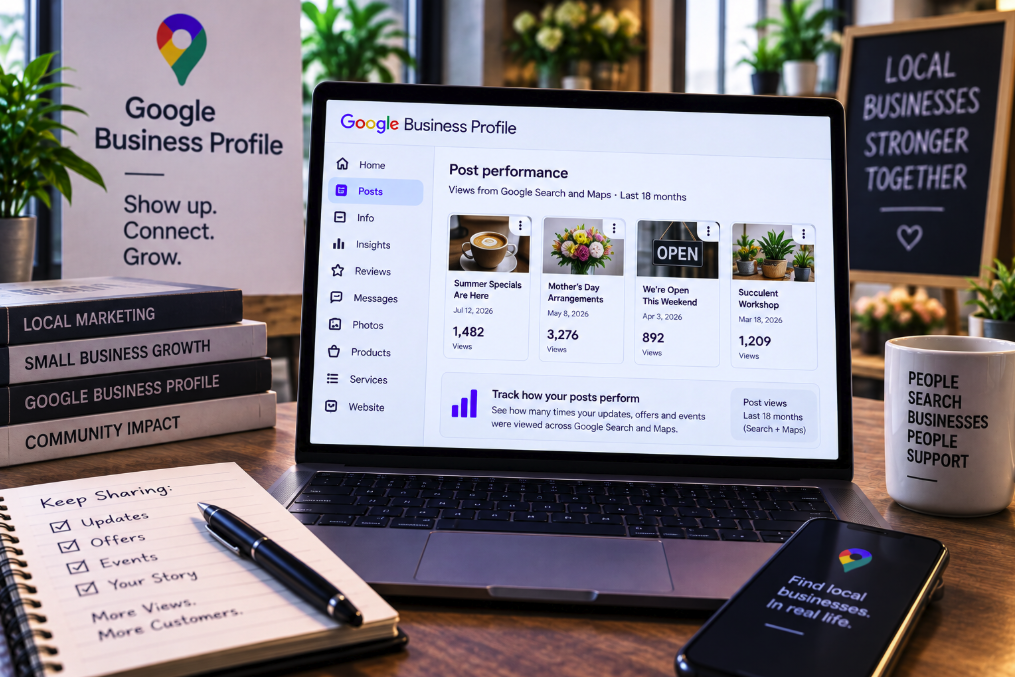
Google is giving local businesses a visibility metric they have been missing for more than three years. Post-level view counts are returning to Google Business Profile, allowing owners and marketers to see how many times individual updates, offers and events have been viewed across Google Search and Maps.
The rollout was confirmed in Google’s September Small Business Bulletin, published in the Google Business Profile Help Community. Google describes the reporting feature as one of its most requested additions and says it is rolling out globally. The counts cover posts published during the previous 18 months on a rolling basis.
Individual Google Posts have a visibility number again
Business Profile posts let companies publish timely information directly on their listings, including announcements, special offers and events. Google’s documentation for Business Profile posts explains that customers can encounter these updates in Search and Maps, including profile update areas on mobile and owner-provided sections on desktop.
Until now, however, measuring the visibility of an individual post had become difficult. The new reporting places a view count on each post card in the Business Profile dashboard, giving managers a direct way to compare how individual pieces of content perform. Google says the metric includes views from both Search and Maps and combines them into a single number.
Reporting applies across the main post formats rather than to a single content type. Updates, offers and events are all covered, which means businesses can compare visibility across different publishing strategies without relying on a third-party tool to estimate whether customers are seeing the content.
The metric disappeared in 2023
The feature is a return rather than an entirely new analytics concept. As Search Engine Journal reports, Google previously provided views and clicks for individual Business Profile posts but retired both metrics during its transition to the Business Profile Performance API.
Google’s developer deprecation schedule ended support for post views and post button clicks on February 20, 2023, without providing a direct replacement. That left a substantial measurement gap: businesses could continue publishing posts, but they had far less visibility into the performance of each individual update.
The restored count closes part of that gap. It tells profile managers whether a post was viewed, but Google has not announced the return of the old post-level click metric alongside it. As a result, the dashboard can now help answer which posts attract visibility without necessarily showing what users did after seeing them.
Google is showing 18 months of post history
The new reporting is not limited to content published after the feature became available. Google says it covers posts from the past 18 months on a rolling basis. For businesses that have maintained a regular posting schedule, that creates an immediate historical dataset for comparing content rather than forcing them to wait months for useful trends to accumulate.
That history could help local marketers identify which types of announcements attract attention. A restaurant might compare event posts with special offers, while a retailer could examine whether seasonal promotions outperform general updates. Multi-location businesses may also be able to use the metric to identify recurring content patterns across individual profiles, although large-scale analysis remains constrained by the lack of API access.
Post views are not available through the API yet
Google explicitly says the feature is not yet available in the API. For individual business owners, that may be a minor inconvenience because the numbers can be reviewed directly in the Business Profile dashboard. For agencies and enterprises managing hundreds or thousands of locations, it is a much more important limitation.
Without API access, automated reporting systems cannot simply pull the new post-level metric into centralized dashboards at scale. Teams that want to evaluate it during the rollout may need to inspect profiles manually or wait for Google to extend programmatic support.
Google has not committed publicly to a date for API availability. The phrase “not yet available” leaves open the possibility of future support, but marketers should not assume an API release until Google documents one.
Google still has not defined exactly what a post view means
There is another important measurement question. Google describes the number as the times local customers viewed a post, but the announcement does not provide a technical definition of a post view. It is therefore unclear whether repeated exposures by the same person can generate multiple views or whether some form of unique-user deduplication is applied.
That ambiguity matters when businesses compare posts or try to connect visibility with commercial outcomes. A metric representing unique viewers is different from an impression-style count in which one customer could contribute several views. Until Google publishes a formal definition, marketers should avoid treating the number as a precise measure of audience size.
The distinction is particularly relevant because other Business Profile performance metrics can use their own counting rules. The safest interpretation for now is simply that the restored number measures post visibility across Search and Maps according to Google’s internal methodology, not necessarily unique people.
What local marketers can learn from the restored metric
Even with those limitations, post-level reporting makes Business Profile publishing easier to evaluate. Local marketers can compare content formats, topics and timing instead of treating every post as an unmeasured listing enhancement. Over an 18-month window, patterns should become visible enough to inform future editorial decisions.
Views alone should not become the objective, however. A highly viewed offer that produces few calls, bookings or purchases may be less valuable than a lower-volume update that reaches customers with stronger intent. Businesses should therefore interpret post views alongside broader Business Profile performance indicators and their own first-party conversion data where possible.
The metric may also help teams distinguish between content that earns exposure and content that merely exists on the profile. If certain events, promotions or visual formats repeatedly generate stronger visibility, that can guide how limited local-marketing resources are allocated.
A small analytics return with practical value
The return of post views does not fundamentally change local SEO, but it restores a useful layer of feedback that disappeared in 2023. Businesses have continued to use Google Posts to communicate offers, events and updates even while individual-post measurement remained limited. The new dashboard count makes that activity more observable again.
For now, the rollout has three clear boundaries: it covers the latest 18 months, combines Search and Maps, and remains unavailable through the API. The biggest unresolved issue is what Google technically counts as a view. Until that definition arrives, the metric is best used comparatively—identifying which posts receive more or less visibility—rather than as an exact measure of unique reach.
Still, after more than three years without post-level view reporting, local businesses have regained a simple question they should never have had to guess at: did customers actually see the update they published?