
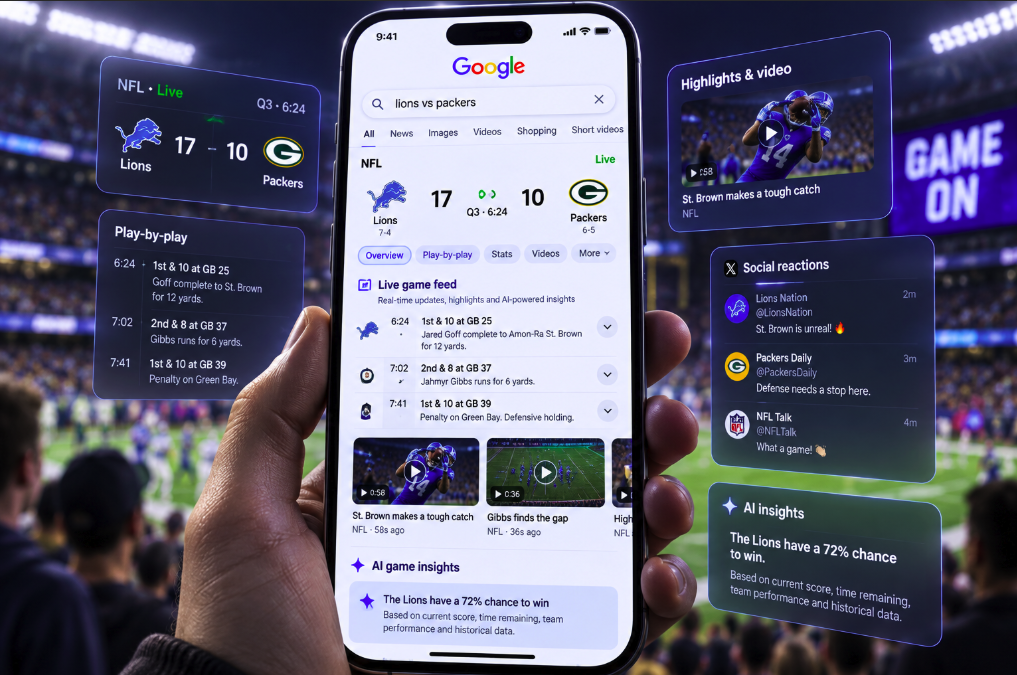
For years, a sports query on Google has been one of the clearest examples of an answer-first search result: type in a matchup and the SERP immediately surfaces the score, schedule and basic game information. Google is now pushing that experience much further. Its new Live Game Feed turns an in-progress football search into a continuously updated game hub that combines play-by-play action, video highlights, social commentary and AI-generated insights directly inside Search.
Google announced the feature on September 9 as part of a broader set of football upgrades for Google Search. To access it, users search for a game that is currently underway and look for a red “Live” indicator. The resulting experience includes an overall recap of the game so far and a dynamic timeline designed to help users understand what is happening without assembling the story from separate search results.
A sports SERP is becoming a real-time content feed
The Live Game Feed brings together several formats that traditionally lived in different places. Google says the timeline can show individual play-by-play updates, notable commentary from social platforms, key video highlights and AI-powered insights. Instead of treating the score as a static information card surrounded by links, Search increasingly behaves like a live sports destination in its own right.
That is a meaningful change in the role of the SERP. A fan who missed the previous quarter may no longer need to open a sports publisher for a written recap, visit a social network to see reactions and then search a video platform for the important play. Google’s interface is designed to assemble those signals into one chronological view while the game is still happening.
The first rollout is deliberately limited. Google says the Live Game Feed for professional American football is available on mobile in the United States in English. Support for collegiate teams is scheduled to arrive later in September, and the company says it also plans to bring the feed to more people internationally.
Matchup carousels and deeper statistics are going global
The Live Game Feed is only one part of the update. When users search for a matchup, Google is adding a carousel that displays scores from other games around the league, reducing the need to run separate searches for each fixture. Unlike the initial Live Game Feed rollout, Google says the new matchup carousel and related Search upgrades will be available globally on mobile.
Player and league statistics are becoming more detailed as well. Search is rolling out views of league leaders in categories such as passing touchdowns and rushing yards, alongside more granular player metrics including sacks, fumbles and yards after catch. Google also says championship favorites and playoff brackets are coming soon.
These additions fit a broader direction already visible across Google’s sports products. Earlier in 2026, the company highlighted richer real-time soccer information in Search, including live scores, lineups, standings, brackets, stories and social content. The new football feed advances the same idea by integrating AI interpretation and a chronological stream directly into the match experience.
AI is becoming part of the live sports interface
The inclusion of AI-powered insights is particularly notable because sports search has traditionally depended heavily on structured data: scores, clocks, standings and statistics are factual objects that can be presented without generative interpretation. AI adds another layer, allowing Search to explain or contextualize developments rather than simply display them.
Google has been moving toward this model for some time. At I/O 2026, the company described a broader vision of Search combining generative AI with fresh, real-time information, including sports data. The Live Game Feed makes that strategy visible in a mainstream, time-sensitive use case where the value of a result can change from one play to the next.
That also raises the stakes for accuracy. A conventional scoreboard can be corrected when a data feed changes; an AI-generated interpretation may involve additional reasoning about momentum, context or performance. Google’s announcement does not detail every signal used for the AI insights in the new feed, so users should distinguish the underlying live facts from generated analysis layered on top of them.
What this could mean for sports publishers
For publishers, the most important question is how much of the fan’s information journey remains inside Google. Live sports already generate highly repetitive searches—scores, injuries, statistics, highlights and reactions—and each additional element incorporated into the SERP can reduce the need to click through for basic information.
At the same time, the feed depends on content that originates elsewhere. Video highlights, commentary and reporting require leagues, broadcasters, publishers, creators and social platforms. That creates the same tension increasingly visible across AI search: Google can make the result more useful by synthesizing and organizing outside information, while the organizations producing that information still depend on attention, attribution and traffic.
The opportunity for publishers may therefore shift toward material that cannot be fully represented by a score card or short AI insight: original reporting, expert analysis, exclusive interviews, tactical breakdowns and distinctive commentary. As Search absorbs more commodity sports information, differentiated editorial value becomes more important rather than less.
Google Search is moving beyond the traditional results page
The Live Game Feed is another sign that the familiar model of ten links surrounding a few informational modules is no longer an adequate description of Google Search. Search now includes conversational AI, live multimodal assistance, personalized connections to external accounts and increasingly rich interfaces for specific query types. Sports are a natural testing ground because users want immediate, structured and continuously changing information.
For fans, the result could be a faster way to understand a game without switching among several apps. For Google, it creates a more immersive search experience during one of the most time-sensitive categories of queries. And for publishers, it is another reason to watch not only where their pages rank, but how much of the user’s task Google can now complete before a click is ever required.