
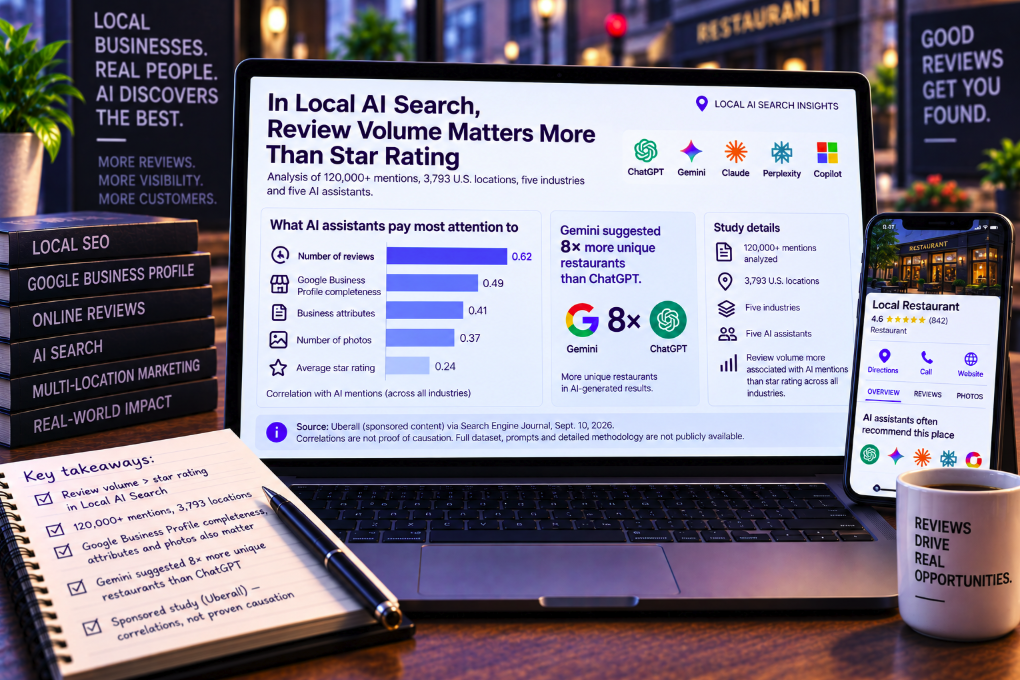
Local businesses trying to appear in AI-generated recommendations may have been watching the wrong review metric. A large Uberall analysis suggests that the number of reviews a location has accumulated is more consistently associated with AI mentions than its average star rating.
The findings come from a September 10 sponsored article in Search Engine Journal based on more than 120,000 AI mentions across 3,793 U.S. business locations. Uberall examined five verticals—restaurants, dentists, grocery stores, hotels and banks—across ChatGPT, Gemini, Claude, Grok and Perplexity.
Across all five industries, Uberall says review volume predicted AI mentions. Average ratings were a weaker signal in four of the five categories, with hotels standing out as an exception. The analysis also reports meaningful relationships between AI visibility and Google Business Profile completeness, business attributes, photo volume, editorial authority and social presence.
The results are useful directional evidence for local marketers, but they should not be converted into a new ranking formula. The article is sponsored by Uberall, the underlying dataset and full prompt set are not published, and the public methodology does not provide enough statistical detail to establish that adding reviews causes an AI assistant to recommend a business more often.
Uberall analyzed more than 120,000 local AI mentions
Uberall says its internal GEO analysis covered 3,793 locations in U.S. cities including Chicago and New York. The businesses came from five categories with very different local-search behavior: restaurants, dental practices, grocery stores, hotels and banks.
The company then monitored recommendations across five major AI assistants. Rather than assuming the platforms behave identically, Uberall describes each model as having a different recommendation pattern. Claude appeared relatively conservative, Perplexity generated the most mentions per run, and ChatGPT tended to produce a narrower, more repetitive shortlist.
Gemini produced the broadest restaurant set. According to Uberall, it surfaced eight times more unique restaurants than ChatGPT in the same study. The company speculates that access to live Google Maps information may contribute to that diversity, although the sponsored article does not demonstrate the retrieval mechanism directly.
That platform-level difference is important. A local business can be highly visible in one assistant and much less visible in another, meaning there may be no single universal set of “AI local ranking factors.”
Review volume was more consistent than star rating
The review finding is the strongest part of Uberall’s public argument. Across all five verticals, the company says higher review volume was associated with AI mentions. Star ratings were less consistently associated with visibility and, where ratings did matter, Uberall says they were not generally the dominant variable.
For dentists, the analysis reports that no star rating on any measured platform reached statistical significance. Mentioned dental practices averaged 643 Google Business Profile reviews, compared with 253 among practices that were not mentioned, while practices with more than 1,000 reviews reached a reported 92.9% mention rate.
For grocery stores, Uberall reports an especially counterintuitive comparison: businesses with higher review volume but lower ratings were mentioned 94.3% of the time, compared with 60.6% for businesses with high ratings but lower review volume. Yelp review count was particularly associated with visibility in that vertical.
Banks produced another warning against reading average stars too literally. Higher aggregate ratings on Yelp and Trustpilot correlated negatively with mention frequency in Uberall’s data. The company’s interpretation is not that poor reviews help visibility, but that large national banks can accumulate both enormous review volume and substantial customer complaints while remaining highly prominent entities.
Hotels were the important exception
The broad “volume beats rating” headline needs one qualification: hotels did not follow the same pattern. Uberall says Google Business Profile star ratings correlated more strongly with both AI mention probability and mention frequency than review count in the hotel category.
That exception makes the study more interesting because it suggests AI recommendation signals may depend heavily on the type of decision a user is making. A hotel stay can involve higher cost and longer commitment than a grocery-store visit, potentially making perceived quality more important to recommendation systems.
But the public article does not establish why the statistical pattern differs. Without the underlying models, coefficients and full prompts, explanations about user intent or model reasoning remain hypotheses rather than measured mechanisms.
The safer takeaway is that review volume appears more consistently associated with AI mentions across the five tested categories, not that star ratings have become irrelevant.
Ratings still matter to the people reading the answer
Even if an AI system weighs review count more heavily than average stars when deciding which businesses to mention, humans still see and interpret ratings. A 2.8-star restaurant with thousands of reviews may have strong entity prominence, but that does not mean a customer will choose it over a well-reviewed competitor.
This creates two different optimization objectives. Review volume may strengthen the amount of evidence available about a business and correlate with machine visibility, while average rating continues to function as a compact trust signal for the person making the final decision.
Uberall’s practical recommendation is therefore not to sacrifice service quality in pursuit of volume. It is to stop treating small movements in average rating as the only reputation metric that matters and build a sustained process for earning fresh reviews across the platforms relevant to the business category.
Google Business Profile completeness also correlated with mentions
Reviews were only one of four broad signal groups Uberall discusses. The company also found relationships between AI mentions and the completeness and richness of business data.
A filled-out Google Business Profile description was associated with substantially higher mention rates for grocery stores. In hotels, Uberall reports that moving from six to ten relevant attributes to 31–50 attributes corresponded with an increase in mention probability from 22% to 94%.
These are large differences, but they are observational. A business with 40 carefully maintained attributes is also likely to differ from a minimally maintained listing in many other ways. It may have a larger marketing team, better structured location data, stronger reviews, more photos and a broader digital footprint.
The public analysis does not show that adding the thirty-first attribute itself causes an AI assistant to start recommending a hotel. It shows that richer profiles and higher AI visibility appeared together in Uberall’s sample.
Photo volume emerged as another strong signal
Photo count was one of the most prominent associations in the study. Uberall calls it the strongest predictor of restaurant mention frequency, reporting that the most-mentioned restaurants averaged three times as many photos.
In dental, photo count was described as the only measured signal predicting both whether a practice was mentioned and how frequently it appeared. For banks, it ranked among the three strongest predictors of AI mentions overall.
There are several plausible reasons photo-rich profiles might correlate with visibility. Businesses that continuously upload photos tend to maintain their listings actively, attract more customers and generate more engagement across the local ecosystem. Photos can also provide additional information about products, premises and customer experience.
Again, the correlation does not identify which of those mechanisms—if any—is responsible. Photo count may partly function as a proxy for business popularity or marketing maturity rather than a direct AI-selection signal.
Editorial authority still appears to matter
Uberall also examined signals outside business listings. Frequent media mentions, editorial-list inclusion and Wikipedia presence were associated with stronger AI visibility in several verticals.
Banks with thirty or more news mentions reportedly showed a fifteen-fold increase in mention frequency, while grocery brands in that group reached a 100% mention rate. Banks appearing across three or more editorial platforms saw a reported thirteen-fold increase.
For restaurants, Michelin recognition appeared in 94.5% of Perplexity responses in Uberall’s analysis. Wikipedia presence was positively associated with mentions for hotels, grocery stores and banks, although not for dentists.
These findings fit a broader model of generative search in which assistants synthesize information from multiple independent sources rather than relying solely on the business’s own website or profile. A company repeatedly described by reputable third parties leaves a larger and more consistent evidence footprint for retrieval systems to work with.
Social signals played different roles
Facebook and Instagram were also associated with local AI visibility, but Uberall says they appeared to play different roles. Facebook follower counts correlated more with whether a business was mentioned at all, while Instagram presence correlated more with how frequently an already-visible business appeared.
For banks, Facebook follower count was the strongest social factor reported. Mentioned dental practices had nearly five times the followers of practices that were not mentioned. Restaurants with strong Instagram and Yelp presence were mentioned almost seven times more frequently, according to the sponsored analysis.
Boutique hotels showed an especially strong Instagram relationship, while Grok was described as referencing Instagram content more often than the other tested assistants.
These results reinforce the idea that local AI visibility is distributed across an entity’s entire web presence. Listings, reviews, editorial coverage and social profiles can all contribute information that helps a system identify and describe a business.
The study does not publish enough methodology to establish ranking factors
This is where the language around the findings needs to become more precise. The Search Engine Journal article calls the observed variables “AI mention factors,” but the public evidence does not justify treating them like confirmed causal ranking signals.
The article does not publish the full underlying dataset, all prompts, detailed sampling procedures, model versions, run dates or a complete statistical specification. It provides many vertical-specific percentages and refers to statistical significance in places, but it does not provide the coefficient tables and reproducibility materials an independent researcher would need to validate the analysis.
The sponsorship is also relevant. Search Engine Journal clearly labels the article as sponsored by Uberall and states that the opinions expressed are the sponsor’s own. Uberall sells local visibility and reputation-management technology, giving it a commercial interest in the optimization framework presented.
That does not make the data wrong. It means the results should be treated as vendor research rather than independent peer-reviewed evidence.
Correlation is especially tricky in local search
Local-business variables are heavily interconnected. Popular restaurants tend to accumulate more reviews, more photos, more Instagram followers, more editorial mentions and more links. Large banks tend to have more customers, more complaints, more media coverage and stronger brand recognition.
If an AI assistant mentions those businesses frequently, separating the influence of each individual variable is difficult. A high review count might directly help the system assess prominence, or it might simply identify businesses that are already widely known for many other reasons.
Uberall’s analysis attempts to find recurring patterns across industries and models, which makes the consistency of review volume noteworthy. But without sufficient public statistical detail, marketers should avoid interpreting a threshold such as 1,000 reviews as a magic number that causes AI visibility.
The same caution applies to the reported photo and attribute thresholds. They are useful benchmarks from this dataset, not guaranteed optimization targets.
Gemini and ChatGPT may create very different local opportunity sets
The eight-fold difference in unique restaurant recommendations between Gemini and ChatGPT highlights another challenge for GEO measurement. A brand’s “AI visibility” score can change dramatically depending on which assistant is measured and how often prompts are repeated.
If ChatGPT repeatedly returns a concentrated shortlist while Gemini explores a much wider set of businesses, a restaurant can look invisible in one system and competitive in another without anything about the business itself changing.
That means local AI tracking should separate platforms rather than collapsing every mention into one aggregate score. Marketers also need repeated runs because generative systems can vary their answers between otherwise identical prompts.
A single test such as “best Italian restaurant near me” cannot establish whether a business is systematically visible. The measurement problem increasingly resembles share-of-voice analysis rather than a traditional fixed ranking position.
The practical lesson is to build a richer local evidence footprint
Despite the methodological limitations, the study points toward a sensible local-search strategy that does not depend on chasing a speculative AI trick. Businesses should maintain complete and accurate location profiles, earn a steady flow of authentic customer reviews, publish useful photos and build genuine third-party recognition.
Those practices already help customers evaluate businesses and strengthen conventional local search presence. If they also make an entity easier for AI assistants to identify, verify and recommend, the upside extends into generative discovery without requiring a separate artificial optimization layer.
The review finding is particularly useful because it challenges an old habit of reputation management: obsessing over whether a location is rated 4.3 or 4.5 while paying less attention to whether customers are continuing to leave reviews at all.
Uberall’s data suggests volume may be the more consistent correlate of AI mentions across local categories. But the right conclusion is not “reviews cause AI rankings.” It is that a large, current body of customer evidence appears alongside stronger AI visibility often enough to deserve attention.
More reviews may matter—but the causal mechanism is still unproven
Across more than 120,000 measured mentions, review volume was associated with AI visibility in every vertical Uberall tested, while average star ratings were less consistent. Profile completeness, attributes, photographs, editorial authority and social presence also correlated with stronger representation, and different assistants produced markedly different recommendation patterns.
That is valuable observational evidence for a rapidly changing area of local search. It is not yet a reverse-engineered AI ranking system.
Until the underlying data, prompts and statistical methods are available for independent analysis, local marketers should treat these findings as directional rather than causal. Review volume appears to matter. Exactly why it matters, how much it matters after controlling for every related popularity signal, and whether the relationship will persist as AI systems change remain open questions.
For now, the most durable strategy is also the least exotic: give customers reasons to review the business, keep location data complete, show what the location actually offers and build enough independent evidence across the web that an AI assistant has multiple reasons to trust the entity it is recommending.