
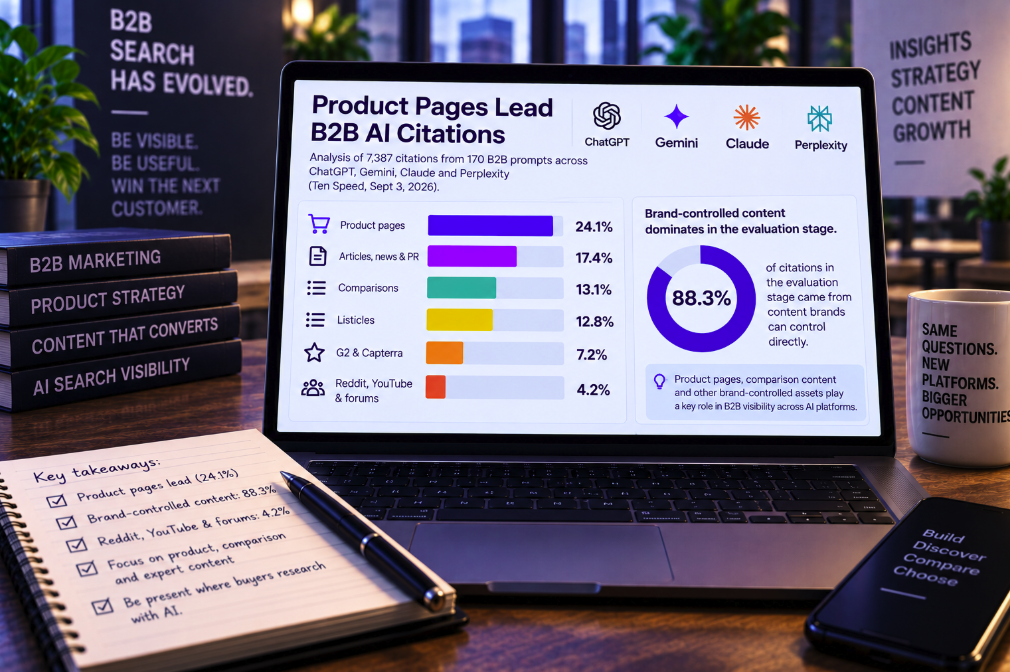
B2B marketers trying to earn citations from AI assistants may be looking in the wrong place if they focus primarily on Reddit threads, YouTube videos and community discussions. In a new analysis of evaluation-stage buyer prompts, product pages were the single largest source category cited by ChatGPT, Gemini, Claude and Perplexity.
The study, produced by B2B content agency Ten Speed and examined in detail by Search Engine Journal, classified 7,387 citation appearances generated from 170 prompts. Product pages accounted for 24.1% of the citations, while Reddit, YouTube, forums and other discussion threads together represented only 4.2%.
That makes the observed share for product pages nearly six times larger. But the finding is narrower—and more useful—than a universal claim that AI assistants prefer product pages. The prompts were designed around B2B buyers who had already moved into the evaluation stage, where questions naturally focus on named products, vendors, features and comparisons.
Product pages led the citation mix
Ten Speed monitored citations through Peec AI across ChatGPT, Perplexity, Claude and Gemini. The 170 prompts were intended to resemble the questions a buyer asks after basic category discovery, such as comparing two named vendors or investigating how a specific product handles a requirement.
Product pages generated 24.1% of all citation appearances, the largest single category. Articles—including blog posts, news and PR content—accounted for another 17.4%. Comparison pages and listicles each landed around 13%, while how-to guides were just under 9% and homepages represented 7.8%.
Third-party directory profiles on platforms such as G2 and Capterra accounted for 7.2%. Reddit, YouTube, forums and discussion threads collectively reached 4.2%, with Search Engine Journal reporting that Reddit supplied most of that share and YouTube alone was around 1%.
The distribution matters because much of the conversation around generative engine optimization has emphasized community and user-generated sources. Those channels can still be valuable, but this dataset suggests they may play a much smaller role once a B2B buyer is comparing specific vendors rather than learning about a category for the first time.
Brands controlled 88.3% of the cited content
Ten Speed’s most strategically important finding may be broader than the product-page result. Content that marketing teams can directly create and control accounted for 88.3% of citation appearances in the evaluation-stage dataset.
That bucket includes product pages, articles, comparison content, listicles, how-to guides, homepages and other owned assets. It suggests that brands do not necessarily need to depend on third-party communities to become visible inside AI-generated vendor research. Their own websites can provide much of the source material assistants use when buyers are evaluating products.
This is an important distinction from reputation-oriented AI search. A company cannot fully control what independent reviewers, customers or journalists say about it, and those external sources can be crucial for trust. But when the question concerns what a product does, who it is for, which features it offers or how it compares with another vendor, first-party pages can be highly relevant source material.
Comparison content punched above its share of prompts
The study also found that comparison content generated more citation activity than its representation in the prompt set would predict. Comparison-format prompts represented 20% of the 170 prompts but produced close to 27% of citation appearances, a roughly 1.33-times return relative to their prompt share.
That is a useful signal for B2B content teams because comparison pages are often treated defensively. Companies may create a handful of “us versus competitor” pages only after sales teams request them, rather than viewing comparisons as a core discovery surface.
AI-assisted evaluation makes those pages potentially more important. When a user asks an assistant to compare named vendors, the model needs concrete information about features, integrations, positioning, pricing structure, target customers and other points of differentiation. A well-constructed comparison page can put those facts into a format that is easy to retrieve and synthesize.
The lesson is not to manufacture biased comparison pages filled with unsupported claims. AI visibility is more durable when a page gives specific, verifiable information that can survive comparison with independent sources. Clear tables, factual differences, limitations and direct explanations are likely to be more useful than marketing superlatives.
Product pages need to work as information sources, not just conversion pages
The 24.1% result also challenges a familiar separation inside B2B marketing organizations. Product pages are often designed primarily for conversion, while blogs and resource centers are expected to handle discovery and search visibility. Generative search can blur that distinction because an AI assistant may treat a product page as evidence.
A page that says little beyond a slogan and a demo button gives a retrieval system limited material to work with. By contrast, a product page that clearly explains what the software does, which users it serves, how major features work, what systems it integrates with and where it fits in a workflow can answer many of the factual subquestions an AI system encounters.
This does not require turning every commercial page into a 5,000-word article. It requires information density and clarity. Buyers—and the systems assisting them—need specific facts rather than positioning language that only makes sense after someone already understands the product.
G2 and Capterra still matter at the decision stage
Third-party software directories accounted for 7.2% of citations, a meaningful share even though it was far below the combined weight of brand-controlled content. For B2B SaaS companies, that reinforces the value of maintaining accurate profiles on sites such as G2 and Capterra.
Directory pages can supply structured category information, product descriptions, comparisons and reviews in a form that is particularly useful when an AI assistant is assembling a shortlist. An outdated category, incomplete integration list or inaccurate product description can therefore affect more than human visitors to the directory; it can also influence the information available to generative systems.
The finding argues for treating directory profiles as part of a broader content system rather than as isolated review-management channels. Product facts should remain consistent across the company website and authoritative third-party profiles so AI systems do not encounter conflicting versions of the same information.
The study does not prove Reddit and YouTube are unimportant
The nearly six-to-one difference between product pages and community sources makes a strong headline, but it should not be generalized beyond the study’s context. These were evaluation-stage B2B prompts. A user asking which vendor supports a specific enterprise requirement is likely to generate a different source mix from someone asking an awareness-stage question about an unfamiliar category.
Community sources can be particularly valuable earlier in discovery, when people are looking for experiences, opinions, recommendations and language that does not come directly from vendors. Reddit can reveal how practitioners describe a problem, while YouTube can demonstrate workflows or products visually. The Ten Speed dataset does not establish that those sources are unimportant across the entire buying journey.
It instead suggests that source strategy should follow intent. A brand trying to appear when buyers compare named vendors may need a different content portfolio from one trying to shape initial category awareness.
Important methodological limits remain
Search Engine Journal subjected the study to several methodological questions before publishing its analysis, and the answers place useful boundaries around the headline statistics. An early visual contained a 220-prompt total that conflicted with the rest of the report; Ten Speed confirmed that 170 was the correct number and said the visual would be corrected.
More importantly, Ten Speed did not disclose how many distinct client brands were represented. The agency said doing so, even as a range combined with the named verticals, could risk identifying clients in a small confidential sample. The dataset covers Ten Speed’s B2B SaaS and professional-services client base across areas including fintech, physical security, hospitality and IT automation, with look-alike competitors added to reduce a pure client-only effect.
That still means the sample is not a random representation of the entire B2B web. Consumer products, ecommerce, healthcare, publishing and other sectors could produce very different citation distributions.
The four AI platforms were also aggregated. Ten Speed did not collect a platform-level breakdown in this data pull, so the study cannot tell us whether ChatGPT strongly favored product pages while another assistant behaved differently. A 24.1% aggregate share can conceal substantial variation between retrieval systems.
The 24% versus 4% gap is descriptive, not a causal ranking factor
Search Engine Journal also asked whether the headline product-page versus community-source difference had been statistically tested. Ten Speed confirmed that the comparison was descriptive. Although the broader work used nonparametric tests for some citation-rate comparisons, the specific 24.1% versus 4.2% split was not presented as a statistically tested effect.
That distinction matters. The study shows what appeared in this dataset; it does not prove that converting a page into a product-page format will cause an AI assistant to cite it more often. Page type is intertwined with user intent, relevance, authority, available information and the retrieval behavior of each platform.
Citation appearances are also not business outcomes. Ten Speed does not yet have data connecting the observed citations to clicks, demo requests, qualified pipeline or closed revenue. A citation can improve visibility without producing a measurable visit, and a highly cited page is not automatically a commercially effective page.
B2B GEO may be more controllable than marketers assume
With those caveats, the study provides a valuable corrective to the idea that AI visibility is primarily won on platforms a brand does not control. At the evaluation stage, Ten Speed’s sample was dominated by owned content, and product pages were the largest individual source category.
That changes the practical starting point for many B2B teams. Before investing heavily in community seeding or trying to manufacture mentions on every external platform, marketers can audit the pages already closest to the buying decision. Do product pages answer concrete questions? Are comparison pages comprehensive and fair? Are integrations, use cases and product capabilities stated explicitly? Are directory profiles current?
Reddit, YouTube and third-party discussion still have roles in the buyer journey, particularly where peer experience and independent opinion matter. But this study suggests that when a B2B buyer asks an AI assistant to evaluate named products, the brand’s own website can be one of its strongest citation assets.
The most useful takeaway is therefore not that product pages universally “beat” Reddit. It is that generative search changes the job of commercial content. A product page is no longer only a destination reached after discovery; in an AI-mediated buying journey, it can become part of the evidence that shapes discovery itself.