
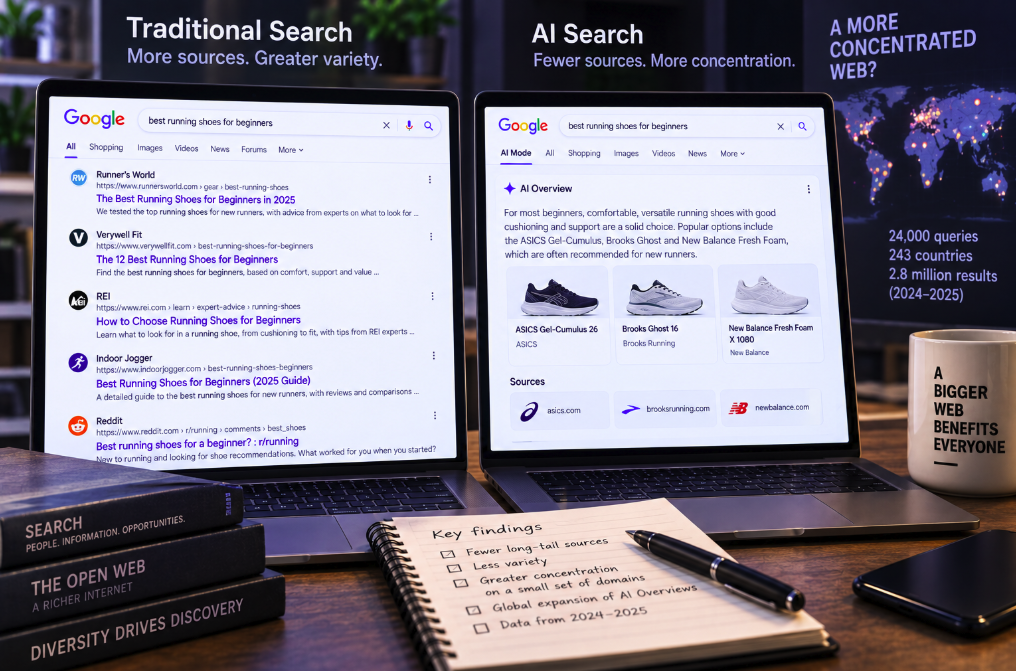
AI search may make finding an answer faster, but it can also make the web behind that answer smaller. A large-scale MIT-led study comparing generative and traditional search found that AI-powered results surfaced fewer long-tail information sources, offered less variety across repeated searches and concentrated attention on a narrower group of domains.
The study, “The Rise of AI Search: Implications for Information Markets and Human Judgement at Scale,” was submitted to arXiv on February 13, 2026 by Sinan Aral, Haiwen Li and Rui Zuo. The researchers executed 24,000 queries in 243 countries and collected 2.8 million AI and traditional search results during 2024 and 2025, creating an unusually broad dataset for examining how generative search changes exposure to online information.
AI answers draw from a more concentrated information ecosystem
Traditional search results can distribute visibility across established publishers, specialist sites and smaller long-tail sources. Generative search changes that interface by synthesizing an answer and selectively surfacing supporting sources. According to the paper, that shift materially changes which parts of the web users are exposed to.
The researchers report that AI search surfaces significantly fewer long-tail information sources than traditional search. It also produces lower response variety, meaning that repeated or comparable searches are more likely to draw users toward a narrower set of information. Together, those patterns imply greater concentration in the domains that receive visibility through AI-generated search experiences.
This matters beyond the design of a results page. Search engines have historically distributed attention and traffic across a large information market. If generative interfaces consistently select from a smaller pool of domains, the economic benefits of being discoverable may become more concentrated as well. Smaller publishers can remain indexed and available on the open web while becoming less visible in the layer through which users increasingly consume information.
The long tail is especially important to the economics of the web
Long-tail sources include niche publishers, specialist communities, independent experts and smaller sites that may rank for relatively narrow questions. Individually, each source may attract modest traffic; collectively, they represent a large share of the web’s informational diversity.
A search interface that disproportionately favors already prominent domains can create a feedback loop. More exposure can produce more readership, links, citations and brand recognition, which can in turn strengthen the signals that make those domains attractive to future retrieval systems. At the same time, sites receiving less exposure face weaker incentives to invest in original information if the path from publication to discovery becomes less reliable.
The paper frames this as an information-market problem rather than merely an SEO issue. Concentrating attention can affect incentives to produce new information, the competitive structure of online publishing and ultimately the range of perspectives available to people making decisions.
AI Overviews expanded from 7 to 229 countries in the study period
The dataset also documents how quickly Google’s AI Overviews expanded geographically. The researchers report that exposure to AI Overviews increased from seven countries in 2024 to 229 countries in 2025. That expansion meant the consequences of AI-mediated search moved from a relatively limited experiment to a global information-distribution issue within the study window.
The rollout was not uniform. The researchers identified countries that did not receive AI search results in their observations and used those geographic differences to examine how access to generative search was being shaped. The study argues that decisions about where and when AI answers appear function as consequential platform policies because they determine which populations encounter AI-mediated information.
That geographic expansion is especially important for publishers operating internationally. A site can face very different discovery environments depending on whether a market receives a conventional results page, an AI-generated answer or some combination of the two. Global SEO performance can therefore become partly dependent on product deployment decisions that publishers do not control.
Google also changed which kinds of questions received AI answers
The study found substantial changes over time in the categories of queries that triggered AI results. One of its most striking examples involves Covid-related searches. According to the researchers, only about 1% of Covid queries in their experiment were answered by AI in 2024, compared with more than 66% in 2025.
That change suggests that AI-search eligibility is not static. Platforms can alter which topics receive generative answers, including sensitive categories involving health and other high-stakes information. For researchers and publishers, measuring AI visibility at one moment therefore may not predict how the same query category will behave months later.
This also complicates attempts to define a universal “AI search ranking.” A publisher may not only need to understand why a domain is selected as a source; it must first understand whether a query is eligible for an AI answer at all, how that eligibility differs by country and how platform policy changes over time.
Less source variety changes what visibility means for SEO
For SEO teams, the findings reinforce a growing distinction between ranking in traditional results and being surfaced by an AI system. Conventional search can display many links on a page and offer users multiple paths into the long tail. An AI-generated response has much less room for visible attribution, so the selection process becomes more consequential.
If a generative answer repeatedly relies on a small set of domains, being outside that set can matter even when a page performs reasonably well in conventional search. Conversely, a publisher frequently selected by AI systems could gain outsized influence because its information is synthesized into answers across many queries.
This makes source diversity an important metric for understanding generative engine optimization. Counting citations alone does not reveal whether an AI system is broadening discovery or repeatedly redistributing attention among the same publishers. Researchers and marketers need to examine domain concentration, citation frequency, query coverage and the presence of smaller sources alongside raw visibility.
The study does not describe today’s AI search exactly
The scale of the dataset makes the findings significant, but the timing is an essential limitation. The 2.8 million results were collected during 2024 and 2025. Google and other search products have continued to change since then, including their interfaces, retrieval systems, geographic availability and rules governing when AI-generated answers appear.
The paper should therefore be read as evidence of how AI search behaved during a major expansion period, not as a definitive map of current availability or source selection in September 2026. The geographic footprint reported in the study, the query categories that triggered AI answers and the exact degree of source concentration may all have changed.
There is also an important distinction between observing concentration and explaining every mechanism behind it. AI search systems combine retrieval, ranking, generation and product-level policies, and external researchers do not have complete visibility into all of those components. The study measures the information users were exposed to; it does not provide a complete internal account of why each source was selected.
A smaller visible web could have consequences beyond search traffic
The most important implication is not simply that some sites may lose clicks. Search engines help determine which information becomes visible enough to influence public knowledge, commercial decisions and future content production. When an AI layer narrows that exposure, the effect can propagate through the wider information ecosystem.
A more concentrated source environment can make authoritative information easier to surface consistently, but concentration also creates risks. It can reduce opportunities for emerging publishers, specialist expertise and alternative sources to reach audiences. It can also make the information ecosystem more dependent on a relatively small group of domains whose content is repeatedly summarized and redistributed.
The study does not establish that generative search will inevitably produce a permanently smaller web. It does provide large-scale evidence that, during 2024 and 2025, AI search exposed users to fewer long-tail sources and less variety than traditional search while AI Overviews expanded rapidly around the world. For publishers, that means the shift from ranked links to generated answers is not merely a new interface. It can change how visibility itself is allocated across the web.