
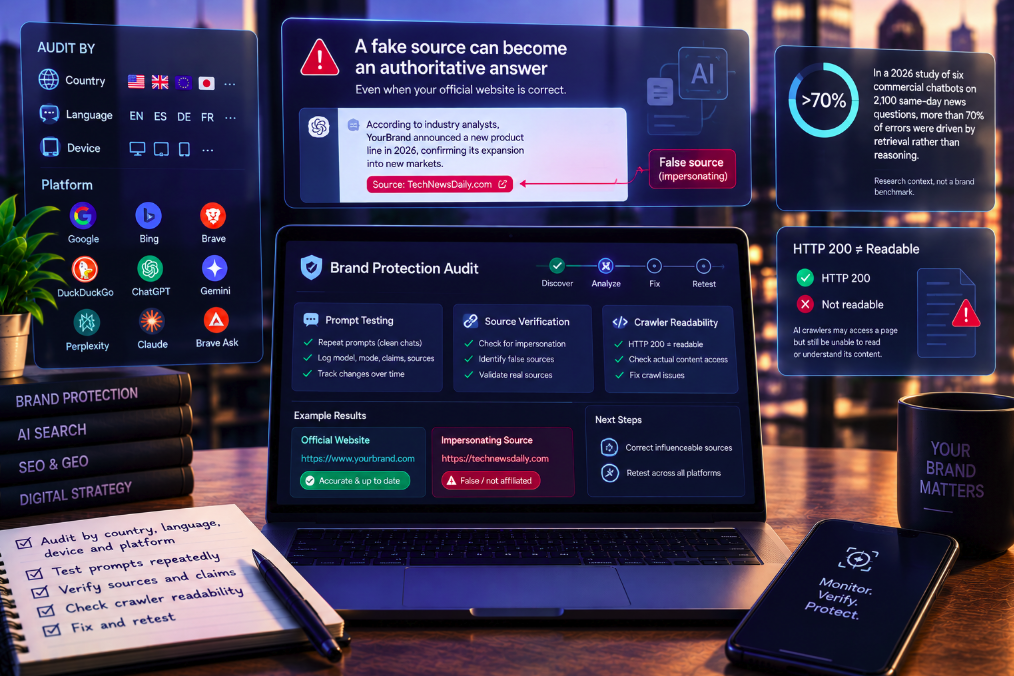
Brand protection is becoming a technical SEO and GEO problem because a company can publish perfectly accurate information on its official website and still be described incorrectly by an AI system.
The reason is retrieval. Generative answers can combine information from official pages, third-party publishers, directories, community discussions, outdated profiles, impersonating websites and other sources into one fluent response. When the wrong evidence enters that pipeline, the final answer can look authoritative even when the underlying claim is false.
A new Search Engine Journal guide by Olesia Korobka proposes an operational framework for detecting and correcting those failures across conventional search and AI answer systems. The process combines familiar brand-protection work with technical crawling checks, repeatable prompt testing and source-level remediation.
The guide is not a new comparative experiment showing which AI platform is safest or most accurate. It is a practitioner playbook for finding where a brand is being misrepresented and tracing the problem back toward the sources and retrieval conditions that may be producing it.
AI can turn fragmented misinformation into one confident answer
Traditional brand-protection problems are relatively visible.
A fake support website appears in Google. An unauthorized reseller buys a branded keyword. An impersonating social account uses the company’s logo. An outdated directory publishes the wrong phone number.
AI search adds another layer because it can synthesize those fragments.
A false support page may be retrieved alongside legitimate information. Other websites may repeat the incorrect details. A generative system can then compress the evidence into one concise response that appears to resolve the user’s question.
The consumer sees an answer, not the messy provenance behind it.
The official website is no longer the only brand record that matters
A company may assume that correcting its own website resolves a factual problem.
That is no longer sufficient.
AI systems can retrieve information from third-party pages that disagree with the official source. Those pages may be older, more frequently linked, easier for a particular crawler to access or simply selected by the retrieval system for that prompt.
This creates a brand-protection problem that resembles technical SEO but extends beyond the company’s domain.
The objective is not merely to publish the correct fact. It is to make the correct fact easier for people and systems to verify across the information environment.
Start by defining the brand as structured facts
Korobka recommends documenting everything consistently associated with the brand before beginning the audit.
For a company, that can include the brand and legal names, previous names, official domain, apps, social profiles, founders, owners, executives, products, markets, support channels and commercially important claims.
Each important fact should have a source and a last-checked date.
This creates a reference set against which search results and AI answers can be evaluated.
Without that baseline, teams can identify that an answer “looks wrong” without having a controlled record of what the current verified fact actually is.
Brand audits need to be separated by country and language
A global brand does not have one universal search presence.
Korobka recommends performing the audit for every meaningful country-language combination.
That is more work, but it reflects how search and AI systems actually behave. Location, language and market context can change which sources are retrieved and how a brand is interpreted.
An accurate answer in English from the United States does not prove that the same brand is represented correctly in German from Germany or Spanish from Mexico.
For multinational companies, “brand accuracy” is therefore a matrix rather than a single score.
Device and login conditions also belong in the audit
Traditional search results can change between desktop and mobile, and personalization can affect what a user sees even when the marketer believes the test is neutral.
The guide recommends recording the conditions rather than pretending they do not exist.
For conventional search, that means tracking location, language, device, login state and the result environment used for each test.
A clean, logged-out browser is useful, but it does not erase geography or every form of contextual variation.
The objective is reproducibility: another analyst should be able to understand the conditions under which the result was observed.
The audit should cover both search engines and AI answer systems
Brand protection can no longer stop at a Google results page.
A comprehensive program may need to monitor conventional search surfaces such as Google, Bing, Brave and DuckDuckGo alongside generative systems such as ChatGPT, Gemini, Perplexity, Claude, Google AI Mode or AI Overviews and Brave Ask, depending on where the audience actually searches.
Korobka specifically recommends auditing the AI systems relevant to the target audience and also highlights Brave because its index can feed other AI products.
The precise platform list should therefore follow the brand’s markets rather than becoming a rigid universal checklist.
One AI answer proves almost nothing
Generative answers are not deterministic search listings.
The same prompt can produce different wording, sources and conclusions across repeated runs. Model versions, modes, account tiers and contextual state can also change the result.
Korobka therefore recommends running each prompt several times in fresh conversations with memory disabled.
That is a crucial methodological improvement over the common practice of taking one screenshot and declaring that a brand “ranks” or “does not rank” in an AI system.
A single output is an observation. Repeated testing begins to reveal a pattern.
Prompts should test both identity and decision-making
The guide separates prompt testing into two broad groups.
Direct prompts ask factual brand questions: what the company is, who owns it, whether it is legitimate, where its official website is and how customers should contact it.
Decision prompts test the moments where misinformation can affect revenue: whether someone should use the brand, how it compares with a competitor or what alternatives exist.
Both matter.
A wrong phone number is an identity failure. A false claim that the product lacks a critical feature can become a commercial decision failure.
Record the model and mode, not just the platform name
“We tested ChatGPT” is not enough information for a serious audit.
The guide recommends recording the product, model and mode used for every run, along with the date, prompt, answer, claims and sources.
That matters because the same branded interface can expose different retrieval behavior depending on product configuration or mode.
Model ecosystems also change rapidly.
A result observed today should be treated as a dated measurement, not a permanent property of the platform.
Every factual claim should be classified
Once an answer is collected, the audit moves from visibility tracking into claim verification.
Korobka suggests classifying statements as correct, partly correct, outdated, unsupported, false, about another entity or based on an impersonating source.
This is more useful than a generic positive-versus-negative sentiment score.
A flattering statement can still be factually wrong. A negative statement may be accurate and well supported.
Brand protection is primarily concerned with identity, provenance and factual integrity, not whether every answer is favorable.
The links shown beside an AI answer may not reveal the complete retrieval path
One of the guide’s most important warnings concerns source attribution.
Marketers often assume that the links displayed by an AI assistant are a complete record of the evidence used to produce the answer.
That assumption can fail.
Korobka gives Brave as an example in which answer generation and the search used to display supporting links can be separate processes. In that situation, the page that introduced the problematic claim may not be among the links visible to the user.
This should not be generalized to every AI assistant, but it demonstrates why displayed citations cannot always be treated as a perfect retrieval log.
Retrieval failures are a documented source of AI error
The guide points to recent academic evidence showing why source selection deserves so much attention.
In “Evaluating Commercial AI Chatbots as News Intermediaries”, Mirac Suzgun and colleagues tested six commercial chatbots on 2,100 factual questions derived from same-day BBC News reporting over 14 days in February 2026.
The questions covered six regional services and were designed to test information about events too recent to rely on static model knowledge.
The researchers found that retrieval rather than reasoning failures drove more than 70% of the errors.
When the systems found the correct evidence, they were often capable of extracting the correct answer. The major weakness was getting to the right source in the first place.
The 2,100-question study is not a brand-search benchmark
The result is highly relevant to brand protection, but its scope needs to remain clear.
The researchers evaluated current-news questions, not branded commercial prompts, GEO campaigns or corporate reputation incidents.
The study therefore does not prove that more than 70% of brand misinformation comes from retrieval.
What it demonstrates is a broader mechanism: sophisticated models can still produce wrong answers because the retrieval layer supplies the wrong evidence.
That makes source accessibility and source quality legitimate technical concerns for anyone protecting brand facts in AI search.
A fake source does not need to outrank the official site everywhere to become dangerous
Traditional SEO encourages marketers to think in rankings.
If the official site is position one for the brand name, the situation may look secure.
Generative retrieval complicates that assumption.
An AI system can retrieve a third-party source for a specific question even when the official domain dominates the standard branded SERP. A false page only needs to become relevant to the retrieval process for the right prompt or context.
This is why brand protection needs to test questions rather than only positions.
Impersonation can spread through repeated sources
A false source becomes more dangerous when its claims are repeated elsewhere.
A fake support number copied into directories can begin to look corroborated. An incorrect executive biography repeated across profiles can appear to have multiple independent sources. An unauthorized reseller can publish language that later appears on comparison sites.
Generative systems are designed to synthesize evidence, which means duplicated misinformation can create the appearance of consensus.
Correcting the original source is valuable, but the downstream copies may also need attention.
Technical SEO now includes checking what AI crawlers can actually read
The audit does not stop at prompt outputs.
Korobka recommends testing whether important official pages are accessible to the user agents published by OpenAI, Anthropic and Perplexity, then comparing those responses with what Googlebot receives.
This is a technical SEO task with a new set of crawlers.
The goal is to verify that the correct brand information is not merely online for human browsers but actually retrievable by the systems that may use it.
A correct page that an AI crawler cannot read is a weak defensive asset.
HTTP 200 does not prove that the content is readable
This is one of the most practical technical warnings in the guide.
A page can return a successful HTTP 200 status while still presenting a blocked, empty or unusable representation to a particular crawler.
JavaScript rendering, bot-management systems, CDN rules, firewalls or user-agent-specific behavior can create a situation where monitoring says the URL is healthy while the crawler receives little meaningful content.
Teams should therefore inspect the actual response delivered to relevant AI user agents rather than checking status codes alone.
“Up” and “readable” are not the same condition.
Crawler parity should become part of AI visibility diagnostics
A useful technical test compares important pages across several user agents.
If Googlebot receives complete content but an AI crawler receives an empty shell, the discrepancy deserves investigation. If all crawlers receive the same substantive HTML, the team can move its attention toward retrieval and source-selection problems instead.
This kind of comparison does not guarantee citation or inclusion.
It simply removes one possible technical reason the official source is absent.
As with conventional SEO, crawlability is necessary in many cases but never sufficient for visibility.
Fix the sources you can influence first
When an audit identifies a false claim, the instinct may be to focus on the AI answer itself.
The more durable intervention is often upstream.
Correct the official website, profiles, support pages, directories and third-party listings the brand can legitimately influence. Contact publishers when they contain factual errors. Use platform abuse processes when a source is genuinely impersonating the brand or intercepting customers.
The objective is to improve the evidence available to retrieval systems rather than repeatedly arguing with the generated answer.
Not every unfavorable source is an abuse target
Brand protection needs an important boundary.
A critical review, negative news story or competitor comparison is not automatically impersonation or misinformation.
The response should match the problem.
False official contact details may warrant correction. A fake domain may warrant an abuse report. An accurate negative review generally does not.
GEO should not become a justification for trying to erase legitimate third-party criticism from the information ecosystem.
Strengthen official verification signals before an incident
Korobka also emphasizes preventive work.
Brands should secure relevant domains and country domains, claim official social handles and developer identities, protect registrar access with strong authentication and remove access belonging to former employees, agencies or affiliates.
A dedicated page listing official domains, apps, accounts, support channels and packages can give users and systems a clear verification reference.
These measures resemble traditional brand security, but AI retrieval makes their informational value more visible.
AI brand protection also extends into software ecosystems
The guide briefly highlights slopsquatting, where malicious or opportunistic software packages are registered under names that AI coding tools are likely to hallucinate or recommend incorrectly.
This expands the definition of brand impersonation beyond fake websites and social profiles.
An invented package name can become an attack surface if developers trust an AI-generated installation command.
For software companies, official package namespaces and developer documentation are therefore part of brand protection.
The identity being defended is not only a logo or domain; it can be the name of a library, package or integration.
After the correction, rerun the same prompts
A fix is not complete when a web page is updated.
The team needs to test whether the systems that produced the false claim now behave differently.
That means rerunning the same prompts under documented conditions and comparing the answers, claims and sources.
Because generative systems are stochastic and indexes may take time to refresh, one clean answer should not be interpreted as permanent resolution.
Repeated retesting is necessary to determine whether the problem has actually become less frequent.
Brand-protection monitoring needs an evidence trail
Every incident should retain the evidence needed to reproduce it.
That includes screenshots, prompts, dates, markets, devices, models, modes, claims, cited URLs and any source believed to have introduced the error.
When a correction or takedown occurs, the affected domain, handle or copied text should remain on the watchlist.
Impersonation often returns through slightly different assets.
A mature program therefore treats brand protection as case management rather than a one-time cleanup.
SEO, GEO, reputation and security are beginning to overlap
The framework sits at the intersection of several disciplines.
SEO teams understand crawling, indexing and branded search results. PR and reputation teams understand third-party narratives. Security teams understand impersonation, domain abuse and account protection. GEO teams monitor how generative systems retrieve and synthesize information.
AI brand protection requires pieces of all four.
A technical crawler problem can become a reputation problem if it causes an AI system to ignore the official correction. A fake support page can become an SEO problem if it intercepts branded demand. A stale article can become a GEO problem if it is repeatedly retrieved as current evidence.
The goal is not to control every AI answer
No brand can guarantee that every generative response will be correct or favorable.
Models change, indexes change, sources change and users ask questions in unpredictable ways.
The realistic objective is narrower: detect materially wrong representations, understand the evidence behind them, make authoritative information easier to retrieve, remove genuine impersonation where possible and monitor whether the problem recurs.
That is a defensive discipline rather than a promise of deterministic AI rankings.
AI visibility audits need more rigor than screenshot SEO
The most valuable contribution of Korobka’s framework is methodological.
It replaces anecdotal screenshots with repeatable conditions. Country and language are recorded. Device and login state are documented. Prompts are repeated. Conversations are reset. Model and mode are logged. Claims are classified. Sources are investigated. Crawler responses are tested. Corrections are followed by retesting.
That is closer to technical QA than conventional rank tracking.
It is also what brand protection needs in an environment where one fluent answer can conceal a complicated chain of retrieval decisions.
A correct website is no longer enough
The old technical SEO question was whether search engines could crawl and index the company’s authoritative page.
The new brand-protection question is harder: when an AI system answers a commercially important question about the brand, which version of reality does it retrieve?
A company can control its own website and still lose that contest if false, stale or impersonating sources remain accessible and persuasive elsewhere.
The evidence from the 2,100-question news study reinforces why retrieval deserves attention: advanced models can reason correctly over the wrong evidence and still produce the wrong answer.
That makes AI brand protection a new form of technical SEO and GEO. Teams must monitor the answer, inspect the source environment, verify crawler access, correct what they can influence and then test again.
The objective is not to make AI say what the brand wants. It is to make accurate identity and authoritative information easier to find than the false version.