
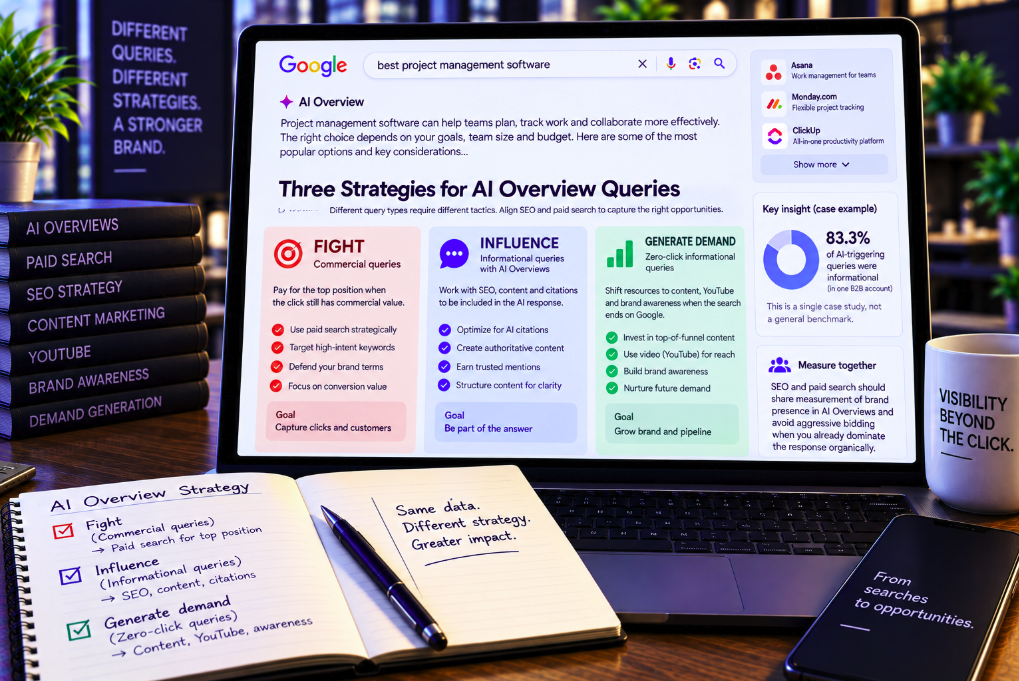
AI Overviews are forcing paid search teams to confront a problem that keyword-level bidding was never designed to solve: the same search term can now represent a click opportunity, a citation opportunity or a signal that the user journey has moved almost entirely onto Google.
A new Search Engine Land framework from Ana Kostic proposes dividing queries into three operational buckets—Fight, Influence and Generate demand—before deciding where to spend. The model starts from a simple observation: once Google can answer part or all of the query directly, the economic value of winning a paid click is no longer uniform across the keyword list.
For commercial terms where a click still leads directly to a quote, purchase or qualified lead, the job remains familiar: compete for premium placement when the economics justify it. For informational terms where the AI Overview does the educating, the objective shifts toward becoming part of the answer through SEO, content and citations. And when informational searches have become structurally zero-click, the framework argues that the budget may work harder upstream in content, YouTube and demand generation than in an increasingly expensive auction for disappearing visits.
AI Overviews turn one keyword list into three different assets
Traditional paid-search management tends to treat keywords as variations of the same basic asset. A query has a bid, a conversion rate, a cost per acquisition and an expected return. Better-performing terms receive more budget; weaker ones receive less.
AI Overviews complicate that model because Google can now resolve different amounts of the user’s task before a click happens.
A “buy,” “quote,” “supplier” or product-plus-modifier query can still require the user to visit a business and take action. A research query may be substantially answered by the Overview while still shaping which brands enter consideration. A basic informational question may be resolved so completely that the search stops on Google.
Those are different economic events even if they all appear in the same Google Ads account.
Fight: pay for the top position when the click still has commercial value
The Fight bucket covers bottom-of-funnel terms with clear purchase intent.
Kostic gives examples such as product-plus-modifier searches, supplier shortlists, “buy,” “quote,” “distributor” and brand terms combined with buying intent. In these cases, the AI Overview has not eliminated the need for the user to reach a commercial destination.
The paid-search objective therefore remains acquisition. The advertiser wants the premium position above or around the answer when that position produces enough incremental leads or sales to justify its cost.
The key qualification is economic. “Fight” does not mean bid to absolute top at any price. The framework recommends using bid simulators and incremental cost-per-acquisition logic to determine whether the additional visibility is actually worth the premium.
Commercial weight still attracts paid competition in AI search
As contextual evidence, the Search Engine Land article points to a July SE Ranking study of commercial queries in Google’s U.S. AI Mode. That analysis found ads appearing more frequently as keyword cost per click increased: about 54% for terms at $10 or more, roughly 32% between $2 and $10 and around 24% below $2.
AI Mode and AI Overviews are different Google Search surfaces, so those percentages should not be treated as a measurement of AI Overview advertising.
They nevertheless illustrate the commercial logic behind the Fight bucket. Where advertisers already assign high value to a click, Google’s AI-era search experiences can still contain meaningful paid competition.
The implication is not that every expensive keyword deserves a higher bid. It is that high-intent searches remain capture opportunities even as informational searches increasingly behave differently.
Influence: when the answer matters more than the visit
The Influence bucket begins where conventional click optimization becomes less useful.
These are queries where the AI Overview or another generative answer performs much of the research and education that previously happened after a user visited several websites.
The marketing objective changes from “win the cheapest qualified click” to “be part of the information environment that shapes the answer.”
That can mean being cited as a source, being named as a relevant brand or ensuring that authoritative third-party content represents the company accurately.
This is where the traditional organizational boundary between SEO and PPC starts to break down.
SEO and paid search are solving the same query from different directions
On an Influence query, the paid-search team can no longer optimize in isolation.
If SEO already earns prominent inclusion in the AI answer, paying aggressively for another appearance may not be the best marginal use of budget. If the brand is absent from the answer while competitors are repeatedly cited, the problem may require content, authority and citation work rather than a higher maximum CPC.
Kostic’s workflow therefore combines paid-search terms with SEO data, Search Console, AI Overview monitoring and manual SERP checks.
The query is evaluated as one search experience rather than as two departmental channels.
That does not mean paid and organic visibility are interchangeable. It means budget decisions should know what the organic and generative layers are already accomplishing.
Do not turn “organic already wins” into a universal no-bid rule
The framework recommends pulling back paid pressure where organic visibility already dominates the answer, but that should be treated as a budget-allocation principle rather than a universal law.
There are situations where paid and organic coverage can reinforce one another, particularly on competitive commercial queries, branded searches or high-value launches.
Kostic’s point is narrower: her team is generally not interested in paying aggressively on Influence terms when SEO has already secured the visibility they wanted.
The decision still depends on incremental acquisition value.
A useful implementation should test whether the paid placement adds conversions, qualified pipeline or defensive value beyond the existing AI and organic presence rather than assuming duplication is always wasteful.
One B2B account was 83.3% informational—but that is not a benchmark
The most striking number in the article comes from one B2B and industrial account analyzed by the author.
Among the terms surfacing AI answer blocks, 83.3% were classified as informational, 10% as “learn and solve” and 6.7% as commercial.
That distribution helps explain why a paid-search team working on that account would need an Influence strategy. Most of the observed AI-triggering query set was not direct purchase intent.
But the 83.3% figure is a single-account case example. It is not evidence that 83.3% of all AI Overview queries, all B2B searches or all Google queries are informational.
Industry, product complexity, campaign structure, keyword universe and account history can produce very different intent mixes.
The correct lesson from 83.3% is to measure your own mix
The useful action is not to copy the percentage. It is to reproduce the classification exercise.
Pull the actual search terms that matter to the business. Identify which ones trigger AI Overviews. Map their intent. Check whether the brand appears, whether it is cited and which competing sources dominate the answer.
Then calculate the account’s own distribution.
A direct-to-consumer retailer may discover that commercial intent remains dominant. An enterprise software company may find a large research layer. A manufacturer may see technical problem-solving queries occupying most of the AI surface.
The framework becomes valuable when it reveals the economics of a specific account, not when its example percentages become industry folklore.
Generate demand: some keywords have stopped being capture channels
The third bucket is the most consequential change to the traditional paid-search model.
Generate demand applies when informational intent still matters commercially but the search itself no longer produces enough clicks to function as an efficient acquisition channel.
The keyword has not become useless. It has changed jobs.
Instead of representing traffic that can be captured immediately, it becomes evidence of a demand gap: people care about the topic, but Google increasingly satisfies the initial research need before they leave the results page.
The marketing response moves upstream.
YouTube and content become substitutes for lost top-of-funnel capture
Kostic recommends shifting some resources toward Demand Gen, YouTube, first-party content, reviews, community presence and broader awareness when paid Search can no longer rebuild the informational funnel efficiently.
The logic is that brands need to influence the customer before the later commercial search occurs.
A user may learn the category through a video, encounter the brand in a review or community discussion, and only weeks later perform a high-intent query that belongs in the Fight bucket.
In that model, Generate demand fills the audience pool that paid Search eventually captures when intent becomes transactional.
Search remains important, but it moves later in the journey.
Zero-click does not mean zero commercial value
Calling a query zero-click can create the impression that it no longer matters.
That is the wrong interpretation.
An informational query can still reveal what potential buyers need to understand before they become customers. It can identify objections, terminology, comparison criteria, technical problems and emerging category demand.
What disappears is the assumption that the keyword’s value must arrive through a website session immediately after the search.
For Generate demand queries, value may appear later as branded search, direct traffic, assisted pipeline or a better-qualified commercial query.
That makes measurement harder, but it does not make the demand disappear.
Last-click Search ROAS can punish the strategy that creates future demand
This is where attribution becomes a strategic constraint.
If a business judges YouTube, content and awareness only by last-click Search revenue, upstream investment will often look inefficient.
The eventual conversion may be credited to a branded search ad or a direct visit even though earlier content created the preference that made the final click possible.
The framework therefore recommends looking at brand-search growth, assisted pipeline and later commercial behavior when evaluating Generate demand activity.
That does not eliminate the need for financial accountability. It changes the timeframe and the evidence used to establish it.
AI Overviews make intent classification more important than keyword classification
A keyword’s wording alone no longer tells the team how it should be managed.
The same term can behave differently as Google changes the result page. An AI Overview can appear, disappear or change composition. Paid inventory can move. The brand can gain or lose citation visibility.
Kostic therefore recommends revisiting bucket assignments regularly rather than treating them as permanent campaign labels.
A query can move from Influence to Fight if commercial intent strengthens, or from Influence to Generate demand if clicks collapse while the AI answer increasingly resolves the task.
The SERP itself becomes part of intent classification.
Semantic coherence is a prerequisite for the framework
The author identifies two foundations before teams begin moving budget between buckets.
The first is semantic coherence: keyword, ad and landing page should represent one clear concept.
This matters because broad match, Performance Max, AI Max and other automated systems can expand reach beyond tightly controlled keyword sets. If an ad group mixes several meanings, automation receives noisy signals about what the business is actually trying to capture.
AI-era campaign expansion does not remove the need for clean account structure. It makes ambiguous structure more expensive.
Conversion quality is the second prerequisite
The framework also depends on knowing which conversions have real business value.
Lead-generation accounts can accumulate form fills that look successful in Google Ads but have little relationship with qualified pipeline or revenue.
Kostic recommends primary conversion actions that reflect actual value, lead scoring and offline or CRM feedback wherever possible.
This becomes essential in the Fight bucket because the decision to pay a premium for absolute top should depend on incremental economic return, not simply a higher volume of low-quality conversions.
Automation amplifies the signals it receives. Weak conversion definitions make every bucket noisier.
Absolute Top impression share becomes more useful on Fight terms
When AI Overviews occupy substantial space near the top of the results page, average position becomes an incomplete way to understand paid visibility.
The framework highlights Absolute Top impression share and impression share lost to rank as useful diagnostics for commercial terms.
The practical question is whether the advertiser is appearing in the premium paid position before the AI answer and what it costs to secure that position.
If moving upward produces profitable incremental conversions, the premium may be justified. If it only increases CPC while the same customers would have arrived anyway, it is not.
The Fight bucket is therefore about disciplined aggression, not maximal bidding.
Influence terms need citation measurement, not just ad metrics
On Influence queries, conventional Google Ads reporting sees only part of the competitive environment.
The business also needs to know whether its brand is named in the AI Overview, whether its pages are cited, which third-party sources are used and which competitors appear.
That information can reveal a gap that paid-search data cannot explain.
An advertiser might see declining click volume and assume it needs a stronger bid. In reality, the AI Overview may already be answering the query while repeatedly presenting a competitor as the recommended solution.
The intervention then belongs partly to SEO, content, digital PR or reputation work.
Google’s own AI Search documentation keeps SEO relevant
Google’s Search Central documentation continues to treat web content as part of its generative Search ecosystem. The company’s Search appearance documentation lists AI features alongside other Search experiences, while its guidance for paywalled content notes that AI Overviews and AI Mode can preview topics using a variety of sources, including web sources.
Google has also expanded its Preferred Sources feature so selected publishers can be highlighted in AI Mode and AI Overviews where the feature is available.
None of this creates a guaranteed citation formula. It does reinforce the core premise of the Influence bucket: appearing inside the answer can itself be a meaningful Search objective even when the user does not click.
Paid search and SEO need a shared query map
The organizational implication may be larger than the bidding advice.
SEO teams traditionally report rankings, organic clicks and conversions. Paid-search teams report impression share, CPC, conversions and return on ad spend. AI Overviews create a shared layer neither team can understand independently.
A useful query map should include search intent, AI Overview presence, brand mention, citation presence, paid visibility, organic visibility, referral behavior and conversion quality.
With that shared view, the teams can decide whether the query needs auction pressure, answer influence or upstream demand creation.
Without it, each channel can optimize its own dashboard while the combined customer journey deteriorates.
The framework is a decision model, not an empirical law
The Fight, Influence and Generate demand model is operational guidance from a practitioner, not a controlled study proving that every query belongs cleanly in one of three universal categories.
The 83.3% informational share comes from one account. The article’s observations about click-through rates, CPC pressure and remaining-click quality describe broader patterns the author sees, but they should not be converted into universal causal estimates without query- and account-level measurement.
Likewise, no fixed threshold tells a team when an Influence query has become a Generate demand query.
The value of the framework is diagnostic. It forces marketers to ask what economic job the query still performs before changing a bid.
Some queries will sit between buckets
Real search behavior is messy.
A comparative software query can educate and convert. A technical problem can begin informationally but produce an immediate request for a supplier. A branded query can show an AI Overview while still generating valuable clicks.
Teams should resist turning the framework into another rigid labeling system.
The better approach is to identify the dominant mechanism and preserve uncertainty where necessary. If a query both influences consideration and generates profitable direct leads, paid and organic investment can coexist.
The buckets are budgeting tools, not laws of user behavior.
AI Max and broad match do not replace strategic classification
Google’s automated targeting systems can expand the set of searches on which an advertiser appears, including around AI-powered Search experiences.
Kostic argues that this makes classification more important, not less.
If the system expands into a large set of zero-click informational searches, an advertiser can spend budget on terms whose role should have been demand intelligence rather than direct capture.
Automation works best when the business already understands which kinds of queries it wants to fight for and which should be handled through influence or upstream marketing.
Reach is not strategy.
Budget should move across mechanisms, not just between keywords
The deepest change in the framework is the unit of optimization.
Traditional paid search reallocates money from one keyword or campaign to another. The AI Overview model may require reallocating money from one marketing mechanism to another.
A weak Fight term can lose budget to a stronger commercial term. But a Generate demand term may lose Search budget to YouTube or content instead of to another keyword.
An Influence term may trigger an SEO project, a source-earning campaign or an update to comparison content.
That is a broader decision than bid management, and it requires teams to share both data and budget logic.
The keyword is no longer always a traffic asset
Search marketers have historically valued keywords because they represented an opportunity to capture an existing stream of intent and redirect it to a website.
AI Overviews weaken that assumption.
Some keywords still represent traffic worth buying. Others represent an answer environment worth influencing. Others reveal demand that must be cultivated before the user returns with commercial intent.
Those are three different assets.
The practical advantage of the Fight, Influence and Generate demand framework is that it stops marketers from forcing all three through the same CPC-based decision system.
The best AI Overview strategy starts by asking what the query is still worth
The arrival of AI answers does not make paid search obsolete, and it does not turn every informational keyword into a branding exercise.
It changes the question marketers need to ask.
For a commercial query, is the remaining click valuable enough to justify paying for absolute top? For an Influence query, is the brand present in the AI answer and are the right sources shaping it? For a zero-click query, does continuing to buy Search traffic make more sense than creating demand through video, content and broader awareness?
The answers will vary by account. The 83.3% informational figure in Kostic’s example is useful precisely because it shows how different one B2B account can look once AI-triggering terms are classified—but it should never become a general benchmark.
The larger lesson is organizational. SEO and paid search can no longer evaluate AI Overview queries independently. They need a shared map of intent, answer visibility, citations, paid placement and economic value.
Once that map exists, a keyword stops being merely a bid target. It becomes one of three things: a click opportunity to fight for, a citation opportunity to influence or a zero-click demand signal telling the business where the next customer journey needs to begin.