
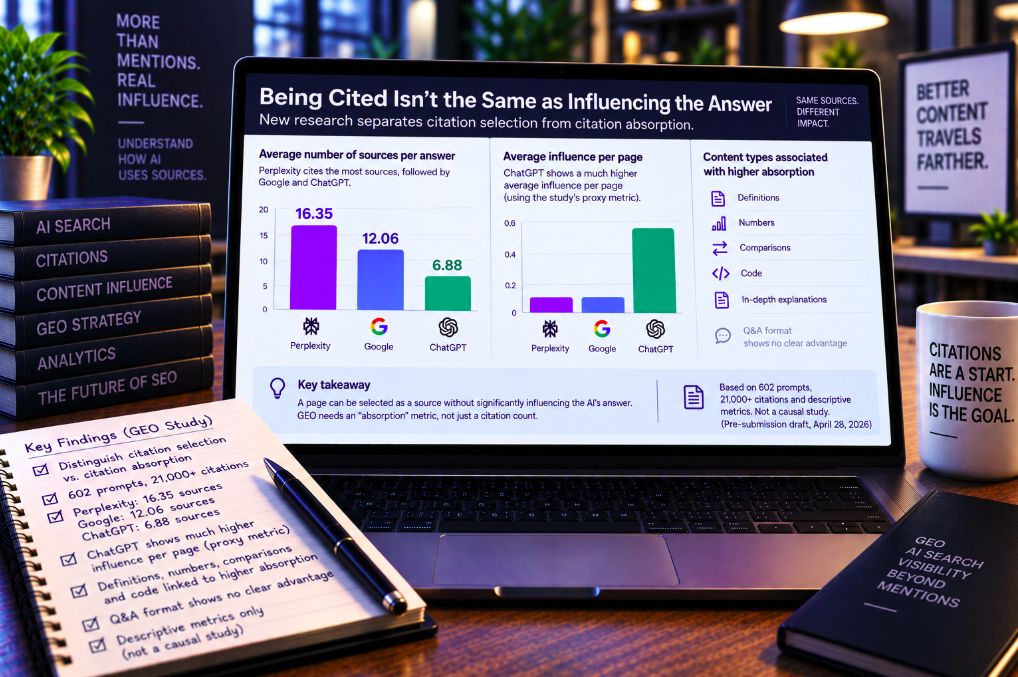
A page can appear in an AI answer’s source list without contributing much to what the answer actually says. That distinction sounds obvious, but most GEO measurement still treats the citation itself as the main unit of success.
A new pre-submission study argues that generative engine optimization needs a second metric. In “From Citation Selection to Citation Absorption: A Measurement Framework for Generative Engine Optimization Across AI Search Platforms,” Zhang Kai, He Xinyue and Yao Jingang separate citation selection—whether an AI system chooses a source—from citation absorption—how strongly the source appears to contribute language, evidence, structure or factual support to the generated response.
Using a public dataset covering 602 controlled prompts, 21,143 valid search-layer citations and 18,151 successfully fetched pages across ChatGPT, Google AI Overview/Gemini and Perplexity, the researchers find a striking breadth-versus-depth split. Perplexity cites the most sources, averaging 16.35 per prompt, followed by Google at 12.06 and ChatGPT at 6.88. Yet ChatGPT records by far the highest average page-level influence under the study’s constructed absorption proxy.
The implication is important for publishers: being present in the citation list and shaping the answer are not necessarily the same achievement. But the paper is deliberately cautious. Its influence score is an observational proxy, not a direct measurement of hidden model attention or causal source dependence, and the reported content patterns are descriptive associations rather than experimentally proven GEO tactics.
GEO has been measuring the gateway more than the outcome
Traditional search offers a relatively familiar measurement funnel. A page is indexed, ranks for a query, earns an impression, receives a click and potentially produces a conversion.
Generative search complicates that funnel because the engine can use a source without sending the user to it. It can retrieve a page, cite it, extract one fact, paraphrase several paragraphs or use it merely as background support.
A binary citation metric collapses all of those possibilities into the same outcome.
The paper argues that GEO therefore has at least two separate stages. Citation selection describes entry into the source pool. Citation absorption describes participation in the answer itself.
That distinction changes what “AI visibility” can mean. A publisher optimizing for referral traffic may care intensely about appearing as a visible source. A brand trying to shape how an AI system explains a category may care more about whether its evidence and framing actually enter the generated text.
The study analyzes 602 controlled prompts across three platforms
The analysis uses the public geo-citation-lab dataset and analysis pipeline. The snapshot contains 602 controlled prompts, 21,143 valid search-layer citations, 23,745 citation-level feature records, 18,151 successfully fetched citation pages and 72 extracted features.
The prompts span several experimental layers, including a main task set, prompt-style contrasts, Chinese-English language comparisons and more complex scenarios such as high-risk, ambiguous and multi-constraint questions.
The platform coverage includes ChatGPT, Google AI Overview/Gemini and Perplexity. After cleaning, the search-layer platform summaries contain 587 observed ChatGPT prompts and 602 each for Google and Perplexity.
This is more structured than an uncontrolled scrape, but it is not a probability sample of all real AI-search traffic. The paper explicitly warns that the results describe the prompt distribution in the dataset rather than the entire population of user behavior.
Perplexity is broadest: 16.35 citations per prompt
The first stage of the framework measures citation selection. Search triggering is near universal in the dataset, but the number of sources selected differs sharply by platform.
Perplexity averages 16.35 valid citations per prompt. Google averages 12.06. ChatGPT averages 6.88.
The medians tell a similar story: 17 citations for Perplexity, 12 for Google and six for ChatGPT.
If GEO were measured only by citation breadth, Perplexity would appear to create substantially more source opportunities. A publisher monitoring nothing beyond whether its URLs enter the citation pool could reasonably interpret that environment as more open to broad source exposure.
But the second stage of the paper produces a very different picture.
ChatGPT is sparse in citations but much deeper under the influence proxy
For successfully fetched citation pages, the researchers calculate a page-level influence_score intended to approximate how deeply each source participates in the generated answer.
ChatGPT’s mean influence score is 0.2713 across 3,323 fetched citation pages. Perplexity averages 0.0646 across 8,443 pages, while Google averages 0.0584 across 6,385.
Under this metric, ChatGPT’s selected pages have an average score more than four times those of the other two platforms.
The paper describes the resulting profile as citation-sparse but absorption-heavy. Perplexity appears citation-rich and coverage-oriented, while Google also selects broadly but resembles Perplexity more closely than ChatGPT on average absorption.
These should not be converted into permanent claims about how the companies’ products work. The authors explicitly frame them as descriptive profiles of a static snapshot. Model backends, browsing systems, citation interfaces and retrieval policies can all change.
The absorption score is a constructed proxy, not a view into the model
The most important methodological caveat is how “influence” is measured.
The researchers do not have access to hidden model attention, internal retrieval traces or a causal record showing which source tokens produced which answer tokens. Instead, they construct an observable proxy from five components.
Twenty percent of the score comes from a capped measure of how often the source is referenced. Fifteen percent rewards appearing earlier in the answer. Twenty percent measures coverage across answer paragraphs. Twenty-five percent comes from TF-IDF similarity between source and answer, while the remaining 20% uses bigram and trigram overlap.
The resulting number is useful for comparing observable source-answer relationships, but it should not be described as literal model influence.
A high score means the page looks more deeply integrated according to the chosen formula. It does not prove that removing the page would causally change the answer by the same amount.
Why a citation can have almost no absorption
A source link can play several roles inside an AI answer.
It may supply the central definition. It may provide the numerical evidence behind a recommendation. It may support a comparison repeated across several paragraphs. Or it may appear as a peripheral reference attached to a sentence whose substantive information came from elsewhere.
Those citations look similar if the dashboard records only “cited: yes.”
The study’s semantic-role analysis illustrates the difference. Pages classified as supplying definitions average an influence score of 0.1531, and comparison sources average 0.1524. Sources functioning merely as references average 0.0529.
The citation is visible in both cases, but the apparent answer-level contribution is very different.
Definitions and comparisons are associated with deeper use
The dataset also compares content features with average influence scores.
Pages containing definition markers average 0.1252 versus 0.0795 for pages without them, a descriptive relative difference of 57.33%. Comparison content shows a 55.28% difference, with mean influence of 0.1389 versus 0.0894.
Those patterns fit the paper’s “evidence container” interpretation. Generative systems need extractable units that can be inserted into answers: a definition that resolves terminology, a comparison that distinguishes alternatives or a factual statement that supports a conclusion.
But the study does not establish that adding a definition section to an existing page will cause its absorption to increase by 57%.
Pages containing definitions may differ in many other ways, including length, authority, editorial quality, topic and semantic relevance. The current analysis is descriptive.
Numbers and statistics show a strong descriptive association
Numerical evidence is another prominent pattern.
Pages containing numbers or statistics have a mean influence score of 0.1171, compared with 0.0725 for pages without that feature. The reported relative difference is 61.55%.
This makes intuitive sense for answer synthesis. Specific numbers can be highly reusable because they give the model concrete evidence to place inside a generated explanation.
For publishers, the practical hypothesis is straightforward: original statistics, quantified comparisons and clearly sourced measurements may create more usable answer material than unsupported general statements.
Scientifically, however, that remains a hypothesis for intervention testing. The dataset shows that numerical pages and higher absorption occur together; it does not isolate the number itself as the causal mechanism.
Code has the largest reported content-feature difference
Among the evidence genres listed in the paper, code has the largest descriptive gap.
Pages containing code average 0.1747 on the influence proxy, compared with 0.0988 for pages without code, a 76.88% relative difference.
This should be interpreted in context. Code is highly relevant to technical prompts because it can be reused directly as a procedural or implementation unit. It also tends to occur on documentation, developer resources and detailed technical pages that may already be strongly aligned with the question.
The result does not mean every publisher should add code snippets to increase AI visibility. It means that in the observed dataset, code-bearing pages tend to show deeper answer participation under the study’s metric.
How-to content is also associated with higher absorption
Pages containing how-to content show mean influence of 0.1296, compared with 0.0918 when that feature is absent, a 41.20% relative difference.
Procedural information gives generative systems a sequence that can be transformed into an actionable answer. It is another example of content providing a reusable evidence unit rather than merely discussing a topic broadly.
The paper’s broader interpretation is that semantic fit matters more than surface optimization. A page is useful for absorption when it contains the specific type of information the answer needs.
This is closer to information architecture than to a conventional checklist of SEO formatting tricks.
Q&A formatting does not show an advantage
One of the paper’s most useful negative findings concerns FAQ-style content.
Pages classified as Q&A format average an influence score of 0.0947, compared with 0.1005 for non-Q&A pages. That is a 5.74% relative difference in the opposite direction from the simplistic expectation that question-and-answer formatting should automatically make a page easier for AI systems to use.
The authors do not conclude that FAQ content is harmful.
The result instead shows that surface format alone is not sufficient. A Q&A page may consist of short support answers with little evidence, while a conventional article may contain definitions, statistics, comparisons and detailed explanations that are far more useful for synthesis.
A follow-up analysis would need to control for page length, quality, relevance, domain type and structure before making a stronger claim about Q&A formatting itself.
High-influence pages are dramatically more substantial
The top quartile of pages by influence score also looks very different structurally from the bottom quartile.
Top-quartile pages average 1,943 words versus about 170 in the bottom quartile. They average 10.59 headings versus 0.85, 47.49 paragraphs versus 8.34 and substantially denser list structures.
The semantic difference is also large. Average answer-citation similarity is 0.570 in the top quartile and 0.247 in the bottom quartile.
Again, these ratios should not be transformed into prescriptions such as “write 11 times more words.” Length, structure, relevance and editorial quality are entangled.
The more defensible interpretation is that deeply used pages tend to be substantial, structured evidence resources rather than thin pages that merely mention the query topic.
Semantic alignment appears stronger than raw length
The study reports its strongest independent descriptive correlation with the LLM relevance score at r=0.4322. Answer-citation embedding similarity follows at 0.3561, LLM content quality at 0.2917 and question-citation embedding similarity at 0.2548.
That hierarchy matters because it discourages a crude “longer is better” reading.
A long page that does not closely match the information need may contain little reusable evidence for the answer. A well-aligned page can provide exactly the definition, comparison or numerical fact the system needs.
The emerging GEO hypothesis is therefore not simply to produce more content. It is to create content whose evidence structure maps cleanly onto the tasks users ask AI systems to perform.
Selection still appears to favor recognizable source types
Absorption does not make citation selection irrelevant.
Before a page can influence an answer, it generally has to enter the candidate source pool. In the dataset, official, news and vertical sources account for between 79.12% and 87.52% of citations across the three platforms.
The high-frequency domains include YouTube, Wikipedia, Reddit, Reuters and several major media and institutional sites.
This suggests a two-stage GEO challenge. Authority, recognizability, fetchability and domain context can help a page become eligible for selection. Once selected, semantic alignment and evidence density may determine whether the page becomes central or peripheral to the answer.
A publisher can therefore succeed at the first stage and still underperform at the second.
News illustrates the selection-absorption gap
News sources appear frequently in the citation pool, but the paper reports a mean influence of 0.0726 for the news-media domain category.
Encyclopedia pages, by contrast, average 0.2144 in the absorption table.
The authors interpret this as another example of selection and absorption serving different functions. News can be valuable for identifying timely events, while explanatory resources can provide the structured background needed to build a fuller answer.
That interpretation is plausible but not causal. The domain categories differ in topic, format, freshness and other characteristics.
Still, it illustrates why a raw citation share can be misleading. A publisher can appear often because it is useful for discovery while contributing relatively little to the final synthesis.
ChatGPT’s higher score may partly reflect the measurement pipeline
The large cross-platform difference in influence deserves particular caution.
The paper itself notes that ChatGPT’s sparse-but-deep profile could reflect more intensive synthesis from a smaller evidence base. But other explanations are possible.
Citation rendering, answer length, browsing implementation and the way each platform’s output is parsed can all affect the components used to calculate the proxy.
If one product attaches many sources to an answer, average influence per source can mechanically become more diffuse. If another exposes fewer citations, each selected page has more opportunity to occupy a larger share of the measured answer.
The finding is therefore best read as a property of the observed platform outputs under this measurement framework, not proof that ChatGPT intrinsically “trusts” or “uses” individual sources four times more than its competitors.
The dataset is a snapshot, not a live market monitor
The paper lists several threats to external validity.
The 602 prompts are designed rather than randomly sampled from all user behavior. The language experiment covers Chinese and English, not the full multilingual AI-search market. Some country and source-type fields are noisy or unknown.
The absorption analysis also includes only pages that were successfully fetched. The public snapshot reports a 76.44% overall fetch success rate, meaning the influence analysis is conditional on source content being retrievable by the research pipeline.
There are also no unified record-level timestamps suitable for strong temporal interpretation.
Given how rapidly AI-search interfaces and model backends change, the authors explicitly characterize the dataset as a static research snapshot rather than a platform-monitoring feed.
The paper deliberately avoids causal claims
Another strength is the manuscript’s explicit identification hierarchy.
Direct counts such as the number of prompts and mean citations are treated as empirical observations. Cross-platform differences and feature-group contrasts are treated as descriptive findings. Mechanistic explanations such as the “evidence-container” hypothesis are presented as interpretations consistent with the data.
Causal prescriptions are reserved for future experiments.
The authors specifically warn against saying that adding comparison sections, definitions or other features will necessarily increase future absorption on a live platform.
To establish that, researchers would need controlled page interventions, repeated platform querying and appropriate inferential analysis.
The current manuscript reports descriptive statistics, not inferential proof
The study does not report fabricated certainty around the observed differences. It explicitly says the current manuscript relies on descriptive statistics from the public report and does not yet provide the confidence intervals, regression coefficients and clustered inference that a confirmatory microdata analysis should include.
The authors propose future robustness tests using alternative influence-score weights, a content-only proxy that removes citation-display components, domain-level deduplication, removal of mega-domains and explicit modeling of fetch failures.
That validation is particularly important because the influence score itself depends on a chosen weighting formula.
A robust absorption metric should ideally preserve its major conclusions under reasonable alternative definitions rather than producing a platform ranking that depends heavily on one arbitrary weighting scheme.
GEO dashboards may need two separate success columns
The practical implication is not that citation counts should disappear. They answer a legitimate question: how often does a platform expose a publisher as a source?
Absorption answers a different question: when the source appears, how much of the answer seems to depend on it?
A useful GEO dashboard could therefore report selection rate, citation breadth and answer-level absorption separately. It could also track whether citations genuinely support the claims they accompany and whether visibility is concentrated among a small number of domains.
Time should be another dimension. Because generative engines change rapidly, the same prompt panel should be rerun at fixed intervals with model, interface and collection conditions logged.
A single “AI visibility score” risks hiding all of these distinctions.
Publishers should optimize for evidence, not just mentionability
For content teams, the paper supports a useful shift in mindset even before causal testing is complete.
Getting cited may depend on becoming a recognizable, accessible and relevant source. Shaping the answer appears to require something more: content that contains clearly extractable evidence aligned with the user’s task.
Definitions, numbers, comparisons, procedures and code are associated with higher absorption in this snapshot because they can function as reusable answer components. Q&A formatting alone does not show the same benefit.
That suggests the more interesting GEO question is not “How do we make this page look AI-friendly?” but “What specific evidence can an AI system use from this page to answer the user better?”
The difference is subtle but consequential. Formatting is a wrapper. Evidence is the payload.
A citation is visibility; absorption may be influence
The study does not yet deliver a definitive industry-standard absorption metric. Its score is constructed, descriptive and still requires robustness and causal validation.
But the conceptual distinction is difficult to ignore.
Perplexity averages 16.35 citations per prompt in the dataset, Google 12.06 and ChatGPT 6.88. Yet ChatGPT’s fetched citations have a much higher average influence score under the paper’s proxy. At the content level, definitions, numbers, comparisons, code and procedural material are associated with deeper use, while Q&A packaging alone is not.
Those results do not prove which edits will make a page influence future AI answers. They do show why citation counting is an incomplete description of GEO performance.
A URL can win the citation and lose the answer. If generative search increasingly becomes the interface through which users consume information, the next generation of GEO analytics will need to measure not only whether a source was named, but whether it actually helped determine what the AI said.