
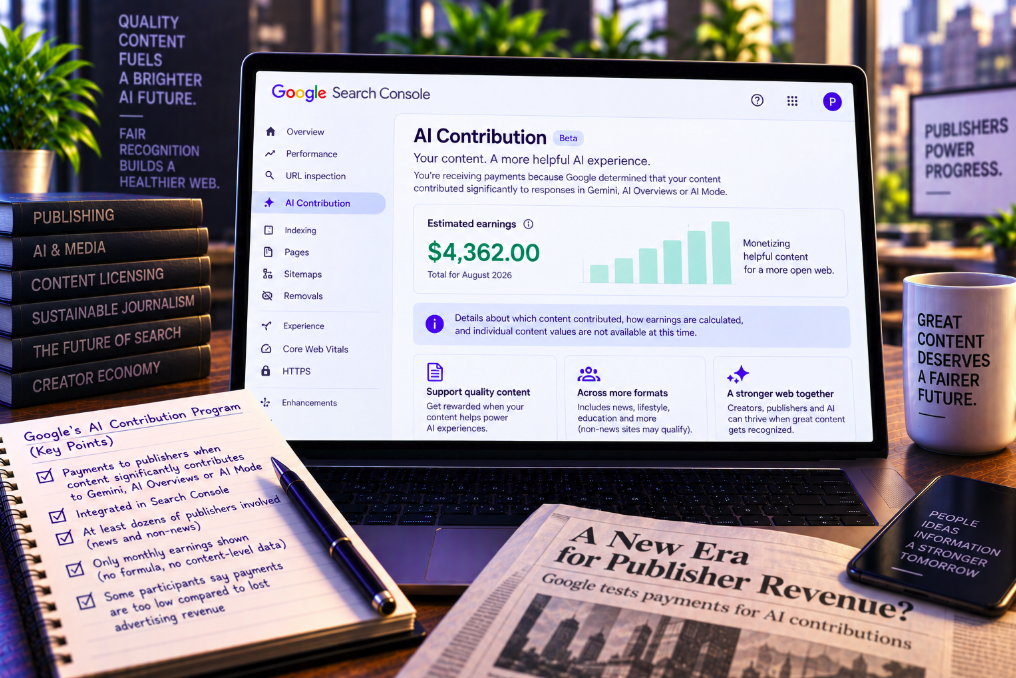
Google has started paying selected publishers when it decides their content has made a “significant” contribution to an AI-generated answer. The experiment establishes something publishers have been demanding for years—a direct return of value when their work helps power an AI product—but it leaves the most commercially important part hidden.
The program, called AI Contribution, appears inside Google Search Console for participating sites and covers content used across Gemini, AI Overviews and AI Mode. According to Digiday’s September 14 investigation, the dashboard tells a publisher how much it earned in a month, with some historical earnings data, but does not disclose which articles generated the payment, how often they were used, how much an individual contribution was worth or how Google calculates the final amount.
Search Engine Land separately confirmed the limited Search Console pilot and surfaced signup language telling publishers they can accumulate earnings when their content “contributes significantly” to AI-generated responses in participating products.
The result is a new publisher revenue model with an unusual asymmetry: Google determines whether the content created enough value to deserve payment, but the publisher cannot yet inspect the events or formula behind that determination.
AI Contribution turns Search Console into a payment interface
Search Console has historically been a measurement and diagnostic product. Publishers use it to understand how Google crawls their sites, which queries produce impressions and clicks, and whether technical problems are affecting search visibility.
AI Contribution introduces a different function: compensation.
Once a participating publisher joins the pilot, Digiday reports that an additional AI Contribution panel appears in Search Console. The interface displays the program name and a monthly payout figure.
That creates a potentially important precedent. Google is no longer treating all publisher participation in its generative products solely as part of the traditional search exchange of content for visibility and traffic. For at least some websites, content that grounds an AI response can now produce a direct monetary payment.
The pilot is limited, however, and Google has not announced it as a generally available Search Console feature.
Google pays for “significant” contribution, not simply for being used
The payment model is not described as a conventional per-crawl, per-token or per-citation license.
Digiday’s reporting says compensation is based more on value than raw usage. Google pays when it judges that a piece of publisher content meaningfully contributed to an AI-generated response.
That distinction is fundamental.
A page could theoretically be retrieved or considered by an AI system without crossing the threshold for payment. A citation could appear without necessarily carrying the same value as another source. A single highly important piece of evidence could potentially be worth more than repeated low-value use.
But because Google does not expose the underlying formula, publishers currently cannot verify how those distinctions are made.
The dashboard shows money but not the content that earned it
The central transparency problem is the lack of content-level attribution.
A publisher can see the monthly earnings number but cannot see which article or page generated the payment. It cannot determine which AI answer used that page, which product produced the event or what Google considered “significant” about the contribution.
That prevents publishers from building the feedback loop Search Console normally provides.
In conventional search, a newsroom can see that an article earned impressions for a query, received clicks and generated traffic. That information helps editors understand which topics and formats perform.
In AI Contribution, the economic result appears without the underlying performance data needed to explain it.
Publishers also cannot see the payout formula
The second black box is valuation.
Google has not disclosed whether the payment depends on the type of content, freshness, exclusivity, factual importance, frequency of use, answer reach, product, geography or any other factor.
Digiday reports that even participating publishers currently receive little detail beyond the monthly payout.
That makes it difficult to answer a basic licensing question: what is a unit of AI contribution worth?
If two publishers each receive the same monthly payment, one cannot know whether Google used their content the same number of times, whether one supplied more valuable evidence or whether completely different valuation rules were applied.
The program therefore creates a market signal without revealing the market mechanism.
Google confirmed the program is an early learning pilot
Google confirmed to Digiday that AI Contribution is an early-stage learning pilot intended to test how the company can reward high-quality content in addition to the traffic and tools it already provides publishers.
The experiment did not emerge without warning.
In a June 18 policy post, Google said it was piloting a new way to partner with websites whose content “meaningfully contributes” to the freshness and factuality of generative AI responses through grounding.
At the time, the company did not publicly describe the Search Console payment mechanics now reported by Digiday.
The September reporting connects that earlier commitment to a concrete compensation interface.
At least dozens of publishers have reportedly been approached
Digiday learned that Google has approached at least dozens of publishers about participating, although the publication could not obtain final confirmation of the total number.
That wording matters. The pilot should not be described as involving a precisely verified number of publishers.
The program also extends beyond conventional journalism.
Digiday reports that Google has widened the initiative to a broader range of publishers and websites, with small and mid-sized organizations appearing particularly interested in the opportunity.
This aligns with Google’s June language about “websites” rather than only news organizations, suggesting the company is testing a broader content-value framework rather than another newsroom-specific licensing scheme.
This is different from Google’s existing news licensing programs
Google already pays publishers through several separate programs, but AI Contribution should not be conflated with them.
The company’s News AI pilot involves commercial partnerships with publishers around enhanced content rights, specialized delivery and experimental AI features. Google said in June that program included more than 200 publications globally.
Google also operates Extended News Previews agreements in Europe and Google News Showcase. In June, the company said it paid more than 5,500 European publications under ENP arrangements and had more than 2,800 News Showcase partners across 33 countries.
AI Contribution is structurally different because the reported compensation is tied to Google’s assessment that website content contributed meaningfully to a generated AI response.
That makes it closer to a value-based inference or grounding marketplace than a conventional fixed licensing agreement—at least in concept.
It is also different from Search Console’s AI Performance report
Google now has multiple AI-related Search Console features, which makes terminology important.
The company’s generative AI performance reporting gives site owners visibility into impressions from AI Overviews and AI Mode. That report is intended to show how pages appear in generative Search experiences.
AI Contribution is the compensation pilot.
A publisher can therefore have AI visibility data without being part of the payment program. Conversely, the existence of an AI Contribution payout should not be interpreted as a new public payment entitlement for every site appearing in AI Overviews.
The pilot remains invitation-limited and experimental.
The missing feedback loop may matter as much as the missing formula
One participating publisher executive told Digiday that the most valuable evolution would be for Search Console to develop the same kind of feedback loop for AI inference that it historically provided for search.
That observation identifies the strategic weakness of the current design.
Money tells a publisher that Google found value somewhere. It does not tell the publisher what created that value.
If a scientific explainer generated most of the payment, the editorial team cannot see that. If a product database, original interview, breaking-news update or reference guide repeatedly grounded Gemini answers, the publisher cannot identify the pattern.
Without content-level attribution, AI Contribution is difficult to use as an editorial analytics product even if it succeeds as a payment mechanism.
Some publishers see value in establishing the precedent
Not every participant is dismissive of the experiment.
Digiday reports that some publisher executives view participation as strategically useful even while acknowledging the lack of transparency. Being inside the pilot allows them to test direct payments, exchange data with Google and participate in discussions about how AI content value might eventually be measured.
Google is reportedly holding regular calls with some partners, and participants described parts of the process as collaborative.
For those publishers, the immediate dollar amount may be less important than establishing a principle: if publisher content creates measurable value during AI inference, some of that value can flow back to the source.
That principle could become significant if AI-generated answers continue replacing part of the referral traffic that historically financed open-web publishing.
Other publishers say the payments are far too low
The economic reaction is far from universally positive.
One source close to the program described the early returns to Digiday as “peanuts” relative to advertising revenue. Another publishing executive characterized offers seen by their company and several peers as low enough that they did not create a compelling reason to join.
Those comments are qualitative assessments from industry participants, not independently audited comparisons between AI payments and lost ad revenue.
Still, they expose the core negotiation.
A publisher is not deciding whether a payment is better than zero in isolation. It is comparing that payment with the economic value of the audience relationship that AI answers may reduce or replace.
A small payment may not compensate for a lost visit
Traditional web publishing monetizes attention.
A user arrives on an article, sees advertising, encounters subscription messaging, joins a newsletter, clicks affiliate links or becomes part of the publisher’s first-party audience.
An AI-generated answer changes that sequence. The platform can consume the publisher’s evidence and satisfy the user without necessarily producing a visit.
A licensing payment therefore needs to be evaluated against more than the marginal cost of creating the content. It may also need to account for the foregone opportunity to monetize the reader directly.
That is why publishers can simultaneously welcome the payment precedent and argue that the initial amounts are inadequate.
The black-box formula makes fairness impossible to audit
A value-based model can theoretically be more sophisticated than a flat per-use fee.
Not every piece of content contributes equally. An exclusive fact that corrects an AI answer may be more valuable than a generic paragraph repeated across hundreds of websites. A frequently cited commodity definition may be less economically scarce than original reporting.
The difficulty is governance.
If Google alone defines significance, observes usage, calculates value and issues payment, publishers have no independent way to determine whether the allocation is fair.
They cannot compare payment rates across content categories, test whether original reporting receives a premium or determine whether high-traffic AI answers create larger payouts.
The program is therefore not merely a pricing experiment. It is an experiment in who gets to measure content value.
AI Contribution could become a new GEO metric—if Google exposes the data
For search marketers and publishers, AI Contribution also raises an intriguing measurement possibility.
GEO analytics currently focus heavily on citations, mentions, impressions and referral clicks. A direct payment signal could add another dimension: economic contribution.
If Google eventually showed which URLs contributed significantly, publishers could compare AI earnings with citation frequency, generative-search impressions and conventional traffic.
That could help distinguish pages that are merely visible from pages Google itself considers valuable enough to compensate.
In the current pilot, however, the absence of URL-level earnings prevents that analysis.
The model may favor publishers that cannot negotiate bespoke deals
Large media companies have more leverage to negotiate individual AI licensing arrangements. Smaller publishers often do not.
A standardized Search Console program could reduce that imbalance by giving a long tail of websites access to compensation without requiring a legal and commercial negotiation with Google.
Several industry sources cited by Digiday see that as one of the pilot’s most plausible roles.
The tradeoff is standardization. A small publisher may gain access to revenue it could never negotiate independently, but it may also have little influence over the formula Google applies.
If AI Contribution eventually scales, the design of that formula could determine how billions of pieces of open-web content are economically valued during AI inference.
Participation could also affect publishers’ negotiating leverage
Some executives are concerned that accepting standardized payments could weaken the argument for larger licensing agreements later.
If Google can point to a functioning compensation system, it may argue that publishers are already being paid for AI contribution.
Publishers, meanwhile, may argue that a payment mechanism does not establish that the amount is fair.
This creates a strategic dilemma. Refusing the pilot preserves negotiating distance but sacrifices immediate revenue and access to the experiment. Joining creates a payment relationship but potentially legitimizes a valuation framework the publisher cannot inspect.
That tension is likely to become more important if AI Contribution expands beyond the current limited group.
Google has an incentive to define value differently from raw usage
A pure usage-based licensing system could create large and unpredictable liabilities for an AI platform. Every retrieval, grounding event or generated answer might become a billable transaction.
A significance threshold gives Google more discretion.
The company can distinguish between content merely present in the information environment and content it considers materially useful to the final response.
There is a reasonable product argument for doing so: not every retrieved document contributes equally.
There is also an obvious economic advantage for Google. A value-based threshold can limit which usage events qualify for compensation.
Without transparency into the threshold, outsiders cannot know how restrictive that filter is.
Publishers still control whether they participate
Digiday reports that publishers can opt out of the AI Contribution pilot at any time.
Google has also expanded broader Search Console controls around participation in generative Search experiences, giving website owners more explicit choices over whether their content can appear and help ground AI Overviews and AI Mode.
Those controls are separate from the compensation experiment, but together they signal a shift in Google’s publisher relationship.
The company is increasingly treating generative AI use as something requiring dedicated controls, reporting and—in selected cases—direct payment.
That is a meaningful departure from the early phase of AI search, when publishers often had little visibility into how their content was being used at all.
The unanswered question is what “significant” really means
The word at the center of the program is doing substantial work.
What makes a contribution significant?
Is it textual overlap with the answer? Supplying a unique fact? Being one of several corroborating sources? Providing fresh information that changes the model’s response? Improving factual confidence? Being cited visibly to the user?
Google has not publicly answered those questions in enough detail to reproduce the calculation.
Until it does, publishers cannot optimize for the metric or independently verify that the compensation reflects the contribution they made.
A payment without attribution is progress—and still a black box
AI Contribution marks an important moment in the economics of generative search.
Google has confirmed an early pilot that pays selected websites when their content meaningfully contributes to grounded AI responses. Digiday reports that at least dozens of publishers have been approached, including organizations beyond the news industry, and that participants see monthly earnings inside Search Console.
But the dashboard stops where the most useful information would begin. Publishers cannot see which content earned the money, how often it was used, what an individual contribution was worth or how Google calculates significance.
Some participants see the program as a valuable first step toward a market for AI inference data. Others say the amounts are too low relative to the advertising economics they fear AI search is eroding.
The experiment therefore establishes the principle of payment without yet establishing transparent pricing. For publishers, that may be the next battle: not simply convincing AI platforms that content has value, but gaining enough data to understand who measured that value, how they measured it and whether the resulting payment is fair.