
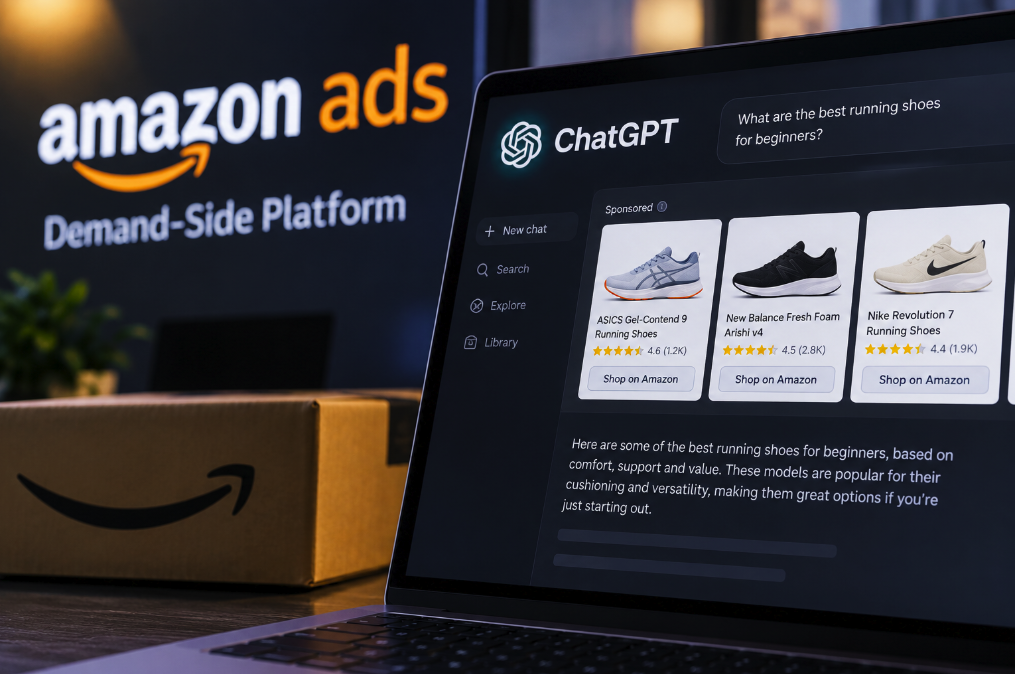
Amazon is opening another door into one of digital advertising’s newest surfaces: ChatGPT. In a U.S.-only pilot announced on September 10, selected advertisers using Amazon’s demand-side platform can buy ChatGPT ad inventory through Amazon DSP, turning a platform best known for retail media, streaming and programmatic reach into a new buying gateway for conversational advertising. The most consequential detail is not simply that Amazon can sell access to the inventory, but how the responsibilities are divided: Amazon handles the advertiser-facing buying and campaign-management layer, while OpenAI keeps control over how ads are delivered and where they appear inside ChatGPT.
The pilot, reported by Search Engine Land, is initially available to a select group of U.S. advertisers, with Delta Vacations named among the participants. For marketers already working inside Amazon DSP, the integration creates a route into ChatGPT advertising without requiring them to manage campaigns solely through OpenAI’s own buying environment. That matters because Amazon brings with it an established advertising operation, campaign workflows and a large base of brands already accustomed to buying media programmatically.
ChatGPT inventory enters the Amazon DSP workflow
According to the report, advertisers in the pilot can buy ChatGPT inventory using both cost-per-click and CPM pricing. The ad units can include text and images and are displayed beneath organic ChatGPT responses with sponsored labeling. That placement is strategically significant: rather than interrupting the assistant’s answer or becoming part of the generated response itself, the commercial unit occupies a separate area below the organic content.
This separation also defines the partnership technically and commercially. Amazon may provide the buying interface and help advertisers set up and optimize campaigns, but it does not determine the final placement of an advertiser within ChatGPT. OpenAI continues to control delivery and placement through its own systems. In practice, the arrangement resembles a division between demand access and supply governance: Amazon makes the inventory accessible to its advertisers, while OpenAI remains responsible for the experience inside its product.
That distinction is particularly important for conversational interfaces, where the boundary between an assistant’s answer and paid influence is more sensitive than it is on a conventional search results page or publisher website. Keeping sponsored units visually and operationally separate from organic responses gives OpenAI a mechanism for preserving that distinction even as it expands the number of ways advertisers can access its inventory.
Product feeds could make creative production much faster
One of the pilot’s most interesting features is support for product-feed advertising. Search Engine Land reports that Amazon can use advertisers’ product catalogs to automatically create ad assets, reducing the need to manually build a separate creative for every product or variation. This is familiar territory for ecommerce marketers: structured feeds already power large portions of shopping, retail-media and dynamic advertising ecosystems. Applying the same logic to ChatGPT could make conversational advertising much easier to scale.
The implications go beyond production efficiency. A product feed contains structured information that can be turned into relevant ad components at scale, allowing campaigns to reflect a changing catalog without requiring constant manual creative updates. If conversational advertising develops into a meaningful performance channel, feeds could become an important bridge between a merchant’s product data and the commercial opportunities generated around user intent.
That does not mean the product feed itself decides what appears in a conversation. The reported architecture still leaves OpenAI in charge of ad delivery and placement. Amazon’s role is to help transform advertiser data and campaign objectives into eligible advertising assets and bids; OpenAI’s systems determine how those eligible ads are ultimately served within ChatGPT.
Amazon brings more than a media-buying interface
The strategic attraction for advertisers is Amazon’s broader data and advertising ecosystem. Search Engine Land notes that Amazon’s shopping and streaming data could make the connection especially interesting for marketers that want to combine Amazon audience insights with a new conversational advertising environment. Amazon DSP is also used by nonendemic advertisers—brands that do not necessarily sell products on Amazon—which means the opportunity is not limited to ecommerce merchants.
Contemporary reporting from Digiday similarly frames the move as part of Amazon’s push to secure access to premium advertising supply beyond its own properties. From that perspective, ChatGPT is another high-profile destination that Amazon can add to a broader programmatic buying proposition. For OpenAI, meanwhile, Amazon offers access to a mature pool of advertisers, agencies and budgets without requiring every buyer to begin from a new advertising workflow.
Measurement starts with familiar performance metrics
For an advertising format that still feels new, the initial measurement framework is deliberately familiar. Advertisers testing the integration are expected to receive aggregated performance reporting that includes impressions, clicks, cost per result, CPM and CPC. Those metrics make the pilot easier to evaluate alongside other paid-media channels, particularly for teams already accustomed to performance marketing and programmatic reporting.
The harder question will be what comes next. Conversational interfaces generate context differently from search engines, social feeds or retail sites, so traditional click and impression metrics may capture only part of their value. As the market matures, advertisers are likely to ask for a clearer understanding of intent, incrementality and downstream conversion behavior. The pilot is therefore as much a test of measurement and advertiser demand as it is a test of inventory access.
A new distribution layer for ChatGPT Ads
The broader significance of the deal is that ChatGPT advertising is beginning to develop a distribution ecosystem around itself. OpenAI does not need every campaign to be bought through a single proprietary path if trusted external platforms can connect advertisers to its inventory while leaving the final serving logic under OpenAI’s control. Amazon, in turn, gains another premium environment to offer through its DSP and strengthens its position as an advertising infrastructure provider beyond Amazon-owned destinations.
Other reporting on September 10 reinforces that this is not simply an isolated media-buying experiment. The Information reported that Amazon is letting advertisers test buying ChatGPT ads through its advertising technology platform and described the initiative as a U.S. pilot. Taken together, the reports point toward a model in which ChatGPT inventory can become accessible through multiple buying relationships while OpenAI retains control over the product-level ad experience.
What advertisers should watch next
The immediate questions are scale and expansion. The pilot is limited to selected U.S. advertisers, so it is too early to treat Amazon DSP as a universally available ChatGPT buying channel. Marketers will be watching whether access broadens, whether product-feed campaigns produce meaningful performance, how reporting evolves and whether the integration attracts budgets that would not otherwise have flowed into ChatGPT Ads.
There is also a larger competitive question. If conversational AI becomes a durable advertising surface, the platforms that control advertiser demand, product data and campaign automation could become important intermediaries even when they do not own the underlying chatbot. Amazon’s pilot provides an early example of that structure: the DSP becomes the gateway, product feeds can power the creative layer, but OpenAI retains the keys to delivery and placement.
For advertisers, that combination makes the September 10 pilot more important than a simple inventory announcement. It connects a mature programmatic buying platform with a rapidly emerging conversational ad environment while preserving a clear division of control. Amazon is making ChatGPT Ads easier for its customers to buy; OpenAI is keeping authority over how those ads reach users. If the model scales beyond the pilot, that split could become a template for how advertising is distributed across AI assistants without turning the assistant’s organic answer itself into the ad.