
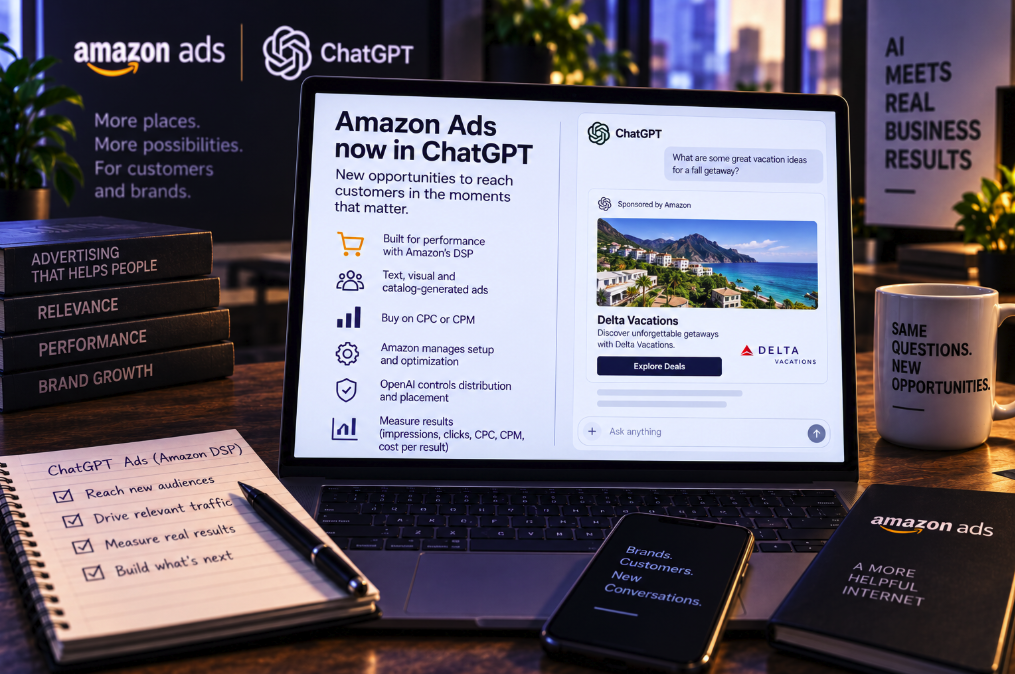
Amazon is becoming a new buying route into ChatGPT’s emerging advertising business. A pilot between Amazon Ads and OpenAI allows selected U.S. advertisers to extend campaigns from Amazon DSP into ChatGPT, connecting one of the world’s largest advertising platforms with a conversational environment that marketers are only beginning to learn how to buy.
The partnership was announced by Amazon Ads on September 10, 2026. Amazon says the integration lets advertisers expand existing campaigns into a conversational ad experience on ChatGPT, reaching users while they research options, compare alternatives and make decisions. Delta Vacations is among the first brands participating in the U.S. pilot.
Amazon DSP becomes the buying layer for ChatGPT inventory
The most important part of the integration is not simply that Amazon advertisers can appear in ChatGPT. It is that they can access the inventory through infrastructure they may already use for programmatic media. For marketers running campaigns across Amazon properties and the open internet, ChatGPT becomes another destination inside a broader media plan rather than a completely separate advertising workflow.
According to Search Engine Land’s reporting on the pilot, ChatGPT Ads inventory is available through Amazon DSP as a managed service. Amazon assists advertisers with campaign setup and optimization, lowering the operational barrier for brands that want to test conversational advertising without building an entirely new buying process around OpenAI.
The pilot is limited to selected advertisers in the United States at launch. Amazon has not announced a general self-service rollout or an international expansion schedule, so the integration should currently be understood as an early test rather than a universally available DSP placement.
Advertisers can buy on CPC or CPM models
The buying mechanics will be familiar to performance and programmatic teams. Search Engine Land reports that advertisers can purchase ChatGPT inventory on either a cost-per-click or cost-per-thousand-impressions basis, allowing campaigns to be structured around traffic or exposure depending on the objective.
The test includes text and image units as well as product-feed ads. The latter can use an advertiser’s product catalog to automatically create advertising assets, potentially making the integration particularly relevant to retailers and other brands with structured product feeds. It also gives Amazon an obvious role: the company already operates an advertising ecosystem built around commerce signals, catalogs and automated campaign optimization.
Measurement currently includes aggregated impressions, clicks, cost per result, CPM and CPC. Those metrics make the inventory legible to advertisers accustomed to evaluating paid media through standard performance indicators, even though the conversational context around the ad is substantially different from a conventional display impression or search ad.
Amazon manages campaigns, but OpenAI controls placement
The partnership also establishes a clear division of responsibility. Buying through Amazon does not mean Amazon decides where an advertisement appears inside ChatGPT. Search Engine Land reports that OpenAI continues to control ad delivery and placement through its own systems.
In practical terms, Amazon provides the advertiser relationship, campaign-management layer and optimization support, while OpenAI remains responsible for how sponsored inventory is ultimately served in the ChatGPT experience. Ads appear beneath organic responses and are labeled as sponsored, preserving a separation between the assistant’s answer and paid placement.
That distinction is strategically important. Conversational advertising carries unusual trust considerations because the organic answer can feel more personal and advisory than a traditional search-results page. Keeping ad placement under OpenAI’s control allows the product owner to determine how commercial messages coexist with the assistant’s responses rather than delegating that experience to an external demand platform.
Amazon’s audience signals could make the partnership more valuable
Amazon’s advantage is not limited to campaign plumbing. Its advertising business is built around extensive first-party signals from shopping, browsing and streaming behavior. Amazon says its broader ad platform uses trillions of proprietary signals to help brands plan, activate, optimize and measure media investments across Amazon properties and the open internet.
For advertisers, the attraction is the possibility of combining those audience insights with a new conversational environment. A user asking ChatGPT to compare destinations, research a product category or explore purchase options may be at a different point in the decision process from someone passively encountering a display ad. Amazon’s systems can help advertisers plan and optimize the campaign, while OpenAI determines whether and where the resulting ad is appropriate to serve.
Delta Vacations illustrates that opportunity beyond conventional ecommerce. The company’s president, Katrin Koenig, said in Amazon’s announcement that the collaboration could use consumer insights to inform how and when Delta Vacations appears within ChatGPT Ads experiences. That makes the pilot relevant not only to merchants selling products on Amazon but also to non-endemic advertisers already using Amazon DSP to reach audiences elsewhere.
ChatGPT Ads is starting to plug into the wider ad-tech ecosystem
The integration is also significant for OpenAI. An advertising product can grow faster when marketers do not have to adopt an entirely new buying platform to access it. By connecting ChatGPT inventory to Amazon DSP, OpenAI gains a route to advertisers, agencies and budgets that already flow through an established programmatic system.
This is a familiar pattern in digital advertising. New media environments often begin with direct sales and limited tests before becoming accessible through larger buying platforms. If conversational ads follow the same trajectory, demand-side integrations could become an important part of how ChatGPT advertising scales beyond early adopters.
Amazon, meanwhile, gains another high-profile supply destination. Its DSP already positions itself as a tool for buying media beyond Amazon’s owned properties, and ChatGPT gives it access to an emerging category of attention: users actively conversing with an AI assistant while exploring decisions.
Conversational context creates opportunities—and measurement questions
The commercial appeal is clear, but conversational advertising will not necessarily behave like search or display. A click generated beneath an AI response may occur after a long exchange in which the user has refined preferences, compared alternatives and received detailed information. That context could make some impressions unusually relevant, but it also complicates attribution because the assistant itself may have already satisfied much of the user’s informational need.
Standard metrics such as CTR, CPC and CPM will therefore be useful but incomplete. Advertisers will eventually want to understand whether conversational placements create incremental conversions, influence consideration, assist later purchases or simply capture demand that was already likely to convert. The initial pilot’s aggregated performance reporting is a starting point rather than a complete answer to those questions.
Brand safety and placement transparency will matter as well. Because OpenAI retains control of delivery, advertisers buying through Amazon will need enough reporting to understand where their campaigns appear and what kinds of conversational contexts generate results without compromising user privacy or the integrity of the organic response.
A new gateway, not a transfer of control
The Amazon partnership does not turn ChatGPT into Amazon inventory, nor does it hand Amazon control of the assistant’s advertising experience. It creates a bridge between two systems: Amazon DSP manages the buying relationship and campaign operations, while OpenAI controls distribution and placement inside ChatGPT.
That bridge could still be consequential. For marketers already spending through Amazon, testing ChatGPT no longer has to begin with an entirely separate advertising stack. For OpenAI, Amazon offers access to a large pool of established advertisers. And for Amazon, conversational AI becomes another environment in which its advertising technology can extend beyond its own properties.
The pilot is still narrow—selected U.S. advertisers, managed access and an emerging set of formats—but it signals how quickly ChatGPT Ads is becoming connected to the wider digital advertising market. If the program expands, the question for brands may shift from whether they can advertise inside an AI conversation to which buying platform they want to use to get there.