
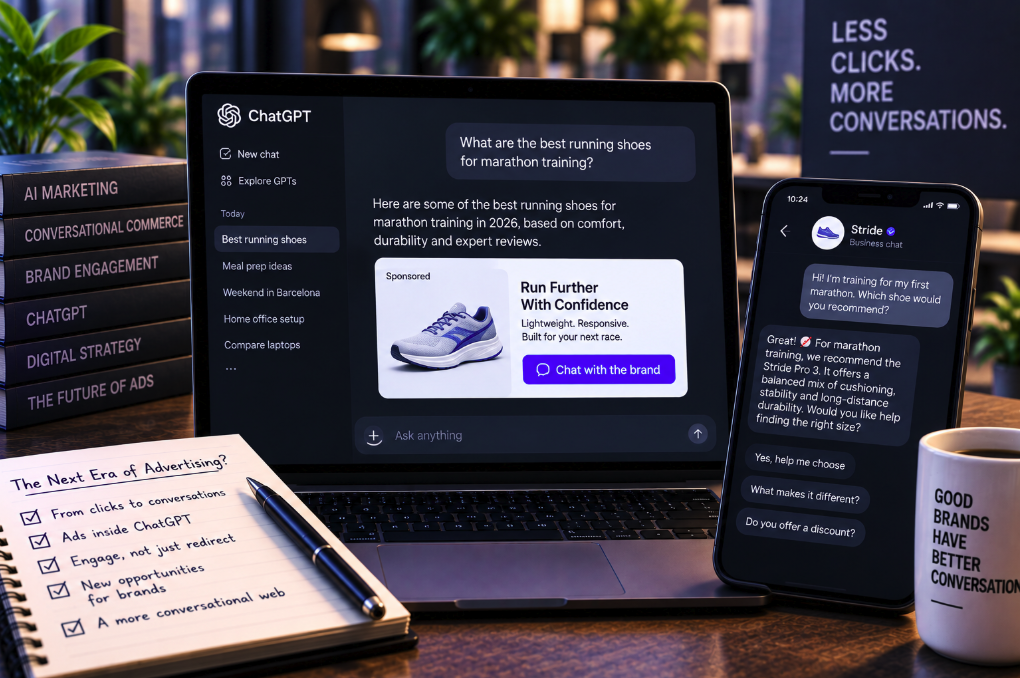
OpenAI is testing a ChatGPT ad format that changes what an advertising click is supposed to do. Instead of immediately opening an advertiser’s website, the click can launch a branded conversation inside ChatGPT, where an AI agent representing the business continues the interaction.
The early format was reported by Digiday on September 14, which says it viewed the experience in video and verified it. Select advertisers can attach a branded business agent to an ad. When a user presses a call-to-action such as “Chat to us,” ChatGPT opens a dedicated brand conversation rather than sending the person straight into a browser tab.
Wayfair is among the advertisers trialing the format, according to a screenshot reviewed by Digiday. The number of companies with access is unclear, and OpenAI did not respond to Digiday’s request for comment. That makes this an early reported test rather than a broadly announced product launch with public specifications.
But the concept matters because it points toward a fundamentally different advertising model. Search advertising traditionally monetizes the handoff from a query to a website. OpenAI appears to be experimenting with monetizing the conversation that happens before that handoff—or potentially replacing part of the website journey altogether.
The ad click becomes the start of another conversation
Current ChatGPT ads are comparatively familiar. OpenAI’s advertiser documentation describes ads that appear below ChatGPT responses with an advertiser name, headline, description, landing page and creative asset. The platform supports CPM and CPC buying, while advertisers can provide contextual hints to help the system match campaigns to relevant conversations.
The new format changes the destination. Rather than treating the advertiser’s landing page as the immediate next step, the ad becomes an entry point into a separate branded agent experience inside ChatGPT.
That agent could theoretically answer product questions, clarify needs, compare options or help determine what the user should do next. Digiday describes the format as an early iteration of the “AI-native” advertising OpenAI has been discussing: an ad designed around the conversational behavior of an assistant rather than imported from search, social or display advertising.
The distinction is more significant than a different CTA button. It changes the unit of engagement from a click to a dialogue.
OpenAI has been signaling that conventional ads are only the starting point
The experiment fits OpenAI’s public direction. At Goldman Sachs’ Communacopia and Technology Conference on September 8, CFO Sarah Friar described the current ads shown beneath ChatGPT answers as a “basic starting point,” according to Digiday. She said the company was already seeing early indications of what a format genuinely native to AI could look like.
OpenAI’s own advertising site frames ChatGPT as a place where people explore options, compare alternatives and make decisions rather than merely type short keywords. The company argues that conversational context can give advertisers a richer understanding of user intent than conventional keyword targeting.
In May, OpenAI also expanded ChatGPT Ads with CPC bidding and a beta self-serve Ads Manager, adding more familiar performance-ad infrastructure around the product. Since then, the platform has continued experimenting with creative formats, product feeds, carousels and conversion-oriented buying.
A branded agent is a different step because it uses the assistant interface itself as the post-click environment.
Why brands might prefer a conversation before a website visit
Many commercial searches require more information than an ad can contain. A shopper considering furniture may need dimensions, delivery timing, material details and recommendations for a particular room. A software buyer may need to know whether a product supports a specific integration, security requirement or company size.
A conventional ad asks the user to click and find those answers on the advertiser’s website. A conversational ad could attempt to resolve them immediately.
That creates a potentially valuable qualification layer. The agent can ask follow-up questions, narrow the user’s requirements and guide the person toward a more appropriate product or next action. If the user eventually leaves ChatGPT for the advertiser’s site, the visit could theoretically arrive with stronger intent than a conventional ad click.
Farhad Divecha, group CEO of Accuracast, compared the idea to Meta ads that send users into WhatsApp conversations. In both cases, the advertiser uses messaging as an intermediate step where prospects can be qualified before being routed toward customer service, sales or a transaction.
The website may no longer be the first destination
For marketers, the most consequential part of the format may be what it removes from the initial journey: the advertiser’s own site.
Websites have traditionally been where brands collect first-party behavioral data, run analytics, control merchandising, deploy personalization and manage conversion flows. If a meaningful share of commercial discovery and qualification moves into ChatGPT, the website can become a later-stage destination rather than the first post-ad touchpoint.
That does not necessarily mean fewer website conversions. A good agent could reduce friction and send more qualified prospects downstream. But it could mean fewer raw sessions, fewer opportunities to observe early browsing behavior and greater dependence on whatever reporting the platform exposes about the in-chat interaction.
Digiday notes the tension explicitly: retailers want the data generated on owned sites, but consumer journeys increasingly happen across external platforms. Brands may have to decide whether preserving the traditional site visit is more valuable than meeting users inside the environment where their decision is already taking shape.
Conversational ads could make attribution harder
The format also raises a measurement problem. With a standard CPC ad, the basic funnel is easy to conceptualize: impression, click, website session, conversion. A branded-agent conversation introduces multiple intermediate behaviors.
A user could open the agent, ask three questions and leave. Another could spend ten minutes comparing products before visiting the site. A third might receive enough information inside ChatGPT that no external click is necessary until a much later session.
Advertisers will need to decide which of those interactions counts as success. Conversation starts, qualified conversations, product selections, lead submissions and eventual purchases could all become relevant outcomes.
OpenAI has already been building more performance-oriented advertising infrastructure, but Digiday’s reporting suggests marketers still see the platform as early and its return on investment as not yet proven. A new interaction model creates opportunity, but it also adds another layer that must be measured convincingly before large budgets follow.
The brand agent creates a new form of creative
Traditional ad creative is largely static: a headline, image, video or product card is approved before the campaign runs. A conversational agent is dynamic. Its output changes according to the questions users ask.
That turns the agent’s knowledge, instructions and behavior into part of the advertising creative itself. Brands may need to manage what the agent can claim, how it handles comparisons, when it acknowledges uncertainty, which products it recommends and when it hands a conversation to a human or external page.
For regulated industries or products with complex specifications, this can become a governance issue as much as a media-buying issue. An inaccurate answer delivered after an ad click can create a different kind of brand risk than a poorly performing banner.
OpenAI’s current advertising policies impose restrictions around sensitive and unsafe contexts, and the company says ads must remain clearly separated from ChatGPT’s organic answers. A branded agent would need to preserve that separation while still feeling useful enough that users want to engage.
The format also tests the boundary between advertising and assistance
One reason conversational ads could be powerful is also why they require careful labeling. A useful AI assistant is expected to answer questions in the user’s interest. A branded agent has a commercial objective.
Those roles are not identical. A retailer’s agent can provide genuinely helpful product guidance while still being designed to sell that retailer’s products. The interface needs to make the commercial relationship unmistakable so that users understand when they have moved from ChatGPT’s general response into an advertiser-controlled experience.
OpenAI says its advertising system is separate from ChatGPT’s answers and that advertisers cannot shape, rank or alter those organic responses. Maintaining that boundary becomes even more important when an ad itself opens another AI conversation that visually resembles the surrounding product.
If users cannot easily tell which agent is speaking and whose incentives it represents, the format risks weakening the trust that makes conversational advertising attractive in the first place.
Wayfair is reportedly among the early testers
Digiday reports that Wayfair is trialing the format based on an ad screenshot it reviewed. Beyond that example, the publication says it is unclear how many advertisers currently have access.
OpenAI has not publicly detailed eligibility, pricing, agent-building requirements, measurement or rollout timing for the format. It also did not provide Digiday with comment for the September 14 report.
Those gaps matter. The current evidence establishes that an early version exists and has been shown to select clients; it does not establish that click-to-chat will replace standard ChatGPT ads or become generally available in its present form.
Early ad products frequently change as platforms test user response, advertiser demand and economics. The final version could differ substantially from the experience being trialed now.
ChatGPT is looking for an ad format that belongs to conversational AI
Every major advertising platform eventually developed a format tied to its core user behavior. Search engines built text ads around queries. Social networks inserted native units into feeds. Short-form video platforms made vertical video the commercial language of scrolling entertainment.
ChatGPT’s core behavior is conversation. An ad that merely sits underneath a response can monetize attention, but it does not fundamentally use that behavior. A branded agent does.
The format effectively says that the commercial action after an AI answer does not have to be “visit this website.” It can be “continue talking, but now with the business.”
If that model works, advertisers may begin optimizing for conversation quality and downstream intent rather than simply click-through rate. Media teams could find themselves evaluating agents alongside landing pages, while brand, commerce, customer-service and performance-marketing functions converge around the same conversational interface.
The biggest question is whether users want to stay inside ChatGPT
The strategic logic is clear: OpenAI wants an advertising experience that feels native to a chatbot rather than copied from the web. Advertisers want access to users while they are actively comparing options and expressing detailed intent.
The unresolved question is whether people will actually prefer a branded AI conversation to visiting the brand’s site. Some may value the convenience of asking follow-up questions without leaving ChatGPT. Others may want the control, visual browsing, trust signals and transaction experience of an owned website.
For brands, success will depend on whether the agent genuinely shortens the path to a useful decision rather than inserting another layer between the user and the product. A conversational ad that simply repeats marketing copy in chatbot form will offer little reason to exist.
But if the agent can answer the questions that normally force a user through product pages, FAQs, filters and comparison tables, OpenAI may have found something more consequential than another ad placement. It may have found a format that turns advertising from a link into an interactive sales surface.
That is still an experiment, not a proven replacement for the website click. Yet it points toward a future in which the most valuable ad interaction inside an AI assistant is not leaving the assistant at all.