
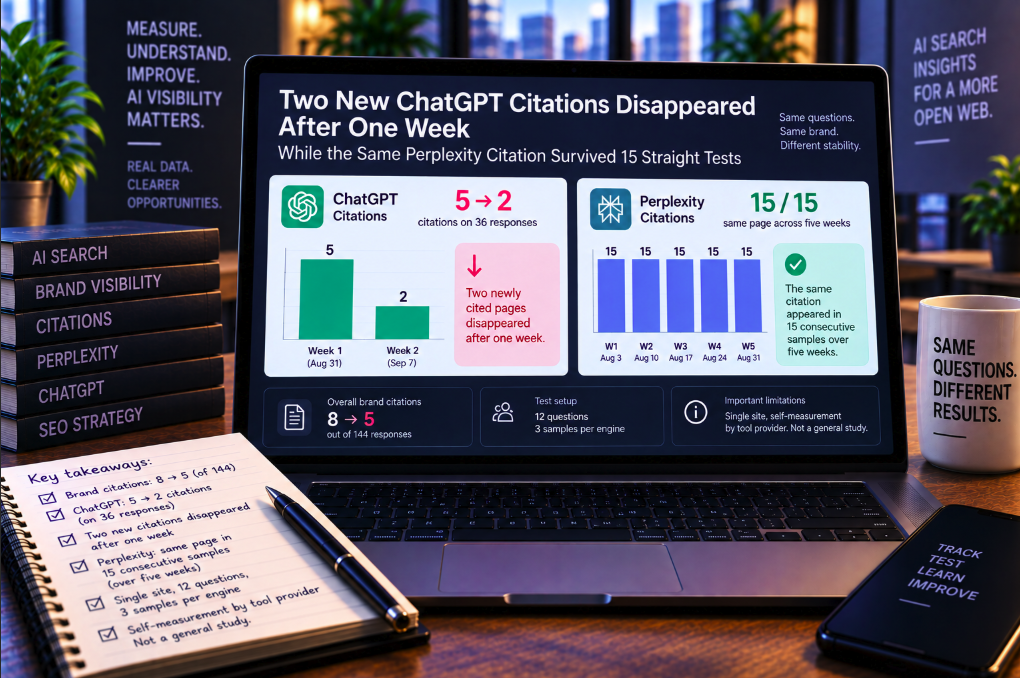
Two pages that earned their first ChatGPT citations disappeared from the same measurement panel just one week later, while a separate Perplexity citation survived its fifteenth consecutive test. The contrast offers a compact illustration of one of generative search’s hardest measurement problems: earning a citation once is not the same thing as establishing durable visibility.
The result comes from AskedAbout’s public weekly self-audit, which runs the same 12 buyer questions three times each across ChatGPT, Perplexity, Gemini and Claude. The September 7 run completed all 144 planned answers and found AskedAbout cited in five of them, down from eight citing answers in the previous week’s run.
ChatGPT accounted for most of that decline. Its citing answers fell from five of 36 on August 31 to two of 36 on September 7. Two comparison pages that had appeared as ChatGPT sources for the first time a week earlier each went from one citation in three identical samples to zero in three. Meanwhile, Perplexity continued attaching the same AskedAbout comparison page to the same buyer question in all three samples for the fifth consecutive week: 15 citations in 15 attempts from August 10 through September 7.
The difference is suggestive, but it is not evidence that Perplexity citations are universally more stable than ChatGPT citations. This is a self-measurement of one website using 12 questions and three samples per engine. What it demonstrates directly is narrower: two newly acquired ChatGPT citations proved ephemeral in this panel, while one older Perplexity citation proved unusually persistent.
The weekly citation rate fell from eight answers to five
AskedAbout has been running the panel every Monday to measure its own visibility using the same production audit system it offers customers. Each scheduled run asks 12 fixed commercial questions three times on four AI engines, producing a target of 144 answers.
On August 31, one Gemini sample failed, leaving 143 completed answers. Eight of those answers contained an AskedAbout URL, a 5.6% citation rate. On September 7, all 144 samples completed and five cited the site, reducing the measured citation rate to 3.5%.
The site’s mention rate—the share of answers that named AskedAbout in the prose—also declined from five of 144 planned samples to three of 144. Its share-of-voice metric fell from 0.61% to 0.36%.
Those are small absolute numbers, which is precisely why the page-level movements matter. A gain or loss of only a few answers can produce a large percentage change when a brand is still cited infrequently.
ChatGPT lost both of the comparison-page citations it had just added
The August 31 run had produced two new page-level wins in ChatGPT. AskedAbout’s page comparing inexpensive AI visibility tools was cited in one of three samples for the question asking for the cheapest AI visibility or brand-monitoring tool. Its AthenaHQ alternative page was also cited in one of three samples for a small-business alternative question.
AskedAbout preregistered the September 7 run as the first survival test for those citations. Both went to zero of three.
The site says neither comparison page changed between the two reads. Its page registry had no relevant commit after August 24, and the pages themselves had last been committed on August 1. That removes one obvious explanation for the loss: AskedAbout did not rewrite the cited pages during the week and accidentally remove whatever had made them eligible.
But unchanged pages do not imply an unchanged retrieval environment. ChatGPT can vary its source set between repeated answers, underlying retrieval systems can change, competing pages can enter the candidate pool, and the model can produce different grounding decisions from the same question.
ChatGPT’s overall count dropped from five citations to two
The two vanished comparison pages were not the only movement inside ChatGPT. Across the full 36-answer ChatGPT panel, citing answers fell from five on August 31 to two on September 7.
Both surviving citations pointed to the AskedAbout homepage. One question about checking what ChatGPT says about a business returned to one citation in three samples after previously declining from three to one to zero. Another question about tools that track whether AI recommends a business remained at one citation in three samples, while the brand was mentioned without a link in an additional answer.
A third question that had cited AskedAbout in all three samples on August 24 and two of three on August 31 dropped to zero of three on September 7.
The pattern shows why a weekly topline can hide substantial composition churn. A brand can maintain roughly similar visibility for several runs while the exact questions and pages generating that visibility change underneath it.
The Perplexity citation behaved completely differently
On Perplexity, AskedAbout’s “best Profound alternatives” page continued to appear as a source for the question asking for a good Profound alternative for a small business. It was cited in all three samples on September 7.
That made five consecutive weekly reads at three of three: August 10, August 17, August 24, August 31 and September 7. Across those dates, the same page was cited in 15 of 15 samples for the same question.
The page had not been edited since August 1, according to AskedAbout. The persistence therefore occurred without weekly content changes designed to refresh the citation.
Interestingly, Perplexity never named AskedAbout in the answer text on those rows even while repeatedly including the page in its citation set. That distinction reinforces another measurement issue: being used as a source and being explicitly recommended as a brand are not the same outcome.
AskedAbout corrected the start date of the Perplexity streak
The public audit also includes a methodological correction worth preserving. An earlier version claimed the Perplexity page had appeared three of three times in the August 3 raw arrays as well.
On September 8, AskedAbout corrected that statement. A refresh script had matched other websites with a similarly named /best-profound-alternatives path without properly checking the hostname. The August 3 run actually contained no AskedAbout citation in any of its 144 answers.
The correct streak therefore begins August 10 and totals 15 of 15 samples across five weeks, not a longer run beginning August 3.
That disclosure is important because citation measurement is technically messy. Tools must normalize URLs, identify domains correctly, distinguish citations from plain-text mentions and cope with different source formats across engines. A small parsing error can create a false persistence signal if the raw data is not auditable.
A new citation may be less meaningful than a repeated citation
The contrast between the two ChatGPT pages and the Perplexity page supports a useful measurement principle: citation age and repetition can carry information that a binary “cited/not cited” dashboard misses.
A page that appears once in one of three samples has demonstrated that it can enter an engine’s source set. It has not demonstrated that the engine reliably prefers or retrieves it. A page that appears in three of three samples for five consecutive weeks represents a qualitatively different pattern.
That does not necessarily mean the older citation is permanent. Retrieval systems can change overnight. But repeated survival across independent runs provides stronger evidence of durable visibility than a first appearance.
For GEO reporting, it may therefore be useful to separate newly acquired citations from recurring citations and to track survival over subsequent reads rather than celebrating every new source appearance equally.
AskedAbout’s broader series shows substantial week-to-week movement
The site’s own history makes the instability visible. Across its first 12 scheduled Monday runs, AskedAbout reports citation counts of 0, 0, 0, 0, 1, 2, 0, 3, 7, 8, 8 and 5.
That series contains both apparent breakouts and reversals. A screenshot taken during a zero week would suggest the brand had no AI citation visibility. A screenshot taken at eight citations would suggest a much stronger position. Neither view alone describes the distribution the site experienced over time.
The same applies at the page level. The two ChatGPT comparison pages looked like new wins on August 31 and vanished at the next scheduled read. The Perplexity page looked stable only because it was measured repeatedly long enough to demonstrate persistence.
This is why single-run GEO audits can be directionally useful but weak as performance reporting. Generative systems are stochastic, and source selection can vary even when the website and question remain unchanged.
The site’s separate churn data points in the same direction
AskedAbout has also published broader repeated-citation analyses from its buyer-question panel. In a September 7 transition study, only 35.1% of 248 domains that entered its AI-cited set on August 31 were cited again one week later, compared with 79.9% of 309 incumbent domains.
The same analysis says that this entrant-versus-incumbent pattern had persisted across five consecutive weekly transitions. Newly appearing domains survived at substantially lower rates than domains that had already demonstrated persistence.
Those figures provide context for the two lost ChatGPT pages, but they still come from the same vendor’s measurement environment and question set. They should be treated as evidence that citation churn deserves measurement, not as universal survival probabilities for the entire web.
Different categories, query types, models and source ecosystems may produce very different stability distributions.
Crawling does not automatically produce citation stability
AskedAbout’s server logs add another useful wrinkle. In the roughly 29 hours before the September 7 audit, PerplexityBot fetched 60 of the site’s 179 sitemap URLs in two concentrated bursts. Yet Perplexity’s citation count remained three of 36, using the same page as the previous week.
AskedAbout also reports regular ChatGPT-User and GPTBot activity while its ChatGPT citation count declined. In other words, crawler activity and citation outcomes did not move together in a simple way.
That distinction matters for technical GEO. Getting crawled can be necessary for some retrieval pathways, but retrieval, selection and citation are separate stages. A crawler can visit dozens of pages without any of them becoming a new source in the next answer set.
Similarly, losing a citation does not prove that an engine stopped crawling the site. The source may simply have lost out during retrieval or selection for that particular run.
Perplexity’s persistence cannot be generalized from one page
The 15-of-15 Perplexity streak is visually compelling, but the denominator is one page, one question and five weekly reads. It cannot establish that Perplexity is generally more stable than ChatGPT across industries or query classes.
The page also has an unusually strong question match: it was built specifically as a Profound-alternatives comparison and is being cited for a question asking for a Profound alternative. AskedAbout itself notes that every citation it currently retains is associated with a close question-page match.
That fit could contribute to persistence independently of the engine. A different Perplexity query with a less purpose-built page might churn more heavily.
Likewise, the two lost ChatGPT citations were only one-of-three appearances when first observed. Their disappearance may say more about weak initial stability than about the durability of all ChatGPT citations.
The study is also a vendor measuring its own product
AskedAbout sells AI visibility measurement, and this audit uses the same engine offered to paying customers. That makes the series unusually transparent but also creates an obvious conflict to acknowledge.
The company has an incentive to argue that repeated monitoring is more valuable than one-off visibility checks. A dataset demonstrating citation churn supports that product positioning.
At the same time, AskedAbout publishes negative weeks, raw methodological detail, preregistered reads and corrections to its own errors. Those practices make the evidence more useful than a marketing case study that reports only improvements.
The appropriate response is neither to dismiss the data because it comes from a vendor nor to treat it as independent platform research. It is first-party observational evidence from a small, disclosed panel.
GEO dashboards may need a stability metric, not just a visibility score
The larger implication is methodological. Many AI visibility products summarize performance as a percentage, share-of-voice score or number of citations. Those metrics tell marketers how often a brand appeared in a particular sample. They do not necessarily tell them how durable that presence is.
A stronger reporting model could distinguish first-time citations, citations surviving one week, citations surviving multiple reads and citations stable across repeated identical prompts. That would make a mature source relationship look different from a one-sample appearance.
Teams could also report confidence bands or rolling averages rather than interpreting every weekly movement as a real change in brand authority. If a source moves from one of three samples to zero of three, the correct interpretation may be ordinary retrieval variance rather than a strategic failure.
Conversely, a citation that persists three of three for five weeks deserves more weight than a newly observed URL even if both count as “one cited page” in a conventional dashboard.
Winning a citation is only the first measurement
The September 7 AskedAbout audit offers a useful caution for brands starting to track generative search. Two new ChatGPT citation wins disappeared after a single weekly interval, while one Perplexity source survived every one of 15 consecutive samples across five weeks.
That does not prove ChatGPT is inherently unstable or Perplexity inherently persistent. The sample is too narrow: one site, 12 buyer questions, three samples per engine and a measurement system operated by the company being measured.
What it does demonstrate is that citation acquisition and citation persistence are different events. A first citation establishes possibility. Repeated citations establish evidence of stability.
For GEO teams, that changes what should happen after a dashboard turns green. The next question is not simply, “Did we get cited?” It is, “Does the citation come back when we ask again next week?”